
Données techniques
| Formule | C31H34F2N6O2 |
||||||
| Poids moléculaire | 560.64 | Numéro CAS | 1108743-60-7 | ||||
| Solubilité (25°C)* | In vitro | DMSO | 100 mg/mL (178.36 mM) | ||||
| Ethanol | 100 mg/mL (178.36 mM) | ||||||
| Water | Insoluble | ||||||
| In vivo (Ajouter les solvants au produit individuellement et dans lordre.) |
|
||||||
|
* <1 mg/ml signifie légèrement soluble ou insoluble. * Veuillez noter que Selleck teste la solubilité de tous les composés en interne, et la solubilité réelle peut différer légèrement des valeurs publiées. Ceci est normal et est dû à de légères variations dun lot à lautre. * Expédition à température ambiante (les tests de stabilité montrent que ce produit peut être expédié sans aucune mesure de refroidissement.) |
|||||||
Préparation des solutions mères
Activité biologique
| Description | L'Entrectinib est un inhibiteur pan-TrkA/B/C, ROS1 et ALK biodisponible par voie orale avec des IC50 allant de 0,1 à 1,7 nM. Entrectinib (RXDX-101) induit l'autophagy. Phase 2. | |||||
|---|---|---|---|---|---|---|
| Cibles |
|
|||||
| In vitro | Entrectinib bloque sélectivement la prolifération des lignées cellulaires dépendantes d'ALK et inhibe puissamment la signalisation dépendante d'ALK. Ce composé inhibe également fortement la croissance cellulaire de la lignée cellulaire de NSCLC NCI-H2228 portant le réarrangement EML4-ALK. |
|||||
| In vivo | Chez les souris porteuses de xénogreffes Karpas-299 et SR-786, Entrectinib (p.o.) induit une régression tumorale complète. Chez les souris transgéniques NPM-ALK, ce composé induit une régression complète des masses tumorales observées dans le thymus et les ganglions lymphatiques. Dans le modèle de xénogreffe NB, le cotraitement avec ce composé a amélioré l'efficacité de la chimiothérapie conventionnelle. |
Protocole (de référence)
Références
|
Validation du produit par le client
-
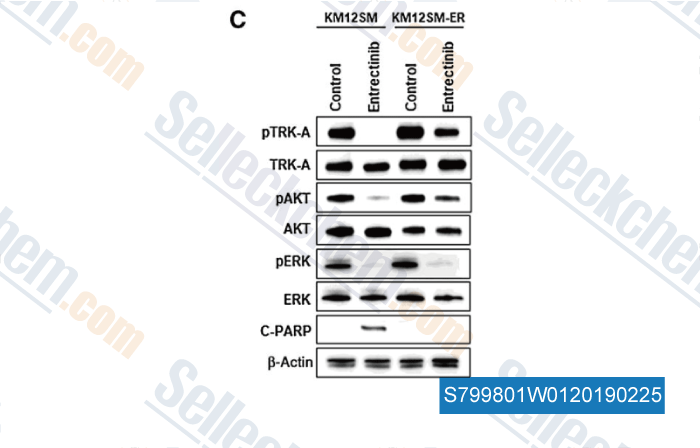
Données de [ , , Clin Cancer Res, 2018, 24(10):2357-2369 ]
![(A) We transfected the EGFP/Eluc gene into KM12SM cells to establish KM12SM/Eluc cells. KM12SM/Eluc cells were inoculated into the brain of SCID mice. The mice were treated daily with or without entrectinib (15 mg/kg) for 37 days until the bioluminescence increased. Mean ± SE of total flux are shown in the lower panel. Then, the entrectinib-treated brain tumor was harvested at the point indicated by the orange triangle and cultured in vitro. The expanded tumor cells were named KM12SM-ER. (B) The sensitivity of KM12SM-ER and KM12SM cells to entrectinib was determined through cell viability assays, using a CCK-8 kit. The data (mean ± standard deviation [SD] of triplicate cultures) shown are representative of three independent experiments with similar results. (C) Tumor cells were treated with entrectinib (10 nmol/L) for 4 h or c-PARP for 48 h, and harvested lysates were assessed by western blotting. Data shown are representative of three independent experiments with similar results.](https://file.selleckchem.com/downloads/review/700px/Entrectinib-S799801W0120180502.gif)
-
Données de [ , , Clin Cancer Res, 2018, doi: 10.1158/1078-0432.CCR-17-1623 ]
-
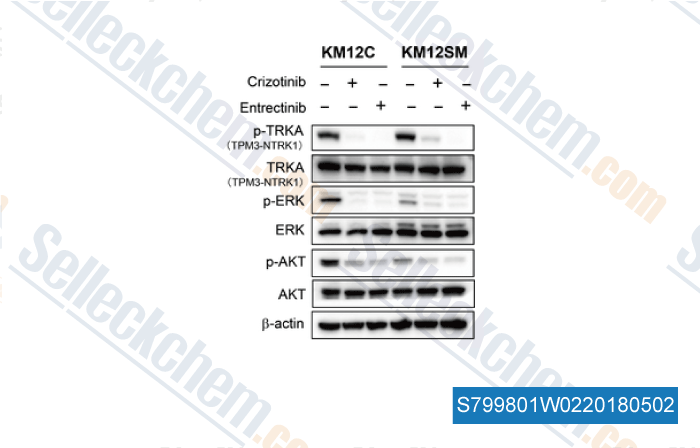
Données de [ , , Cancer Med, 2017, 6(12):2972-2983 ]
-
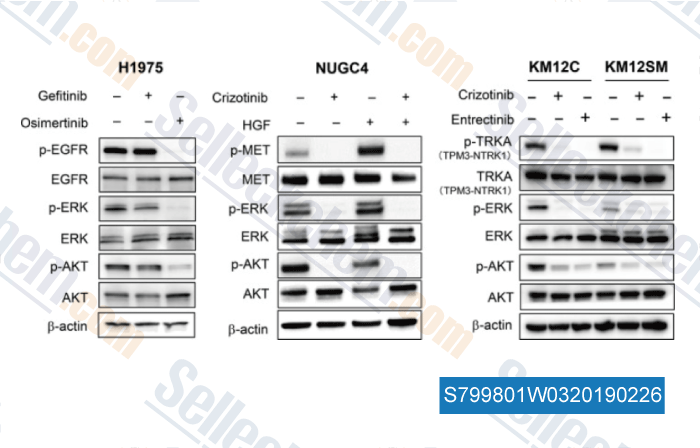
Données de [ , , Cancer Med, 2017, 6(12):2972-2983 ]
Sellecks Entrectinib (Rxdx-101) A été cité par 61 Publications
| Targeting proteostasis in multiple myeloma through inhibition of LTK [ Leukemia, 2025, 10.1038/s41375-025-02682-8] | PubMed: 40634511 |
| Methylstat sensitizes ovarian cancer cells to PARP-inhibition by targeting the histone demethylases JMJD1B/C [ Cancer Gene Ther, 2025, 10.1038/s41417-025-00874-z] | PubMed: 39915607 |
| Zidesamtinib Selective Targeting of Diverse ROS1 Drug-Resistant Mutations [ Mol Cancer Ther, 2025, 10.1158/1535-7163.MCT-25-0025] | PubMed: 40299789 |
| Development of PROTACs for targeted degradation of oncogenic TRK fusions [ bioRxiv, 2025, 2025.06.18.660465] | PubMed: 40666929 |
| Clinical efficacy and identification of factors confer resistance to afatinib (tyrosine kinase inhibitor) in EGFR-overexpressing esophageal squamous cell carcinoma [ Signal Transduct Target Ther, 2024, 9(1):153] | PubMed: 38937446 |
| Pharmacological inhibition of PDGF-C/neuropilin-1 interaction: A novel strategy to reduce melanoma metastatic potential [ Biomed Pharmacother, 2024, 176:116766] | PubMed: 38788599 |
| Acquired NF2 mutation confers resistance to TRK inhibition in an ex vivo LMNA::NTRK1-rearranged soft-tissue sarcoma cell model [ J Pathol, 2024, 10.1002/path.6282] | PubMed: 38613194 |
| Acquired NF2 mutation confers resistance to TRK inhibition in an ex vivo LMNA::NTRK1-rearranged soft-tissue sarcoma cell model [ J Pathol, 2024, 263(2):257-269] | PubMed: 38613194 |
| LTK mutations responsible for resistance to lorlatinib in non-small cell lung cancer harboring CLIP1-LTK fusion [ Commun Biol, 2024, 7(1):412] | PubMed: 38575808 |
| Patient-derived rhabdomyosarcoma cells recapitulate the genetic and transcriptomic landscapes of primary tumors [ iScience, 2024, 27(10):110862] | PubMed: 39319271 |
POLITIQUE DE RETOUR
La politique de retour inconditionnelle de Selleck Chemical garantit une expérience dachat en ligne fluide à nos clients. Si vous nêtes en aucun cas satisfait de votre achat, vous pouvez retourner tout article dans les 7 jours suivant sa réception. En cas de problèmes de qualité du produit, quil sagisse de problèmes liés au protocole ou au produit, vous pouvez retourner tout article dans les 365 jours suivant la date dachat initiale. Veuillez suivre les instructions ci-dessous lors du retour des produits.
EXPÉDITION ET STOCKAGE
Les produits Selleck sont transportés à température ambiante. Si vous recevez le produit à température ambiante, soyez assuré que le service dinspection de la qualité de Selleck a mené des expériences pour vérifier que le placement à température normale pendant un mois naffectera pas lactivité biologique des produits en poudre. Après réception, veuillez stocker le produit conformément aux exigences décrites dans la fiche technique. La plupart des produits Selleck sont stables dans les conditions recommandées.
NON DESTINÉ À UN USAGE HUMAIN, VÉTÉRINAIRE DIAGNOSTIQUE OU THÉRAPEUTIQUE.