
Données techniques
| Formule | C25H24N4O2 |
||||||||||||||
| Poids moléculaire | 412.48 | Numéro CAS | 133052-90-1 | ||||||||||||
| Solubilité (25°C)* | In vitro | DMSO | 82 mg/mL (198.79 mM) | ||||||||||||
| Ethanol | 1 mg/mL (2.42 mM) | ||||||||||||||
| Water | Insoluble | ||||||||||||||
| In vivo (Ajouter les solvants au produit individuellement et dans lordre.) |
|
||||||||||||||
|
* <1 mg/ml signifie légèrement soluble ou insoluble. * Veuillez noter que Selleck teste la solubilité de tous les composés en interne, et la solubilité réelle peut différer légèrement des valeurs publiées. Ceci est normal et est dû à de légères variations dun lot à lautre. * Expédition à température ambiante (les tests de stabilité montrent que ce produit peut être expédié sans aucune mesure de refroidissement.) |
|||||||||||||||
Préparation des solutions mères
Activité biologique
| Description | Le Bisindolylmaleimide I (GF109203X, GO 6850) est un puissant inhibiteur de la PKC avec des valeurs d'IC50 de 20 nM, 17 nM, 16 nM et 20 nM pour la PKC , la PKC I, la PKC II et la PKC dans des essais sans cellules, respectivement. Ce composé montre une sélectivité plus de 3000 fois supérieure pour la PKC par rapport à l'EGFR, au PDGFR et au récepteur de l'insuline. | ||||||||
|---|---|---|---|---|---|---|---|---|---|
| Cibles |
|
||||||||
| In vitro | Le Bisindolylmaleimide I (GF109203X) est un inhibiteur de la PKC compétitif à l'ATP qui prévient l'agrégation plaquettaire induite par des stimuli activant la PKC, et a un potentiel en tant qu'outil pour étudier l'implication de la PKC dans les voies de transduction du signal. Il produit également une activité d'inversion sur la multirésistance aux médicaments médiée par la P-glycoprotéine et le MRP. L'inhibition de la PKC par ce composé réduit significativement l'activation d'ERK1/2 stimulée par le carbachol et la prolifération ultérieure des cellules cancéreuses du côlon SNU-407. | ||||||||
| In vivo | Le Bisindolylmaleimide I (GF109203X) inhibe de manière dose-dépendante l'allodynie mécanique induite par la BK chez les rats Wistar à une dose de 10 μg/souris (i.pl.). | ||||||||
| Caractéristiques | Sélectivité supérieure à celle de la staurosporine, un inhibiteur de la PKC. GF109203X est une sonde chimique pour l'étude des voies de transduction du signal de la PKC. Potentiel d'utilisation dans une variété de cancers. |
Protocole (de référence)
| Test kinase : |
|
|---|---|
| Test cellulaire : |
|
| Étude animale : |
|
Références
|
Validation du produit par le client
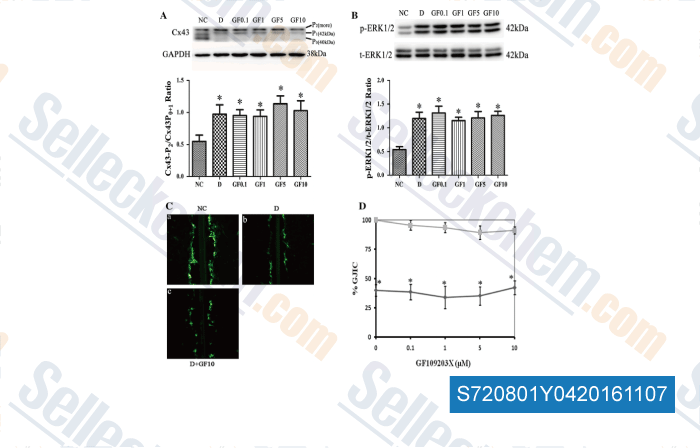
-
, , Mol Cell Biochem, 2015, 400(1-2):213-22.
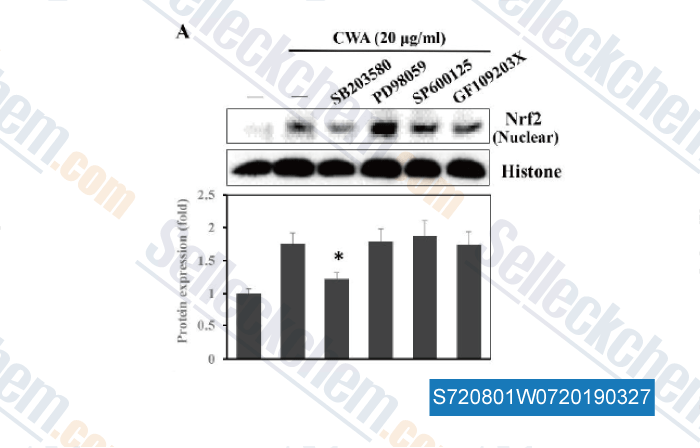
-
Données de [ , , Free Radic Biol Med, 2018, 129:338-353 ]
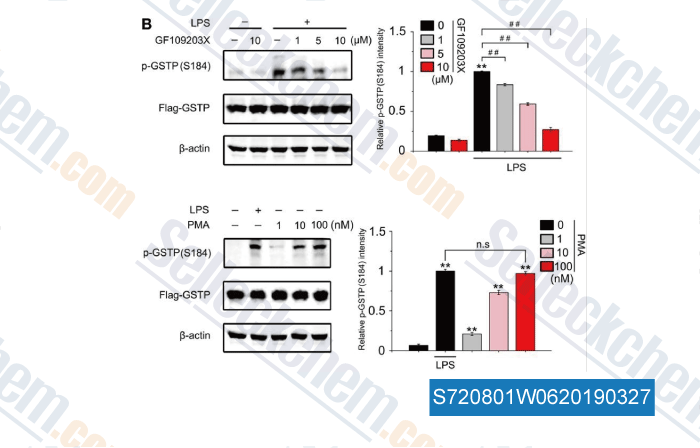
-
Données de [ , , Front Immunol, 2018, 9:268 ]
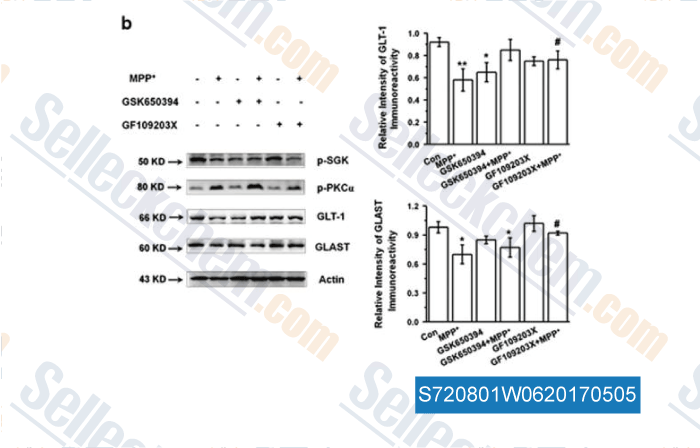
-
Données de [ , , Cell Death Dis, 2017, 8(2):e2574 ]
Sellecks Bisindolylmaleimide I (GF109203X) A été cité par 64 Publications
| Dynamic phosphorylation of Fascin-1 orchestrates microglial phagocytosis and neurological recovery after spinal cord injury [ J Neuroinflammation, 2025, 22(1):121] | PubMed: 40281563 |
| HEP14-activated PKC-ERK1/2 pathway boosts HEP14-empowered hADSCs for ovarian regeneration and functional restoration [ Commun Biol, 2025, 8(1):1267] | PubMed: 40849553 |
| ELK3 destabilization by speckle-type POZ protein suppresses prostate cancer progression and docetaxel resistance [ Cell Death Dis, 2024, 15(4):274] | PubMed: 38632244 |
| Transcription of microRNAs is regulated by developmental signaling pathways and transcription factors [ Front Cell Dev Biol, 2024, 12:1356589] | PubMed: 38721525 |
| Downregulation of PIK3IP1/TrIP on T cells is controlled by TCR signal strength, PKC, and metalloprotease-mediated cleavage [ J Biol Chem, 2024, 300(12):107930] | PubMed: 39454954 |
| Epithelial TNF controls cell differentiation and CFTR activity to maintain intestinal mucin homeostasis [ J Clin Invest, 2023, 10.1172/JCI163591] | PubMed: 37643009 |
| Lysine methylation promotes NFAT5 activation and determines temozolomide efficacy in glioblastoma [ Nat Commun, 2023, 14(1):4062] | PubMed: 37429858 |
| Neurokinin-1 receptor drives PKCɑ-AURKA/N-Myc signaling to facilitate the neuroendocrine progression of prostate cancer [ Cell Death Dis, 2023, 14(6):384] | PubMed: 37385990 |
| HDAC Inhibition Restores Response to HER2-Targeted Therapy in Breast Cancer via PHLDA1 Induction [ Int J Mol Sci, 2023, 24(7)6228] | PubMed: 37047202 |
| Epicardial Adipose Tissue-Derived Leptin Promotes Myocardial Injury in Metabolic Syndrome Rats Through PKC/NADPH Oxidase/ROS Pathway [ J Am Heart Assoc, 2023, 12(15):e029415] | PubMed: 37489731 |
POLITIQUE DE RETOUR
La politique de retour inconditionnelle de Selleck Chemical garantit une expérience dachat en ligne fluide à nos clients. Si vous nêtes en aucun cas satisfait de votre achat, vous pouvez retourner tout article dans les 7 jours suivant sa réception. En cas de problèmes de qualité du produit, quil sagisse de problèmes liés au protocole ou au produit, vous pouvez retourner tout article dans les 365 jours suivant la date dachat initiale. Veuillez suivre les instructions ci-dessous lors du retour des produits.
EXPÉDITION ET STOCKAGE
Les produits Selleck sont transportés à température ambiante. Si vous recevez le produit à température ambiante, soyez assuré que le service dinspection de la qualité de Selleck a mené des expériences pour vérifier que le placement à température normale pendant un mois naffectera pas lactivité biologique des produits en poudre. Après réception, veuillez stocker le produit conformément aux exigences décrites dans la fiche technique. La plupart des produits Selleck sont stables dans les conditions recommandées.
NON DESTINÉ À UN USAGE HUMAIN, VÉTÉRINAIRE DIAGNOSTIQUE OU THÉRAPEUTIQUE.