
Données techniques
| Formule | C23H20N6O |
||||||
| Poids moléculaire | 396.44 | Numéro CAS | 1243244-14-5 | ||||
| Solubilité (25°C)* | In vitro | DMSO | 79 mg/mL (199.27 mM) | ||||
| Water | Insoluble | ||||||
| Ethanol | Insoluble | ||||||
| In vivo (Ajouter les solvants au produit individuellement et dans lordre.) |
|
||||||
|
* <1 mg/ml signifie légèrement soluble ou insoluble. * Veuillez noter que Selleck teste la solubilité de tous les composés en interne, et la solubilité réelle peut différer légèrement des valeurs publiées. Ceci est normal et est dû à de légères variations dun lot à lautre. * Expédition à température ambiante (les tests de stabilité montrent que ce produit peut être expédié sans aucune mesure de refroidissement.) |
|||||||
Préparation des solutions mères
Activité biologique
| Description | LGK974 (WNT974) est un inhibiteur puissant et spécifique de PORCN qui inhibe la signalisation Wnt avec une IC50 de 0,4 nM dans les cellules TM3, et est actuellement en phase 1. | |
|---|---|---|
| Cibles |
|
|
| In vitro | Dans l'essai de liaison du radioligand PORCN, le LGK974 (WNT974) déplace efficacement le [3H]-GNF-1331 avec une IC50 de 1 nM et ne montre pas de cytotoxicité majeure dans les cellules jusqu'à 20 µM. Il montre des activités inhibitrices comparables contre tous les Wnts testés avec des IC50 allant de 0,05 à 2,4 nM, ce qui est cohérent avec la perte génétique du phénotype PORCN. Ce composé inhibe spécifiquement la croissance de trois lignées cellulaires mutantes RNF43, HPAF-II, PaTu 8988S et Capan-2. | |
| In vivo | Dans un modèle de tumeur murine MMTV-Wnt1 et un modèle de carcinome épidermoïde de la tête et du cou humain (HN30), le LGK974 (WNT974) (3 mg/kg) inhibe la signalisation Wnt in vivo et induit une régression tumorale sans perte de poids corporel significative chez les souris. Ce composé (5 mg/kg, p.o., BID) inhibe également la croissance tumorale des tumeurs pancréatiques mutantes RNF43 (HPAF-II et Capan-2) in vivo. | |
| Caractéristiques | Inhibiteur spécifique de Porcupine biodisponible par voie orale, testé dans des essais cliniques de phase I pour le traitement des malignités dépendantes des ligands Wnt. |
Protocole (de référence)
| Test cellulaire : |
|
|---|---|
| Étude animale : |
|
Références
|
Validation du produit par le client
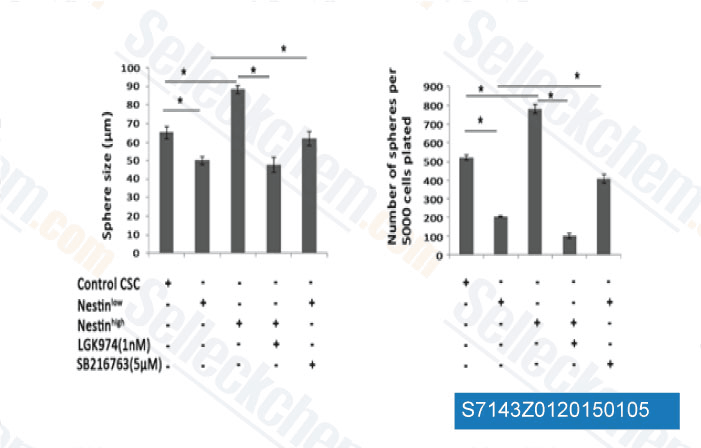
-
Données de [ Breast Cancer Res , 2014 , 16(4), 408 ]
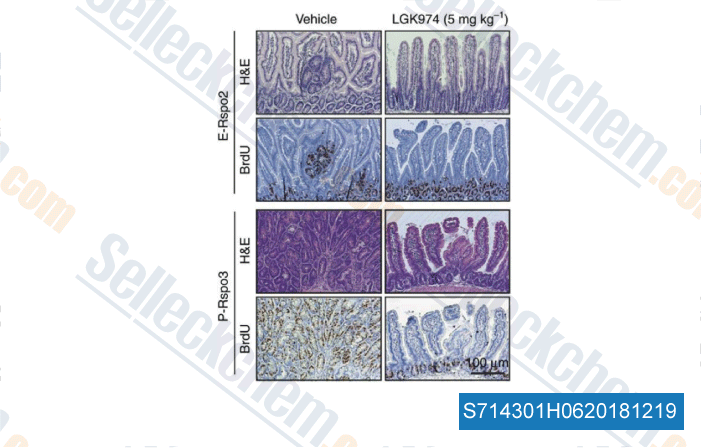
-
Données de [ , , Nat Commun, 2017, 8:15945 ]
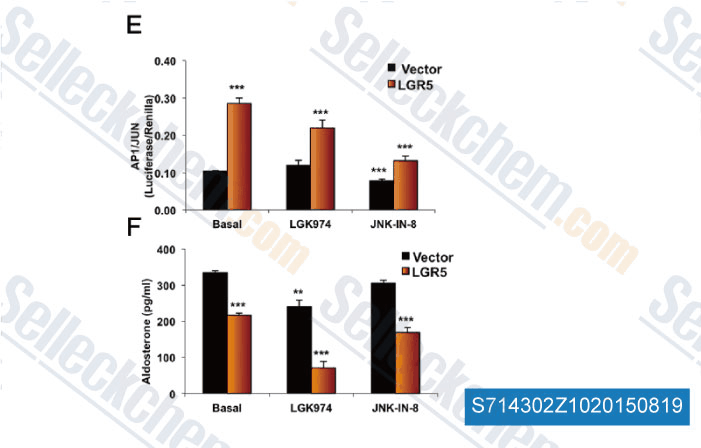
-
Données de [ , , J Clin Endocrinol Metab, 2015, 100(6): E836-44 ]
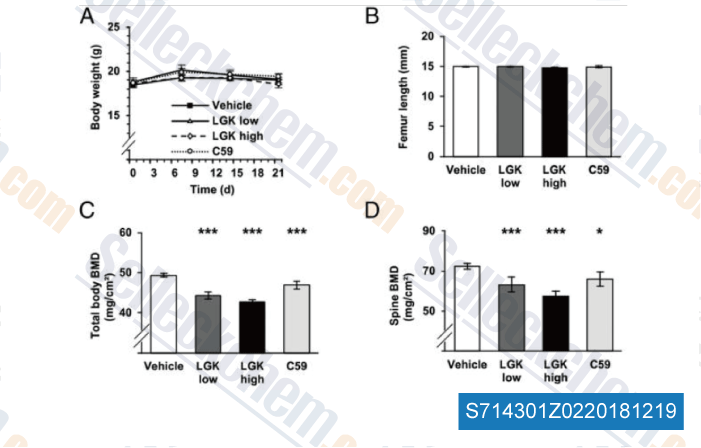
-
Données de [ , , J Endocrinol, 2018, 238(1):13-23 ]
Sellecks LGK974 (WNT974) A été cité par 94 Publications
| CD36 enrichment in HER2-positive mesenchymal stem cells drives therapy refractoriness in breast cancer [ J Exp Clin Cancer Res, 2025, 44(1):19] | PubMed: 39833955 |
| Wnt signaling activation induces CTCF binding and loop formation at cis-regulatory elements of target genes [ Genome Res, 2025, 10.1101/gr.279684.124] | PubMed: 40550689 |
| Tamoxifen induces protection against manganese toxicity by REST upregulation via the ER-α/Wnt/β-catenin pathway in neuronal cells [ J Biol Chem, 2025, 301(6):108529] | PubMed: 40280417 |
| Developmental signals control chromosome segregation fidelity during pluripotency and neurogenesis by modulating replicative stress [ Nat Commun, 2024, 15(1):7404] | PubMed: 39191776 |
| Loss of ARID3A perturbs intestinal epithelial proliferation-differentiation ratio and regeneration [ J Exp Med, 2024, 221(10)e20232279] | PubMed: 39150450 |
| Physiological regulation of neuronal Wnt activity is essential for TDP-43 localization and function [ EMBO J, 2024, 43(16):3388-3413] | PubMed: 38918634 |
| GPA33 expression in colorectal cancer can be induced by WNT inhibition and targeted by cellular therapy [ Oncogene, 2024, ] | PubMed: 39472498 |
| Unbalancing cAMP and Ras/MAPK pathways as a therapeutic strategy for cutaneous neurofibromas [ JCI Insight, 2024, 9(3)e168826] | PubMed: 38175707 |
| Higher overall survival rates of oral squamous cell carcinoma treated with metronomic neoadjuvant chemotherapy [ Am J Cancer Res, 2024, 14(3):1033-1051] | PubMed: 38590400 |
| Porcupine inhibitors LGK-974 and ETC-159 inhibit Wnt/β-catenin signaling and result in inhibition of the fibrosis [ Toxicol In Vitro, 2024, 104:105986] | PubMed: 39647516 |
POLITIQUE DE RETOUR
La politique de retour inconditionnelle de Selleck Chemical garantit une expérience dachat en ligne fluide à nos clients. Si vous nêtes en aucun cas satisfait de votre achat, vous pouvez retourner tout article dans les 7 jours suivant sa réception. En cas de problèmes de qualité du produit, quil sagisse de problèmes liés au protocole ou au produit, vous pouvez retourner tout article dans les 365 jours suivant la date dachat initiale. Veuillez suivre les instructions ci-dessous lors du retour des produits.
EXPÉDITION ET STOCKAGE
Les produits Selleck sont transportés à température ambiante. Si vous recevez le produit à température ambiante, soyez assuré que le service dinspection de la qualité de Selleck a mené des expériences pour vérifier que le placement à température normale pendant un mois naffectera pas lactivité biologique des produits en poudre. Après réception, veuillez stocker le produit conformément aux exigences décrites dans la fiche technique. La plupart des produits Selleck sont stables dans les conditions recommandées.
NON DESTINÉ À UN USAGE HUMAIN, VÉTÉRINAIRE DIAGNOSTIQUE OU THÉRAPEUTIQUE.