
Données techniques
| Formule | C25H34N6O·xHCl |
||||||
| Poids moléculaire | 434.58 (free base) | Numéro CAS | 2070014-87-6 | ||||
| Solubilité (25°C)* | In vitro | DMSO | 5 mg/mL | ||||
| Water | Insoluble | ||||||
| Ethanol | Insoluble | ||||||
| In vivo (Ajouter les solvants au produit individuellement et dans lordre.) |
|
||||||
|
* <1 mg/ml signifie légèrement soluble ou insoluble. * Veuillez noter que Selleck teste la solubilité de tous les composés en interne, et la solubilité réelle peut différer légèrement des valeurs publiées. Ceci est normal et est dû à de légères variations dun lot à lautre. * Expédition à température ambiante (les tests de stabilité montrent que ce produit peut être expédié sans aucune mesure de refroidissement.) |
|||||||
Préparation des solutions mères
Activité biologique
| Description | MRT68921 est un puissant inhibiteur double de la kinase Autophagy ULK1/2 avec une IC50 de 2,9 nM et 1,1 nM, respectivement. | ||||
|---|---|---|---|---|---|
| Cibles |
|
||||
| In vitro | MRT68921 perturbe spécifiquement la maturation des autophagosomes et bloque ainsi le flux autophagique par inhibition de ULK1. |
||||
| In vivo | MRT68921 est un puissant inhibiteur double de la kinase Autophagy ULK1/2. |
Protocole (de référence)
| Test kinase : |
|
|---|---|
| Test cellulaire : |
|
| Étude animale : |
|
Références
|
Validation du produit par le client

-
, , Methods Enzymol. 2017, 587:391-404
-
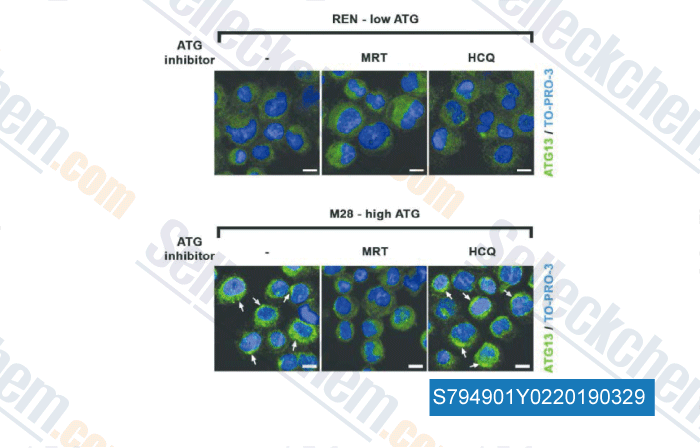
Données de [ , , Mol Carcinog, 2018, 57(3):319-332 ]
Sellecks MRT68921 HCl A été cité par 46 Publications
| Excessive autophagic degradation of MYLK3 causes sunitinib-induced cardiotoxicity [ Autophagy, 2025, 1-20.] | PubMed: 40568844 |
| Inhibiting autophagy selectively prunes dysfunctional tumor vessels and optimizes the tumor immune microenvironment [ Theranostics, 2025, 15(1):258-276] | PubMed: 39744218 |
| Defective chaperone-mediated autophagy in the retinal pigment epithelium of age-related macular degeneration patients [ EMBO Mol Med, 2025, 17(12):3472-3495] | PubMed: 41168502 |
| Image-based temporal profiling of autophagy-related phenotypes [ Autophagy Rep, 2025, 4(1)2484835] | PubMed: 40291494 |
| Exposure of the inner mitochondrial membrane triggers apoptotic mitophagy [ Cell Death Differ, 2024, 10.1038/s41418-024-01260-2] | PubMed: 38396150 |
| Synthetic lethality of combined ULK1 defection and p53 restoration induce pyroptosis by directly upregulating GSDME transcription and cleavage activation through ROS/NLRP3 signaling [ J Exp Clin Cancer Res, 2024, 43(1):248] | PubMed: 39215364 |
| Starvation-induced phosphorylation activates gasdermin A to initiate pyroptosis [ Cell Rep, 2024, 43(9):114728] | PubMed: 39264808 |
| Chronic hypoxia stabilizes 3βHSD1 via autophagy suppression [ Cell Rep, 2024, 43(1):113575] | PubMed: 38181788 |
| ATG7/GAPLINC/IRF3 axis plays a critical role in regulating pathogenesis of influenza A virus [ PLoS Pathog, 2024, 20(1):e1011958] | PubMed: 38227600 |
| ULK2 Is a Key Pro-Autophagy Protein That Contributes to the High Chemoresistance and Disease Relapse in FLT3-Mutated Acute Myeloid Leukemia [ Int J Mol Sci, 2024, 25(1)646] | PubMed: 38203816 |
POLITIQUE DE RETOUR
La politique de retour inconditionnelle de Selleck Chemical garantit une expérience dachat en ligne fluide à nos clients. Si vous nêtes en aucun cas satisfait de votre achat, vous pouvez retourner tout article dans les 7 jours suivant sa réception. En cas de problèmes de qualité du produit, quil sagisse de problèmes liés au protocole ou au produit, vous pouvez retourner tout article dans les 365 jours suivant la date dachat initiale. Veuillez suivre les instructions ci-dessous lors du retour des produits.
EXPÉDITION ET STOCKAGE
Les produits Selleck sont transportés à température ambiante. Si vous recevez le produit à température ambiante, soyez assuré que le service dinspection de la qualité de Selleck a mené des expériences pour vérifier que le placement à température normale pendant un mois naffectera pas lactivité biologique des produits en poudre. Après réception, veuillez stocker le produit conformément aux exigences décrites dans la fiche technique. La plupart des produits Selleck sont stables dans les conditions recommandées.
NON DESTINÉ À UN USAGE HUMAIN, VÉTÉRINAIRE DIAGNOSTIQUE OU THÉRAPEUTIQUE.