
Données techniques
| Formule | C8H14N2O4Pt |
|||
| Poids moléculaire | 397.29 | Numéro CAS | 61825-94-3 | |
| Solubilité (25°C)* | In vitro | Water | 5 mg/mL (12.58 mM) | |
| Ethanol | Insoluble | |||
|
* <1 mg/ml signifie légèrement soluble ou insoluble. * Veuillez noter que Selleck teste la solubilité de tous les composés en interne, et la solubilité réelle peut différer légèrement des valeurs publiées. Ceci est normal et est dû à de légères variations dun lot à lautre. * Expédition à température ambiante (les tests de stabilité montrent que ce produit peut être expédié sans aucune mesure de refroidissement.) |
||||
Préparation des solutions mères
Activité biologique
| Description | Oxaliplatin est un agent alkylant de l'ADN qui active l'autophagy. Oxaliplatin inhibe la synthèse de l'ADN en formant des adduits d'ADN dans les cellules RT4, TCCSUP, A2780, HT-29, U-373MG, U-87MG, SK-MEL-2 et HT-144.Les solutions sont instables et doivent être préparées extemporanément. Il n'est pas recommandé de dissoudre les médicaments à base de platine dans le DMSO, ce qui peut facilement entraîner une inactivation du médicament. | |
|---|---|---|
| Cibles |
|
|
| In vitro | Le principal mécanisme d'action d'Oxaliplatin est médié par la formation d'adduits d'ADN. Ce composé induit des lésions primaires et secondaires de l'ADN qui conduisent à l'apoptose cellulaire. Il est actif contre les lignées cellulaires de mélanome humain C32 et G361 avec des IC50 de 0,98 mM et 0,14 mM, respectivement. Ce produit chimique inhibe efficacement les lignées cellulaires de carcinome de la vessie RT4 et TCCSUP, la lignée cellulaire de carcinome ovarien A2780, la lignée cellulaire de carcinome du côlon HT-29, les lignées cellulaires de glioblastome U-373MG et U-87MG, et les lignées cellulaires de mélanome SK-MEL-2 et HT-144 avec des IC50 de 11 μM, 15 μM, 0,17 μM, 0,97 μM, 2,95 μM, 17,6 μM, 30,9 μM et 7,85 μM, respectivement. |
|
| In vivo | Une injection hebdomadaire i.p. d'Oxaliplatin à 10 mg/kg chez des souris nues porteuses de tumeurs hépatocellulaires HCCLM3 réduit significativement le volume tumoral et l'indice apoptotique. Ce composé (5 mg/kg, i.v. les jours 1, 5 et 9) est actif sur la leucémie-lymphome à cellules T L40 AKR avec un T/C de 1,77. Il est également efficace sur la leucémie L1210 greffée intracérébralement, les xénogreffes MA 16-C, les xénogreffes de mélanome B16, les xénogreffes pulmonaires de Lewis et les xénogreffes de carcinome du côlon C26. Ce produit chimique induit une altération du transport neuronal rétrograde chez la souris. |
|
| Caractéristiques | Il n'est pas recommandé de dissoudre ce produit dans le diméthylsulfoxyde (DMSO). |
Protocole (de référence)
| Test cellulaire : |
|
|---|---|
| Étude animale : |
|
Références
|
Validation du produit par le client
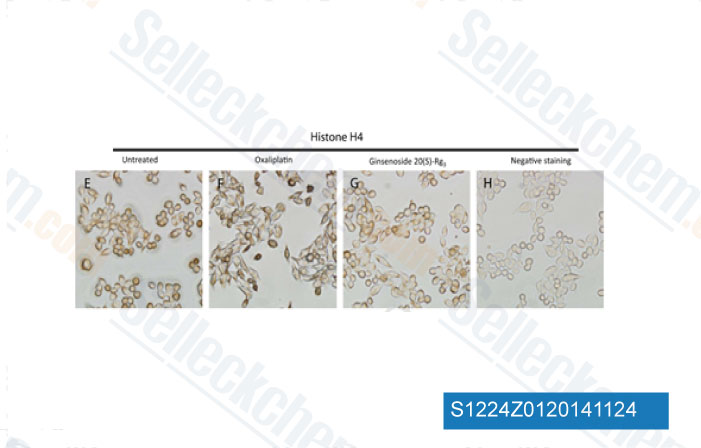
-
Données de [ J Proteomics , 2014 , 10.1016/j.jprot.2014.10.009 ]
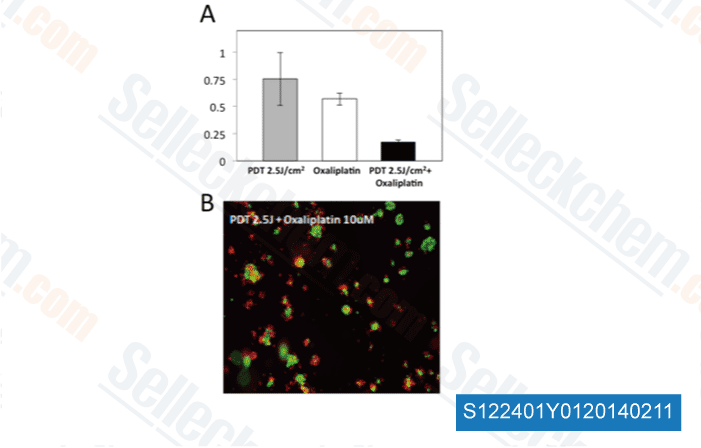
-
Données de [ Optical Methods for Tumor Treatment and Detection , 2013 , 10.1117/12.2010730 ]
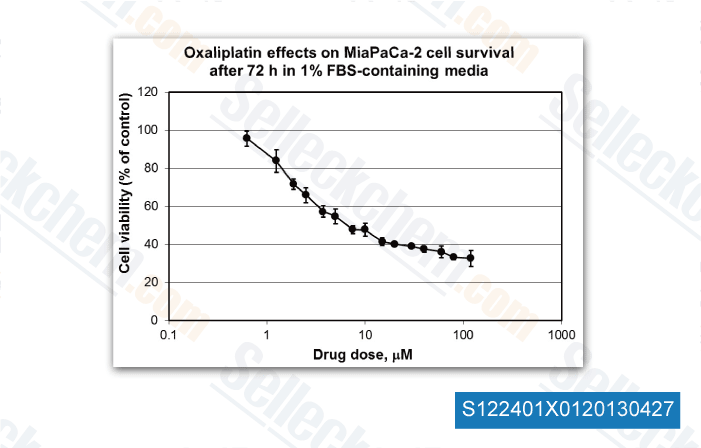
-
, 2013 , Dr. Edita Aksamitiene from Thomas Jefferson University
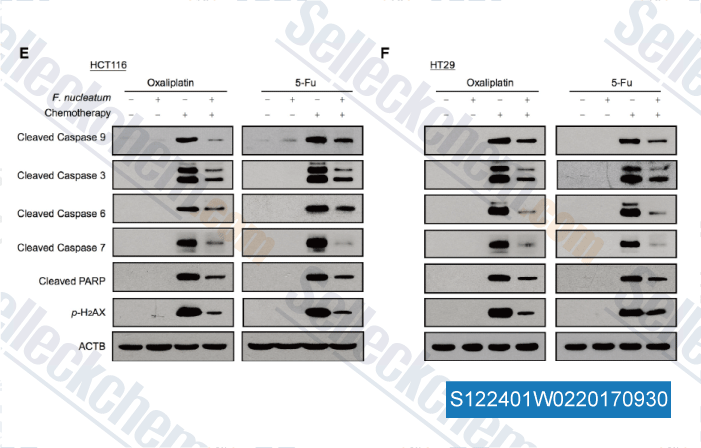
-
Données de [ , , Cell, 2017, 170(3):548-563.e16 ]
Sellecks Oxaliplatin A été cité par 282 Publications
| Activation of lysosomal iron triggers ferroptosis in cancer [ Nature, 2025, 10.1038/s41586-025-08974-4] | PubMed: 40335696 |
| Cisplatin and temozolomide combinatorial treatment triggers hypermutability and immune surveillance in experimental cancer models [ Cancer Cell, 2025, S1535-6108(25)00223-5] | PubMed: 40513578 |
| The noncanonical function of liver-type phosphofructokinase potentiates the efficacy of HDAC inhibitors in cancer [ Signal Transduct Target Ther, 2025, 10(1):341] | PubMed: 41083431 |
| A pancreatic cancer organoid biobank links multi-omics signatures to therapeutic response and clinical evaluation of statin combination therapy [ Cell Stem Cell, 2025, S1934-5909(25)00265-6] | PubMed: 40812300 |
| Prediction of Patient Drug Response via 3D Bioprinted Gastric Cancer Model Utilized Patient-Derived Tissue Laden Tissue-Specific Bioink [ Adv Sci (Weinh), 2025, 12(10):e2411769] | PubMed: 39748450 |
| Targeting of the G9a, DNMT1 and UHRF1 epigenetic complex as an effective strategy against pancreatic ductal adenocarcinoma [ J Exp Clin Cancer Res, 2025, 44(1):13] | PubMed: 39810240 |
| Unveiling radiobiological traits and therapeutic responses of BRAFV600E-mutant colorectal cancer via patient-derived organoids [ J Exp Clin Cancer Res, 2025, 44(1):92] | PubMed: 40069844 |
| Gemcitabine and ATR inhibitors synergize to kill PDAC cells by blocking DNA damage response [ Mol Syst Biol, 2025, 21(3):231-253] | PubMed: 39838187 |
| Monitoring Response to Combinatorial Immunotherapies by Tracking both T Cells and Natural Killer Cells In Vivo via ImmunoPET-Raman Multimodal Gold Nanostars [ ACS Appl Mater Interfaces, 2025, 10.1021/acsami.5c11312] | PubMed: 41099635 |
| CBX3 promotes multidrug resistance by suppressing ferroptosis in colorectal carcinoma via the CUL3/NRF2/GPX2 axis [ Oncogene, 2025, 10.1038/s41388-025-03337-9] | PubMed: 40089640 |
POLITIQUE DE RETOUR
La politique de retour inconditionnelle de Selleck Chemical garantit une expérience dachat en ligne fluide à nos clients. Si vous nêtes en aucun cas satisfait de votre achat, vous pouvez retourner tout article dans les 7 jours suivant sa réception. En cas de problèmes de qualité du produit, quil sagisse de problèmes liés au protocole ou au produit, vous pouvez retourner tout article dans les 365 jours suivant la date dachat initiale. Veuillez suivre les instructions ci-dessous lors du retour des produits.
EXPÉDITION ET STOCKAGE
Les produits Selleck sont transportés à température ambiante. Si vous recevez le produit à température ambiante, soyez assuré que le service dinspection de la qualité de Selleck a mené des expériences pour vérifier que le placement à température normale pendant un mois naffectera pas lactivité biologique des produits en poudre. Après réception, veuillez stocker le produit conformément aux exigences décrites dans la fiche technique. La plupart des produits Selleck sont stables dans les conditions recommandées.
NON DESTINÉ À UN USAGE HUMAIN, VÉTÉRINAIRE DIAGNOSTIQUE OU THÉRAPEUTIQUE.