
Données techniques
| Formule | C12H7Cl2NO3S2 |
||||||||||
| Poids moléculaire | 348.22 | Numéro CAS | 882257-11-6 | ||||||||
| Solubilité (25°C)* | In vitro | DMSO | 35 mg/mL (100.51 mM) | ||||||||
| Water | Insoluble | ||||||||||
| Ethanol | Insoluble | ||||||||||
| In vivo (Ajouter les solvants au produit individuellement et dans lordre.) |
|
||||||||||
|
* <1 mg/ml signifie légèrement soluble ou insoluble. * Veuillez noter que Selleck teste la solubilité de tous les composés en interne, et la solubilité réelle peut différer légèrement des valeurs publiées. Ceci est normal et est dû à de légères variations dun lot à lautre. * Expédition à température ambiante (les tests de stabilité montrent que ce produit peut être expédié sans aucune mesure de refroidissement.) |
|||||||||||
Préparation des solutions mères
Activité biologique
| Description | P5091 est un inhibiteur sélectif et puissant de la ubiquitin-specific protease 7 (USP7) avec une EC50 de 4,2 μM et de l'USP47 étroitement liée. | ||||
|---|---|---|---|---|---|
| Cibles |
|
||||
| In vitro | P5091 est un thiophène trisubstitué avec des substituants dichlorophénylthio, nitro et acétyl médiant une activité anti-USP7. Ce composé présente une activité de déubiquitination puissante, spécifique et sélective contre USP7. En revanche, il n'inhibe pas d'autres DUBs ou d'autres familles de cystéine protéases testées (EC50 > 100 mM). Ce produit chimique inhibe le marquage de l'USP7 avec HA-UbVME de manière concentration-dépendante. Le clivage des chaînes de polyubiquitine de haut poids moléculaire médié par l'USP7 est inhibé de manière dose-dépendante par ce composé. De plus, il inhibe le clivage des chaînes d'ubiquitine poly-K48 liées médié par l'USP7, mais pas par l'USP2 ou l'USP8. L'inhibition de l'USP7 par ce composé induit la polyubiquitination de HDM2 et accélère la dégradation de HDM2. Il inhibe l'activité de déubiquitination de l'USP7, sans bloquer l'activité du protéasome dans les cellules MM. Ce produit chimique induit une diminution dose-dépendante de la viabilité de diverses lignées cellulaires de MM. Il surmonte la croissance des cellules MM induite par les cellules stromales de la moelle osseuse. Ce composé a diminué les niveaux de HDM2 et HDMX, et a augmenté les niveaux de p53 et p21. Dans l'ensemble, la cytotoxicité induite par ce composé est médiée en partie par l'axe de signalisation HDM2-p21 et bien que p53 soit régulée à la hausse en réponse à ce traitement chimique, son activité cytotoxique n'est pas dépendante de p53. |
||||
| In vivo | Dans les études de modèles tumoraux animaux, P5091 est bien toléré, inhibe la croissance tumorale et prolonge la survie. La combinaison de ce composé avec l'inhibiteur d'HDAC SAHA déclenche une activité anti-MM synergique. |
Protocole (de référence)
| Test kinase : |
|
|---|---|
| Test cellulaire : |
|
| Étude animale : |
|
Références
|
Validation du produit par le client
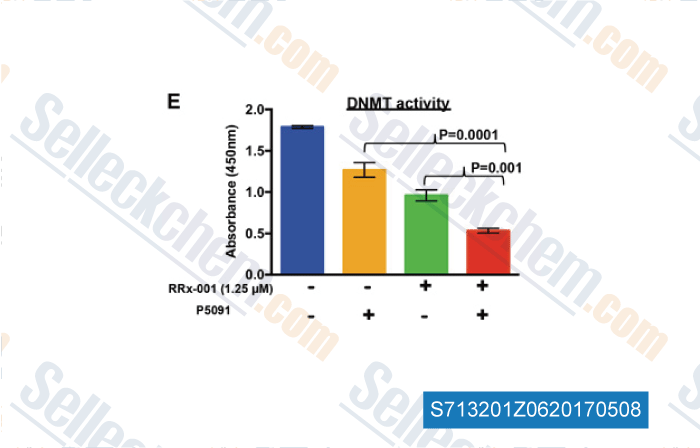
-
Données de [ , , Leukemia, 2016, 30(11):2187-2197 ]
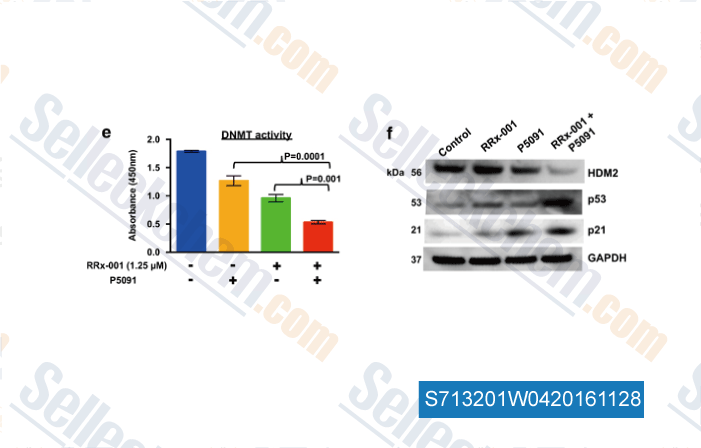
-
Données de [ , , Leukemia, 2016, 30(11):2187-2197. ]

-
Données de [ , , Cell Physiol Biochem, 2017, 43(5):1755-1766 ]
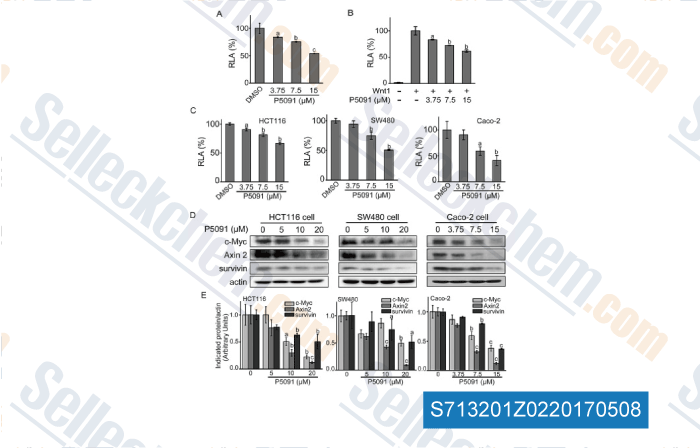
-
Données de [ , , Biochem Pharmacol, 2017, 131:29-39 ]
Sellecks P5091 A été cité par 57 Publications
| ACC1 is a dual metabolic-epigenetic regulator of Treg stability and immune tolerance [ Mol Metab, 2025, 94:102111] | PubMed: 39929287 |
| The deubiquitinase USP7 stabilizes HER2 expression and promotes breast cancer progression [ Neoplasia, 2025, 66:101192] | PubMed: 40472738 |
| Stabilization of KPNB1 by deubiquitinase USP7 promotes glioblastoma progression through the YBX1-NLGN3 axis [ J Exp Clin Cancer Res, 2024, 43(1):28] | PubMed: 38254206 |
| ER Stress-Activated HSF1 Governs Cancer Cell Resistance to USP7 Inhibitor-Based Chemotherapy through the PERK Pathway [ Int J Mol Sci, 2024, 25(5)2768] | PubMed: 38474017 |
| USP7/Maged1-mediated H2A monoubiquitination in the paraventricular thalamus: an epigenetic mechanism involved in cocaine use disorder [ Nat Commun, 2023, 14(1):8481] | PubMed: 38123574 |
| Engineered Microparticles for Treatment of Murine Brain Metastasis by Reprograming Tumor Microenvironment and Inhibiting MAPK Pathway [ Adv Sci (Weinh), 2023, 10(8):e2206212] | PubMed: 36698296 |
| USP7 promotes non-small-cell lung cancer cell glycolysis and survival by stabilizing and activating c-Abl [ Clin Transl Med, 2023, 13(12):e1509] | PubMed: 38082439 |
| De-ubiquitination of SAMHD1 by USP7 promotes DNA damage repair to overcome oncogenic stress and affect chemotherapy sensitivity [ Oncogene, 2023, 42(22):1843-1856] | PubMed: 37081042 |
| Suppression of USP7 negatively regulates the stability of ETS proto-oncogene 2 protein [ Biomed Pharmacother, 2023, 162:114700] | PubMed: 37062218 |
| USP7 Inhibits Osteoclastogenesis via Dual Effects of Attenuating TRAF6/TAK1 Axis and Stimulating STING Signaling [ Aging Dis, 2023, 14(6):2267-2283] | PubMed: 37199589 |
POLITIQUE DE RETOUR
La politique de retour inconditionnelle de Selleck Chemical garantit une expérience dachat en ligne fluide à nos clients. Si vous nêtes en aucun cas satisfait de votre achat, vous pouvez retourner tout article dans les 7 jours suivant sa réception. En cas de problèmes de qualité du produit, quil sagisse de problèmes liés au protocole ou au produit, vous pouvez retourner tout article dans les 365 jours suivant la date dachat initiale. Veuillez suivre les instructions ci-dessous lors du retour des produits.
EXPÉDITION ET STOCKAGE
Les produits Selleck sont transportés à température ambiante. Si vous recevez le produit à température ambiante, soyez assuré que le service dinspection de la qualité de Selleck a mené des expériences pour vérifier que le placement à température normale pendant un mois naffectera pas lactivité biologique des produits en poudre. Après réception, veuillez stocker le produit conformément aux exigences décrites dans la fiche technique. La plupart des produits Selleck sont stables dans les conditions recommandées.
NON DESTINÉ À UN USAGE HUMAIN, VÉTÉRINAIRE DIAGNOSTIQUE OU THÉRAPEUTIQUE.