
Données techniques
| Formule | C17 H12 N2 O |
||||||||||||||
| Poids moléculaire | 260.29 | Numéro CAS | 4382-63-2 | ||||||||||||
| Solubilité (25°C)* | In vitro | DMSO | 19 mg/mL (72.99 mM) | ||||||||||||
| Ethanol | 5 mg/mL (19.2 mM) | ||||||||||||||
| Water | Insoluble | ||||||||||||||
| In vivo (Ajouter les solvants au produit individuellement et dans lordre.) |
|
||||||||||||||
|
* <1 mg/ml signifie légèrement soluble ou insoluble. * Veuillez noter que Selleck teste la solubilité de tous les composés en interne, et la solubilité réelle peut différer légèrement des valeurs publiées. Ceci est normal et est dû à de légères variations dun lot à lautre. * Expédition à température ambiante (les tests de stabilité montrent que ce produit peut être expédié sans aucune mesure de refroidissement.) |
|||||||||||||||
Préparation des solutions mères
Activité biologique
| Description | PFK15 (PFK-015) est un inhibiteur puissant et s lectif de la 6-phosphofructo-2-kinase (PFKFB3) avec une IC50 de 207 nM. | ||
|---|---|---|---|
| Cibles |
|
||
| In vitro | PFK15 produit une puissante inhibition de la croissance dans une s rie de cellules canc reuses. Dans les cellules de leuc mie cellules T Jurkat et les cellules d'ad nocarcinome pulmonaire H522, ce compos r duit galement le F26BP, l'absorption de glucose et le niveau d'ATP intracellulaire. | ||
| In vivo | In vivo, PFK15 pr sente des propri t s pharmacocin tiques ad quates. Ce compos (25 mg/kg i.p.) supprime la croissance, la propagation m tastatique et le m tabolisme du glucose des tumeurs LLC chez des souris syng niques. Dans trois mod les de x nogreffes humaines de cancer chez des souris athymiques, il produit galement des effets antitumoraux comparables ceux des agents chimioth rapeutiques approuv s. |
Protocole (de référence)
| Test kinase : |
|
|---|---|
| Test cellulaire : |
|
| Étude animale : |
|
Références
|
Validation du produit par le client
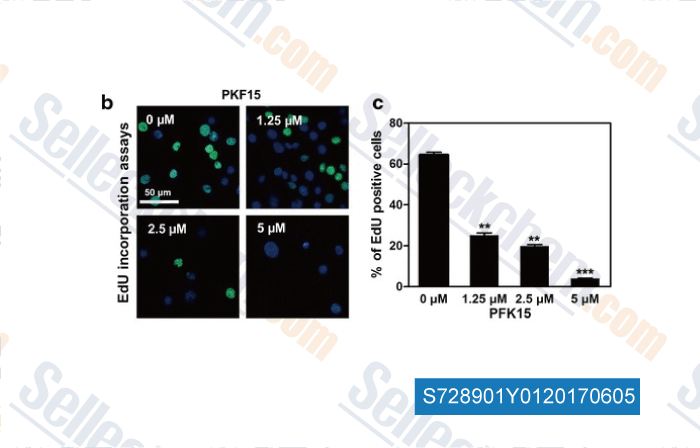
-
, , J Exp Clin Cancer Res, 2017, 36(1):7
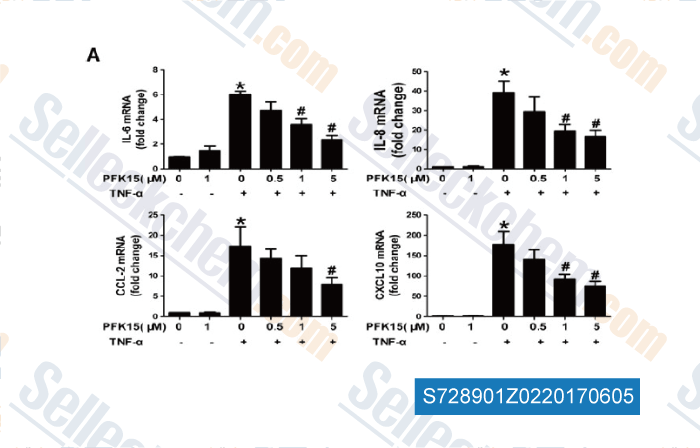
-
Données de [ , , Br J Pharmacol, 2017, 174(9):893-908 ]
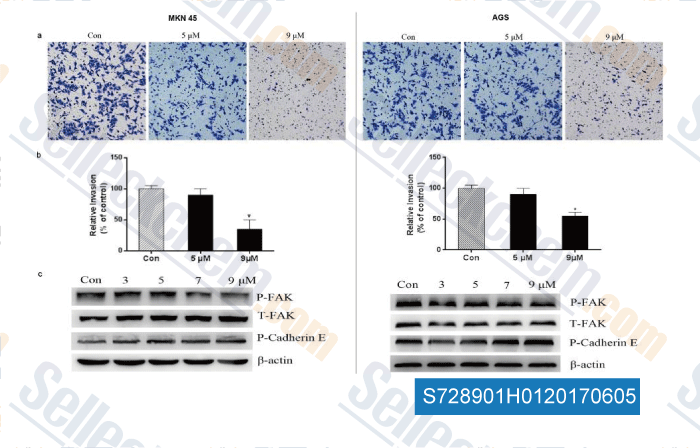
-
Données de [ , , PLoS One, 2016, 11(9):e0163768 ]
Sellecks PFK15 A été cité par 30 Publications
| Transient APC/C inactivation by mTOR boosts glycolysis during cell cycle entry [ Nature, 2025, 10.1038/s41586-025-09328-w] | PubMed: 40739344 |
| Immunosuppressive Formulations for Immunological Defense against Traumatic Brain Injury [ Adv Healthc Mater, 2025, e2501417.] | PubMed: 40437894 |
| Vitamin D impedes eosinophil chemotaxis via inhibiting glycolysis-induced CCL26 expression in eosinophilic chronic rhinosinusitis with nasal polyps [ Cell Commun Signal, 2025, 23(1):104] | PubMed: 39985085 |
| Live-cell metabolic analyzer protocol for measuring glucose and lactate metabolic changes in human cells [ STAR Protoc, 2025, 6(1):103518] | PubMed: 39799573 |
| Identification of PFKFB3 as a key factor in the development of colorectal cancer and immunotherapy resistance [ Clin Exp Med, 2024, 24(1):219] | PubMed: 39261380 |
| Multi-omics and immunogenomics analysis revealed PFKFB3 as a targetable hallmark and mediates sunitinib resistance in papillary renal cell carcinoma: in silico study with laboratory verification [ Eur J Med Res, 2024, 29(1):236] | PubMed: 38622715 |
| Human blood vessel organoids reveal a critical role for CTGF in maintaining microvascular integrity [ Nat Commun, 2023, 14(1):5552] | PubMed: 37689702 |
| Arginine methylation of PPP1CA by CARM1 regulates glucose metabolism and affects osteogenic differentiation and osteoclastic differentiation [ Clin Transl Med, 2023, 13(9):e1369] | PubMed: 37649137 |
| PFKFB3-mediated Pro-glycolytic Shift in Hepatocellular Carcinoma Proliferation [ Cell Mol Gastroenterol Hepatol, 2023, 15(1):61-75] | PubMed: 36162723 |
| Long noncoding RNA LINC00930 promotes PFKFB3-mediated tumor glycolysis and cell proliferation in nasopharyngeal carcinoma [ J Exp Clin Cancer Res, 2022, 41(1):77] | PubMed: 35209949 |
POLITIQUE DE RETOUR
La politique de retour inconditionnelle de Selleck Chemical garantit une expérience dachat en ligne fluide à nos clients. Si vous nêtes en aucun cas satisfait de votre achat, vous pouvez retourner tout article dans les 7 jours suivant sa réception. En cas de problèmes de qualité du produit, quil sagisse de problèmes liés au protocole ou au produit, vous pouvez retourner tout article dans les 365 jours suivant la date dachat initiale. Veuillez suivre les instructions ci-dessous lors du retour des produits.
EXPÉDITION ET STOCKAGE
Les produits Selleck sont transportés à température ambiante. Si vous recevez le produit à température ambiante, soyez assuré que le service dinspection de la qualité de Selleck a mené des expériences pour vérifier que le placement à température normale pendant un mois naffectera pas lactivité biologique des produits en poudre. Après réception, veuillez stocker le produit conformément aux exigences décrites dans la fiche technique. La plupart des produits Selleck sont stables dans les conditions recommandées.
NON DESTINÉ À UN USAGE HUMAIN, VÉTÉRINAIRE DIAGNOSTIQUE OU THÉRAPEUTIQUE.