
Données techniques
| Formule | C23H30N8O |
||||||
| Poids moléculaire | 434.54 | Numéro CAS | 1211441-98-3 | ||||
| Solubilité (25°C)* | In vitro | DMSO | 8 mg/mL (18.41 mM) | ||||
| Water | Insoluble | ||||||
| Ethanol | Insoluble | ||||||
| In vivo (Ajouter les solvants au produit individuellement et dans lordre.) |
|
||||||
|
* <1 mg/ml signifie légèrement soluble ou insoluble. * Veuillez noter que Selleck teste la solubilité de tous les composés en interne, et la solubilité réelle peut différer légèrement des valeurs publiées. Ceci est normal et est dû à de légères variations dun lot à lautre. * Expédition à température ambiante (les tests de stabilité montrent que ce produit peut être expédié sans aucune mesure de refroidissement.) |
|||||||
Préparation des solutions mères
Activité biologique
| Description | Le Ribociclib est un inhibiteur oralement disponible et hautement spécifique de CDK4 et CDK6 avec des IC50 de 10 nM et 39 nM. Phase 3. | ||||
|---|---|---|---|---|---|
| Cibles |
|
||||
| In vitro | LEE011, en tant qu'inhibiteur double de CDK4/CDK6, inhibe significativement la croissance de 12 des 17 lignées cellulaires de neuroblastome avec une IC50 moyenne de 307 nM. L'inhibition de la croissance des lignées cellulaires de neuroblastome est principalement cytostatique et est médiée par un arrêt du G1 Cell Cycle et une sénescence cellulaire. |
||||
| In vivo | LEE011 (200 mg/kg par jour, p.o.) provoque un retard significatif de la croissance tumorale chez les souris porteuses des xénogreffes BE2C ou 1643 sans perte de poids ni autres signes de toxicité. |
||||
| Caractéristiques | Inhibiteur sélectif de CDK4/6 biodisponible par voie orale qui a été testé dans des essais cliniques de phase III pour le traitement du cancer du sein avancé. |
Protocole (de référence)
| Test cellulaire : |
|
|---|---|
| Étude animale : |
|
Références
|
Validation du produit par le client
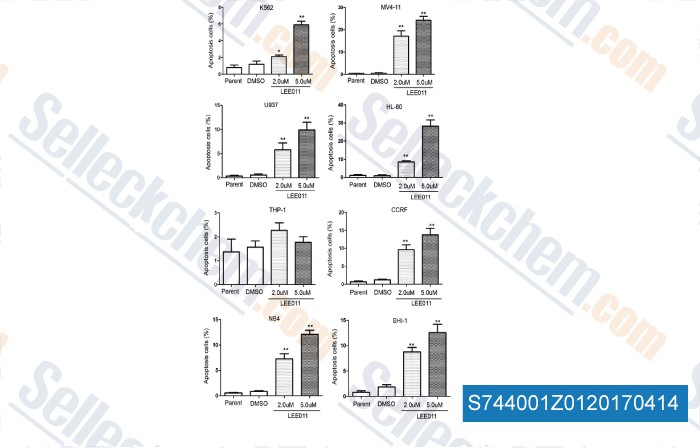
-
, , Cancer Cell Int, 2017, 17:35
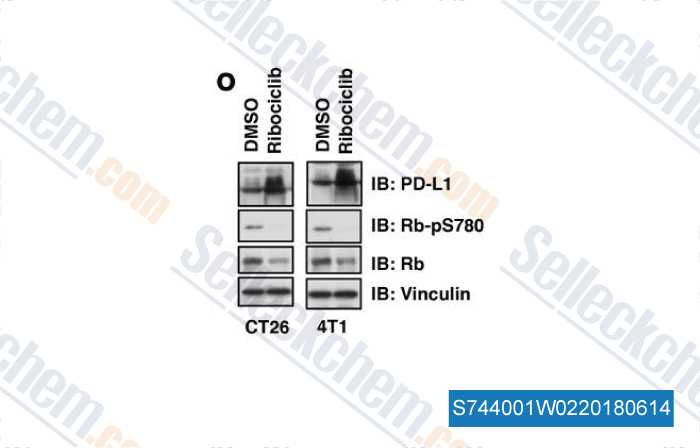
-
Données de [ , , Nature, 2017, 553(7686):91-95 ]

-
Données de [ , , Clin Cancer Res, 2017, 23(22):6958-6968 ]
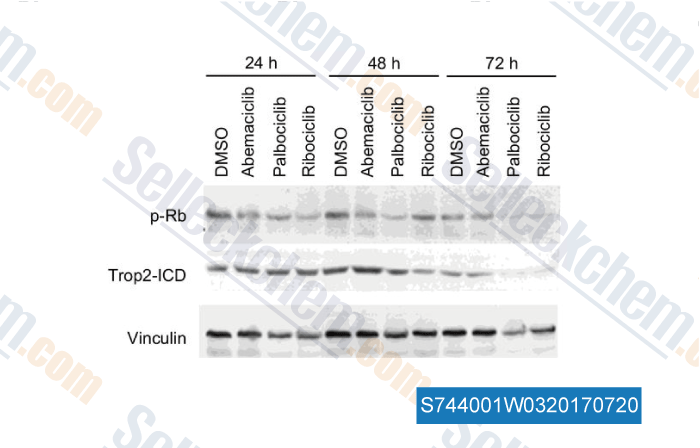
-
Données de [ , , Cancer Res, 2016, 76(22):6723-6734 ]
Sellecks LEE011 (Ribociclib) A été cité par 116 Publications
| Cellular interactions within the immune microenvironment underpins resistance to cell cycle inhibition in breast cancers [ Nat Commun, 2025, 16(1):2132] | PubMed: 40032842 |
| Combined therapy with DR5-targeting antibody-drug conjugate and CDK inhibitors as a strategy for advanced colorectal cancer [ Cell Rep Med, 2025, S2666-3791(25)00231-9] | PubMed: 40449480 |
| Resistance to CDK7 inhibitors directed by acquired mutation of a conserved residue in cancer cells [ EMBO J, 2025, 10.1038/s44318-025-00554-6] | PubMed: 40921851 |
| Blocking cancer-fibroblast mutualism inhibits proliferation of endocrine therapy resistant breast cancer [ Mol Syst Biol, 2025, 10.1038/s44320-025-00104-6] | PubMed: 40341770 |
| Gene expression analysis in circulating tumour cells to determine resistance to CDK4/6 inhibitors plus endocrine therapy in HR + /HER2- metastatic breast cancer patients [ J Transl Med, 2025, 23(1):400] | PubMed: 40186268 |
| Efficacy of CDK4/6 Inhibition in colorectal cancer and the role of p16 expression in predicting drug resistance [ Cell Oncol (Dordr), 2025, 10.1007/s13402-025-01080-7] | PubMed: 40522623 |
| FLT4 activation promotes acute lymphoid leukemia survival through stabilization of MDM2/MDMX and inactivation of p53 [ Oncogenesis, 2025, 14(1):14] | PubMed: 40316529 |
| Preclinical Evaluation of the Efficacy of a Cyclin-dependent Kinase Inhibitor Ribociclib in Combination with Letrozole Against Patient-Derived Glioblastoma Cells [ Mol Cancer Ther, 2025, 10.1158/1535-7163.MCT-25-0277] | PubMed: 40994426 |
| Investigation of ribociclib, abemaciclib and palbociclib resistance in ER+ breast cancer cells reveal potential therapeutic opportunities` [ Sci Rep, 2025, 15(1):28579] | PubMed: 40764324 |
| Bacterial ubiquitin ligase engineered for small molecule and protein target identification [ bioRxiv, 2025, 2025.03.20.644192] | PubMed: 40166235 |
POLITIQUE DE RETOUR
La politique de retour inconditionnelle de Selleck Chemical garantit une expérience dachat en ligne fluide à nos clients. Si vous nêtes en aucun cas satisfait de votre achat, vous pouvez retourner tout article dans les 7 jours suivant sa réception. En cas de problèmes de qualité du produit, quil sagisse de problèmes liés au protocole ou au produit, vous pouvez retourner tout article dans les 365 jours suivant la date dachat initiale. Veuillez suivre les instructions ci-dessous lors du retour des produits.
EXPÉDITION ET STOCKAGE
Les produits Selleck sont transportés à température ambiante. Si vous recevez le produit à température ambiante, soyez assuré que le service dinspection de la qualité de Selleck a mené des expériences pour vérifier que le placement à température normale pendant un mois naffectera pas lactivité biologique des produits en poudre. Après réception, veuillez stocker le produit conformément aux exigences décrites dans la fiche technique. La plupart des produits Selleck sont stables dans les conditions recommandées.
NON DESTINÉ À UN USAGE HUMAIN, VÉTÉRINAIRE DIAGNOSTIQUE OU THÉRAPEUTIQUE.