
Données techniques
| Formule | C17H18N6 |
||||||||||||||
| Poids moléculaire | 306.37 | Numéro CAS | 941678-49-5 | ||||||||||||
| Solubilité (25°C)* | In vitro | DMSO | 300 mg/mL (979.2 mM) | ||||||||||||
| Ethanol | 12 mg/mL (39.16 mM) | ||||||||||||||
| Water | Insoluble | ||||||||||||||
| In vivo (Ajouter les solvants au produit individuellement et dans l'ordre.) |
|
||||||||||||||
|
* <1 mg/ml signifie légèrement soluble ou insoluble. * Veuillez noter que Selleck teste la solubilité de tous les composés en interne, et la solubilité réelle peut différer légèrement des valeurs publiées. Ceci est normal et est dû à de légères variations d'un lot à l'autre. * Expédition à température ambiante (les tests de stabilité montrent que ce produit peut être expédié sans aucune mesure de refroidissement.) |
|||||||||||||||
Préparation des solutions mères
Activité biologique
| Description | Ruxolitinib (INCB18424) est le premier inhibiteur puissant et sélectif de JAK1/2 à entrer en clinique avec une IC50 de 3,3 nM/2,8 nM dans les essais sans cellules, une sélectivité >130 fois supérieure pour JAK1/2 par rapport à JAK3. Ce composé tue les cellules tumorales par Mitophagy toxique. Il induit Autophagy et améliore Apoptosis related. | ||||
|---|---|---|---|---|---|
| Cibles |
|
||||
| In vitro | Ruxolitinib (INCB18424) potently and selectively inhibits JAK2V617F-mediated signaling and proliferation in Ba/F3 cells and HEL cells. This compound markedly increases apoptosis in a dose dependent manner in Ba/F3 cells. It (64 nM) results in a doubling of cells with depolarized mitochondria in Ba/F3 cells. This chemical inhibits proliferating of erythroid progenitors from normal donors and polycythemia vera patients with IC50 of 407 nM and 223 nM, respectively. It demonstrates remarkable potency against erythroid colony formation with IC50 of 67nM. | ||||
| In vivo | INCB018424 (180 mg/kg, orally, twice a day) results in a survival rate of greater than 90% by day 22 in a JAK2V617F-driven mouse model. This compound (180 mg/kg, orally, twice a day) markedly reduces splenomegaly and circulating levels of inflammatory cytokines, and preferentially eliminates neoplastic cells, resulting in significantly prolonged survival without myelosuppressive or immunosuppressive effects in a JAK2V617F-driven mouse model. In the double-blind trial of myelofibrosis, the primary end point is reached in 41.9% of patients in the Ruxolitinib (INCB18424) group as compared with 0.7% in the placebo group. It results in maintaining reduction in spleen volume and improvement of 50% or more in the total symptom score. A total of 28% of the patients in the group receiving this compound (15 mg twice daily) has at least a 35% reduction in spleen volume at week 48 in patients with myelofibrosis, as compared with 0% in the group receiving the best available therapy. The mean palpable spleen length has decreased by 56% with it but has increased by 4% with the best available therapy at week 48. Patients in the ruxolitinib group has an improvement in overall quality-of-life measures and a reduction in symptoms associated with myelofibrosis. |
Protocole (de référence)
| Test kinase :[1] |
|
|---|---|
| Test cellulaire :[1] |
|
| Étude animale :[1] |
|
Références
|
Validation du produit par le client
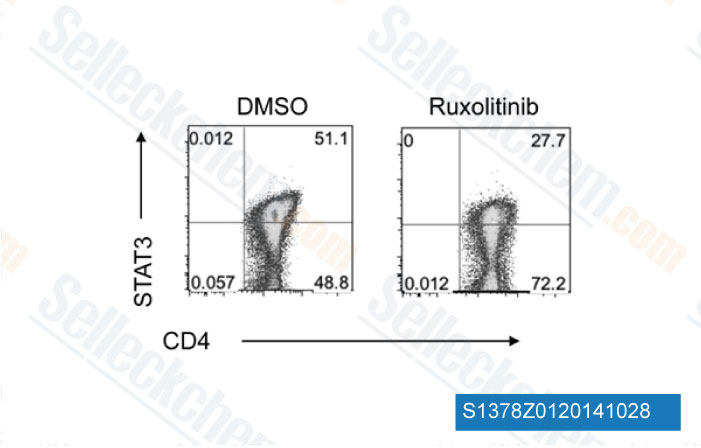
-
Données de [ Blood , 2014 , 123(24), 3832-42 ]
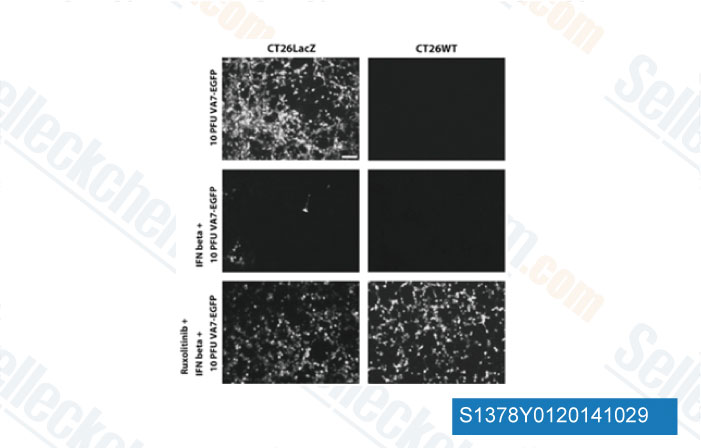
-
Données de [ Gene Ther , 2014 , 10.1038/gt.2014.83 ]
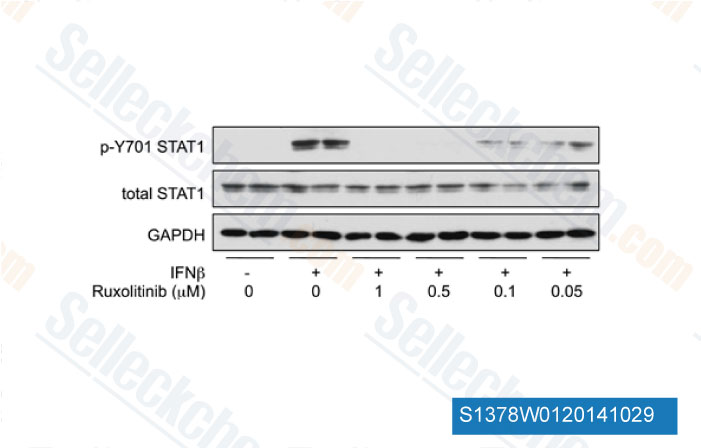
-
Données de [ J Immunol , 2012 , 189(6), 2784-92 ]
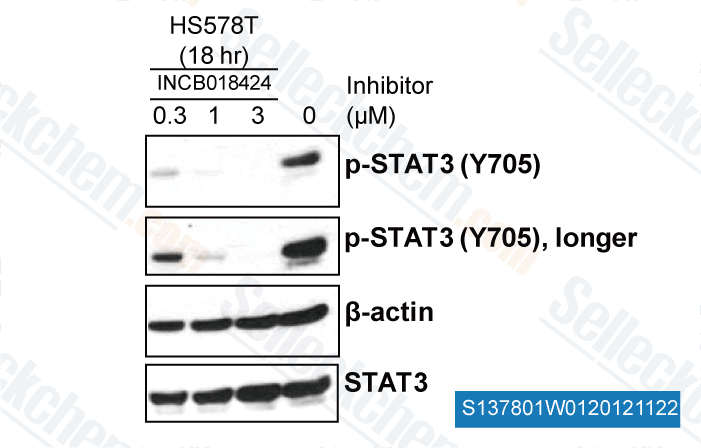
-
, , Yong Weon Yi Georgetown University
Selleck's Ruxolitinib (INCB18424) A été cité par 676 Publications
| Systematic design of combination therapy by targeting master regulators of coexisting diffuse midline glioma cell states [ Nat Genet, 2026, 58(5):1112-1125.] | PubMed: 42020604 |
| Biomarkers of response to neoadjuvant palbociclib plus anastrozole in endocrine-resistant estrogen receptor-positive/HER2-negative breast cancer: a phase 2 trial [ Nat Commun, 2026, 17(1):949] | PubMed: 41593097 |
| Prolonged KRAS-MAPK Inhibition Induces Interferon Signaling that Promotes Cell State Transition and Confers Therapeutic Vulnerabilities [ Cancer Res, 2026, 10.1158/0008-5472.CAN-25-4114.] | PubMed: 42008116 |
| JAK1/2 inhibitor ruxolitinib reduces aggregates in cardiac proteinopathy [ EMBO Mol Med, 2026, 10.1038/s44321-026-00411-x] | PubMed: 41917326 |
| Wntless degradation mediated by CaMKII inhibition drives endoplasmic reticulum stress and apoptosis [ Cell Rep, 2026, 45(4):117256] | PubMed: 41966825 |
| ADA2-deficient cells exhibit increased levels of cell death and metabolic disturbances [ Cell Death Discov, 2026, 12(1)167] | PubMed: 41866403 |
| Non-gene-edited neural stem cells reverse neuroinflammation and microbiota dysbiosis in a sprague-dawley rat model of autism spectrum disorder [ Transl Psychiatry, 2026, 10.1038/s41398-026-03841-w] | PubMed: 41922322 |
| The tumor suppressor NDRG2 recruits protein phosphatase 2A to suppress STAT5 phosphorylation in adult T-cell leukemia/lymphoma [ J Biol Chem, 2026, S0021-9258(26)01952-6] | PubMed: 42055322 |
| Microbial metabolite drives ageing-related clonal haematopoiesis via ALPK1 [ Nature, 2025, 10.1038/s41586-025-08938-8] | PubMed: 40269158 |
| Macrophage-derived amphiregulin induces myofibroblast transition in adipogenic lineage precursors near Staphylococcus aureus abscess in bone marrow [ Nat Commun, 2025, 16(1):8409] | PubMed: 40998791 |
POLITIQUE DE RETOUR
La politique de retour inconditionnelle de Selleck Chemical garantit une expérience d'achat en ligne fluide à nos clients. Si vous n'êtes en aucun cas satisfait de votre achat, vous pouvez retourner tout article dans les 7 jours suivant sa réception. En cas de problèmes de qualité du produit, qu'il s'agisse de problèmes liés au protocole ou au produit, vous pouvez retourner tout article dans les 365 jours suivant la date d'achat initiale. Veuillez suivre les instructions ci-dessous lors du retour des produits.
EXPÉDITION ET STOCKAGE
Les produits Selleck sont transportés à température ambiante. Si vous recevez le produit à température ambiante, soyez assuré que le service d'inspection de la qualité de Selleck a mené des expériences pour vérifier que le placement à température normale pendant un mois n'affectera pas l'activité biologique des produits en poudre. Après réception, veuillez stocker le produit conformément aux exigences décrites dans la fiche technique. La plupart des produits Selleck sont stables dans les conditions recommandées.
NON DESTINÉ À UN USAGE HUMAIN, VÉTÉRINAIRE DIAGNOSTIQUE OU THÉRAPEUTIQUE.