
Données techniques
| Formule | C27H22Cl2N4O |
||||||
| Poids moléculaire | 489.4 | Numéro CAS | 192185-72-1 | ||||
| Solubilité (25°C)* | In vitro | DMSO | 14 mg/mL (28.6 mM) | ||||
| Ethanol | 9 mg/mL (18.38 mM) | ||||||
| Water | Insoluble | ||||||
| In vivo (Ajouter les solvants au produit individuellement et dans lordre.) |
|
||||||
|
* <1 mg/ml signifie légèrement soluble ou insoluble. * Veuillez noter que Selleck teste la solubilité de tous les composés en interne, et la solubilité réelle peut différer légèrement des valeurs publiées. Ceci est normal et est dû à de légères variations dun lot à lautre. * Expédition à température ambiante (les tests de stabilité montrent que ce produit peut être expédié sans aucune mesure de refroidissement.) |
|||||||
Préparation des solutions mères
Activité biologique
| Description | Tipifarnib est un inhibiteur puissant et spécifique de la farnésyltransférase (FTase) avec une IC50 de 0,6 nM. Ses effets anti-prolifératifs sont les plus prononcés dans les cellules mutantes H-ras ou N-ras. Phase 3. | ||
|---|---|---|---|
| Cibles |
|
||
| In vitro | En utilisant Tipifarnib 5 μM pendant 72 heures, le pourcentage de cellules apoptotiques est significativement plus élevé dans les lymphocytes T LGL traités par le médicament par rapport à ceux traités par le DMSO. En utilisant des lymphocytes T de donneurs sains, ce composé réduit le pourcentage de cellules IFNγ-positives de manière dépendante du temps. Il réduit la quantité de Ras activé dans les précipités par rapport au DMSO. Cette substance chimique exerce une toxicité in vitro sélective contre l'hématopoïèse MDS clonale à des concentrations inférieures à 10 nM, l'effet étant plus prononcé dans les progéniteurs de globules blancs. Cette action n'est pas due à l'induction de l'apoptose, car les progéniteurs normaux et MDS présentent une expression équivalente de DiOC3 et d'annexine V jusqu'à 72 heures après l'exposition à ce composé. Sa combinaison avec 10 nM de 4-OH-ICI 46474 en présence d'E2 réduit l'IC50 de 8 fois, de 400 à 50 nM. Il induit l'apoptose dans les cellules U937. De plus, cette substance chimique inhibe la farnésyltransférase humaine isolée pour un peptide de lamine B et pour le peptide K-RasB avec une IC50 de 0,86 nM et 7,9 nM, respectivement. |
||
| In vivo | Ki-67 est plus faible dans les tumeurs traitées par le retrait d'E2 plus ce composé par rapport au retrait d'E2 seul. La combinaison d'ICI 46474 et de cette substance chimique entraîne un Ki-67 significativement plus faible par rapport à ICI 46474 ou à cet agent seul (moyenne de 5% contre 16,9% et 67,3%, respectivement). En revanche, aucune différence significative dans les scores apoptotiques n'est observée entre les groupes de traitement. Ce composé seul réduit également le CTI par rapport au contrôle. La combinaison d'ICI 46474 et de cet agent ou de cette substance chimique associée au retrait d'E2 est la plus efficace pour abaisser le CTI (0,8 et 0,7, respectivement), ce qui peut expliquer la diminution du volume tumoral. |
||
| Caractéristiques | Un inhibiteur puissant et sélectif de la farnésyl protéine transférase avec des effets antitumoraux significatifs. |
Protocole (de référence)
| Test cellulaire : |
|
|---|---|
| Étude animale : |
|
Références
|
Validation du produit par le client
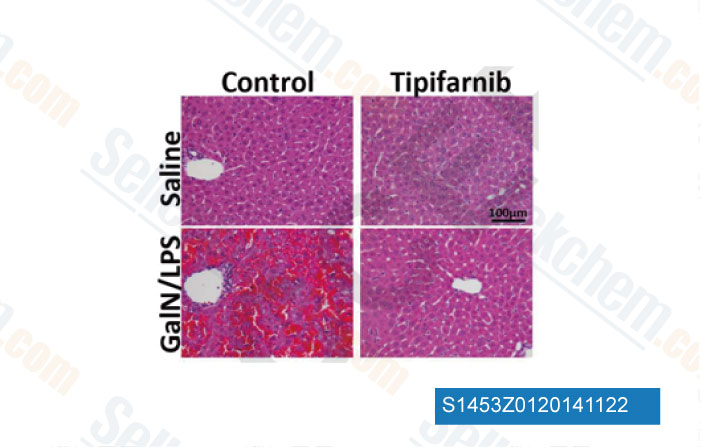
-
Données de [ Shock , 2014 , 42(6), 570-7 ]
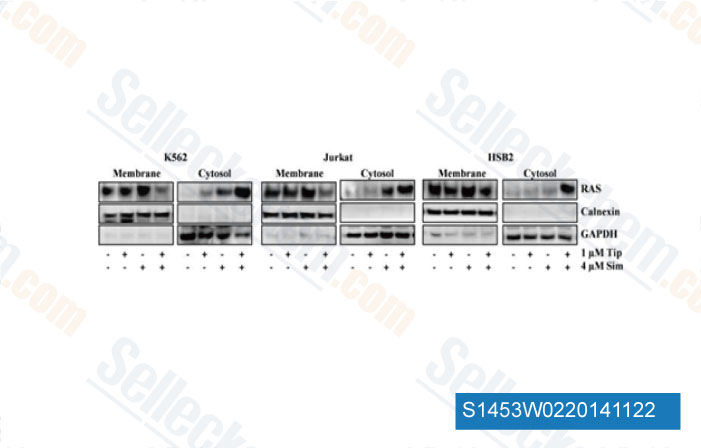
-
Données de [ Leuk Res , 2014 , 10.1016/j.leukres.2014.09.002 ]
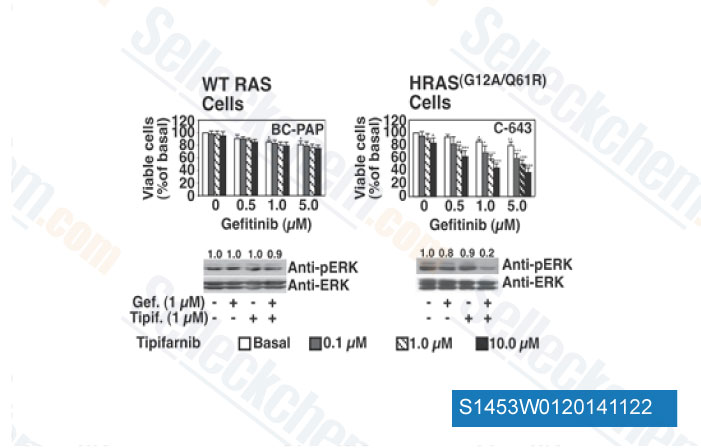
-
Données de [ J Clin Endocrinol Metab , 2013 , 98(6), 2502-12 ]
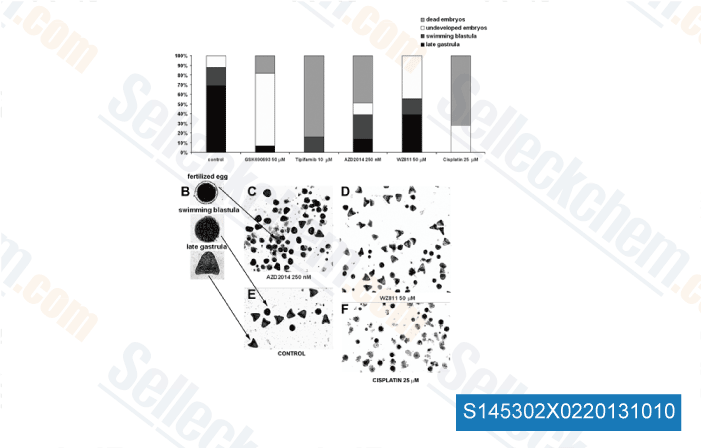
-
, , Dr. Milica Pesic from Institute for Biological Research
Sellecks Tipifarnib (IND 58359) A été cité par 38 Publications
| Impaired MC3T3-E1 osteoblast differentiation triggered by oncogenic HRAS is rescued by the farnesyltransferase inhibitor Tipifarnib [ Sci Rep, 2025, 15(1):6832] | PubMed: 40000861 |
| In Vitro synergy of Farnesyltransferase inhibitors in combination with colistin against ESKAPE bacteria [ PLoS One, 2025, 20(9):e0331440] | PubMed: 40911556 |
| Mitotic perturbation is a key mechanism of action of decitabine in myeloid tumor treatment [ Cell Rep, 2023, 42(9):113098] | PubMed: 37714156 |
| Salivary gland cancer organoids are valid for preclinical genotype-oriented medical precision trials [ iScience, 2023, 26(5):106695] | PubMed: 37207275 |
| Suppression of NASH-Related HCC by Farnesyltransferase Inhibitor through Inhibition of Inflammation and Hypoxia-Inducible Factor-1α Expression [ Int J Mol Sci, 2023, 24(14)11546] | PubMed: 37511305 |
| Cooperative Genomic Lesions in HRAS-Mutant Cancers Predict Resistance to Farnesyltransferase Inhibitors [ Res Sq, 2023, rs.3.rs-3154719] | PubMed: 37503077 |
| BRAF activation by metabolic stress promotes glycolysis sensitizing NRASQ61-mutated melanomas to targeted therapy [ Nat Commun, 2022, 13(1):7113] | PubMed: 36402789 |
| Impact of a conserved N-terminal proline-rich region of the α-subunit of CAAX-prenyltransferases on their enzyme properties [ Cell Commun Signal, 2022, 20(1):118] | PubMed: 35941619 |
| Combination of Tipifarnib and Sunitinib Overcomes Renal Cell Carcinoma Resistance to Tyrosine Kinase Inhibitors via Tumor-Derived Exosome and T Cell Modulation [ Cancers (Basel), 2022, 14(4)903] | PubMed: 35205655 |
| Bacteria Are New Targets for Inhibitors of Human Farnesyltransferase [ Front Microbiol, 2021, 12:628283] | PubMed: 34917041 |
POLITIQUE DE RETOUR
La politique de retour inconditionnelle de Selleck Chemical garantit une expérience dachat en ligne fluide à nos clients. Si vous nêtes en aucun cas satisfait de votre achat, vous pouvez retourner tout article dans les 7 jours suivant sa réception. En cas de problèmes de qualité du produit, quil sagisse de problèmes liés au protocole ou au produit, vous pouvez retourner tout article dans les 365 jours suivant la date dachat initiale. Veuillez suivre les instructions ci-dessous lors du retour des produits.
EXPÉDITION ET STOCKAGE
Les produits Selleck sont transportés à température ambiante. Si vous recevez le produit à température ambiante, soyez assuré que le service dinspection de la qualité de Selleck a mené des expériences pour vérifier que le placement à température normale pendant un mois naffectera pas lactivité biologique des produits en poudre. Après réception, veuillez stocker le produit conformément aux exigences décrites dans la fiche technique. La plupart des produits Selleck sont stables dans les conditions recommandées.
NON DESTINÉ À UN USAGE HUMAIN, VÉTÉRINAIRE DIAGNOSTIQUE OU THÉRAPEUTIQUE.