
Usage réservé à la recherche
PI3 Kinase p110β Antibody [D23E3]
N° de cat.: F4196
Application:
Réactivité:
-
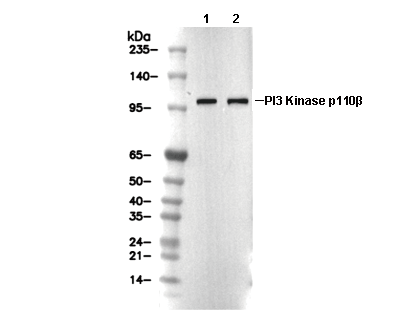 Lane 1: MCF7, Lane 2: K562
Essentiels pour lexpérimentation
WB
Recommended SDS-PAGE separating gel concentration: 5%.
Recommended SDS-PAGE separating gel concentration: 5%.
Informations dutilisation
| Dilution |
|---|
|
| Application |
|---|
| WB, IP |
| Réactivité |
|---|
| Human |
| Source |
|---|
| Rabbit Monoclonal Antibody |
| Tampon de stockage |
|---|
| PBS, pH 7.2+50% Glycerol+0.05% BSA+0.01% NaN3 |
| Stockage (à partir de la date de réception) |
|---|
| -20°C (avoid freeze-thaw cycles), 2 years |
| Poids moléculaire prédit |
|---|
| 110 kDa |
| Contrôle positif | MCF-7 cell; K-562 cell |
|---|---|
| Contrôle négatif |
Méthodes expérimentales
| WB |
|---|
Experimental Protocol:
Sample preparation
1. Tissue: Lyse the tissue sample by adding an appropriate volume of ice-cold RIPA/NP-40 Lysis Buffer (containing Protease Inhibitor Cocktail),and homogenize the tissue at a low temperature. 2. Adherent cell: Aspirate the culture medium and wash the cells with ice-cold PBS twice. Lyse the cells by adding an appropriate volume of RIPA/NP-40 Lysis Buffer (containing Protease Inhibitor Cocktail) and put the sample on ice for 5 min. 3. Suspension cell: Transfer the culture medium to a pre-cooled centrifuge tube. Centrifuge and aspirate the supernatant. Wash the cells with ice-cold PBS twice. Lyse the cells by adding an appropriate volume of RIPA/NP-40 Lysis Buffer (containing Protease Inhibitor Cocktail) and put the sample on ice for 5 min. 4. Place the lysate into a pre-cooled microcentrifuge tube. Centrifuge at 4°C for 15 min. Collect the supernatant;
5. Remove a small volume of lysate to determine the protein concentration;
6. Combine the lysate with protein loading buffer. Boil 20 µL sample under 95-100°C for 5 min. Centrifuge for 5 min after cool down on ice.
Electrophoretic separation
1. According to the concentration of extracted protein, load appropriate amount of protein sample and marker onto SDS-PAGE gels for electrophoresis. Recommended separating gel (lower gel) concentration: 5%. Reference Table for Selecting SDS-PAGE Separation Gel Concentrations 2. Power up 80V for 30 minutes. Then the power supply is adjusted (110 V~150 V), the Marker is observed, and the electrophoresis can be stopped when the indicator band of the predyed protein Marker where the protein is located is properly separated. (Note that the current should not be too large when electrophoresis, too large current (more than 150 mA) will cause the temperature to rise, affecting the result of running glue. If high currents cannot be avoided, an ice bath can be used to cool the bath.)
Transfer membrane
1. Take out the converter, soak the clip and consumables in the pre-cooled converter;
2. Activate PVDF membrane with methanol for 1 min and rinse with transfer buffer;
3. Install it in the order of "black edge of clip - sponge - filter paper - filter paper - glue -PVDF membrane - filter paper - filter paper - sponge - white edge of clip"; 4. The protein was electrotransferred to PVDF membrane. ( 0.45 µm PVDF membrane is recommended ) Reference Table for Selecting PVDF Membrane Pore Size Specifications Recommended conditions for wet transfer: 200 mA, 120 min. ( Note that the transfer conditions can be adjusted according to the protein size. For high-molecular-weight proteins, a higher current and longer transfer time are recommended. However, ensure that the transfer tank remains at a low temperature to prevent gel melting.)
Block
1. After electrotransfer, wash the film with TBST at room temperature for 5 minutes;
2. Incubate the film in the blocking solution for 1 hour at room temperature;
3. Wash the film with TBST for 3 times, 5 minutes each time.
Antibody incubation
1. Use 5% skim milk powder to prepare the primary antibody working liquid (recommended dilution ratio for primary antibody 1:1000), gently shake and incubate with the film at 4°C overnight; 2. Wash the film with TBST 3 times, 5 minutes each time;
3. Add the secondary antibody to the blocking solution and incubate with the film gently at room temperature for 1 hour;
4. After incubation, wash the film with TBST 3 times for 5 minutes each time.
Antibody staining
1. Add the prepared ECL luminescent substrate (or select other color developing substrate according to the second antibody) and mix evenly;
2. Incubate with the film for 1 minute, remove excess substrate (keep the film moist), wrap with plastic film, and expose in the imaging system. |
Description biologique
| Spécificité |
|---|
| PI3 Kinase p110β Antibody [D23E3] detects endogenous levels of total PI3K p110β protein. |
| Localisation subcellulaire |
|---|
| Cytoplasm, Nucleus |
| Uniprot ID |
|---|
| P42338 |
| Clone |
|---|
| D23E3 |
| Synonyme |
|---|
| Phosphatidylinositol 4;5-bisphosphate 3-kinase catalytic subunit beta isoform; PI3-kinase subunit beta; PI3K-beta; PI3Kbeta; PtdIns-3-kinase subunit beta; Phosphatidylinositol 4 |
| Contexte |
|---|
| Phosphoinositide 3-kinases (PI3Ks) are lipid kinases that phosphorylate phosphatidylinositol (PI), phosphatidylinositol-4-phosphate (PIP), and phosphatidylinositol-4,5-bisphosphate (PIP₂) to generate phosphatidylinositol-3,4,5-trisphosphate (PIP₃). This reaction is a central step in intracellular signaling cascades initiated by growth factors and hormones, coordinating key cellular processes such as proliferation, survival, migration, and cell cycle progression. PI3Ks function as heterodimers composed of a catalytic subunit (p110) and a regulatory subunit. Four catalytic isoforms—p110α, p110β, p110γ, and p110δ—have been identified, each displaying distinct regulatory interactions and tissue distributions. The p110α, p110β, and p110δ isoforms associate with regulatory subunits p85α or p85β, whereas p110γ binds to p101, a unique regulatory partner that links its activation to βγ subunits of heterotrimeric G proteins rather than receptor tyrosine kinases.Among these, p110β is ubiquitously expressed and is indispensable for early embryonic development. It promotes cell proliferation and invasive growth, with elevated expression observed in several malignancies, including glioblastomas. Collectively, the PI3K family serves as a critical signaling hub integrating extracellular stimuli with intracellular pathways that control growth and survival, and its dysregulation is closely associated with oncogenesis and developmental abnormalities. |
| Références |
|---|
|
Support technique
Tel: +1-832-582-8158 Ext:3
Si vous avez dautres questions, veuillez laisser un message.

Les produits sont destinés à la recherche uniquement. Ne pas utiliser chez lhomme. Nous ne vendons pas aux patients.
©Copyright 2013 Selleck Chemicals. Tous droits réservés.