
pour la recherche uniquement
Heparin Sodium Anticoagulant
Réf. Catalogue: S1346
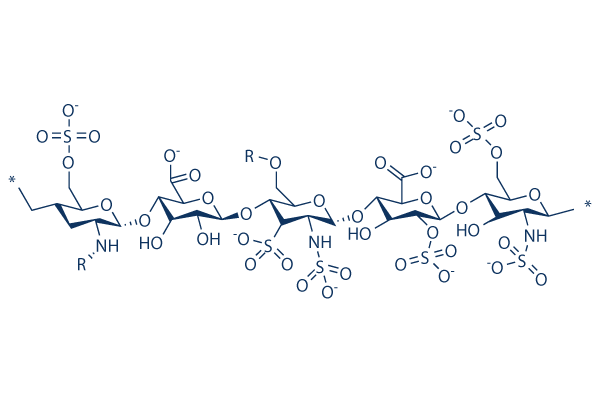
Structure chimique
Contrôle Qualité (Quality Control)
| Cibles apparentées | HDAC Caspase Proteasome Secretase MMP HCV Protease Cysteine Protease Tyrosinase HIV Protease DPP |
|---|---|
| Produits vedettes | Y-27632 Dihydrochloride SB431542 CHIR-99021 (Laduviglusib) RMC-7977 RMC-6236 (Daraxonrasib) MRTX1133 MG132 Z-VAD-FMK VT3989 IAG933 |
Informations chimiques, stockage et stabilité (Chemical Information, Storage & Stability)
| Poids moléculaire | Formule | (C12H16NS2Na3)20 |
Stockage (À compter de la date de réception) | ||
|---|---|---|---|---|---|
| N° CAS | 9041-08-1 | -- | Stockage des solutions mères |
|
|
| Synonymes | N/A | Smiles | CCC1CC(N[R])C(OC1CO[S]([O-])(=O)=O)OC2C(O)C(O)C(OC3C(CO[R])OC(OC4C(O)C(O[S]([O-])(=O)=O)C(OC5C(O)C(N[S]([O-])(=O)=O)C(C)OC5CO[S]([O-])(=O)=O)OC4C([O-])=O)C(N[S]([O-])(=O)=O)C3[S]([O-])(=O)=O)OC2C([O-] | ||
Solubilité (Solubility)
|
In vitro |
Water : 162 mg/mL
DMSO
: Insoluble
Ethanol : Insoluble |
Calculateur de molarité
|
In vivo |
|||||
Calculateur de formulation in vivo (Solution claire)
Étape 1 : Saisir les informations ci-dessous (Recommandé : Un animal supplémentaire pour tenir compte des pertes pendant l'expérience)
Étape 2 : Saisir la formulation in vivo (Ceci est seulement le calculateur, pas la formulation. Veuillez nous contacter d'abord s'il n'y a pas de formulation in vivo dans la section Solubilité.)
Résultats du calcul :
Concentration de travail : mg/ml;
Méthode de préparation du liquide maître DMSO : mg médicament prédissous dans μL DMSO ( Concentration du liquide maître mg/mL, Veuillez nous contacter d'abord si la concentration dépasse la solubilité du DMSO du lot de médicament. )
Méthode de préparation de la formulation in vivo : Prendre μL DMSO liquide maître, puis ajouterμL PEG300, mélanger et clarifier, puis ajouterμL Tween 80, mélanger et clarifier, puis ajouter μL ddH2O, mélanger et clarifier.
Méthode de préparation de la formulation in vivo : Prendre μL DMSO liquide maître, puis ajouter μL Huile de maïs, mélanger et clarifier.
Note : 1. Veuillez vous assurer que le liquide est clair avant d'ajouter le solvant suivant.
2. Assurez-vous d'ajouter le(s) solvant(s) dans l'ordre. Vous devez vous assurer que la solution obtenue, lors de l'ajout précédent, est une solution claire avant de procéder à l'ajout du solvant suivant. Des méthodes physiques telles que le vortex, les ultrasons ou le bain-marie chaud peuvent être utilisées pour faciliter la dissolution.
Mécanisme d'action (Mechanism of Action)
| Targets/IC50/Ki |
Antithrombin III
|
|---|---|
| In vitro |
Heparin is widely used as an anticoagulant drug based on its ability to accelerate the rate at which antithrombin inhibits serine proteases in the blood coagulation cascade. Heparin and the structurally related heparan sulfate are complex linear polymers comprised of a mixture of chains of different length, having variable sequences. Heparin interactes most tightly with peptides containing a complementary binding site of high positive charge density. Heparin and heparan sulfate predominantly exhibit linear helical secondary structures with sulfo and carboxyl groups displayed at defined intervals and in defined orientations along the polysaccharide backbone. Heparin resembles DNA as both are highly charged linear polymers that behave as polyelectrolytes. Heparin is believed to function as an anticoagulant primarily through its interaction with AT III by enhancing AT-III-mediated inhibition of blood coagulation factors, including thrombin and factor Xa. Heparin binds to AT III and thrombin in a ternary complex, increasing the bimolecular rate constant for the inhibition of thrombin by a factor of 2000. Heparin is principally located in the granules of tissue mast cells that are closely associated with the immune response. Heparin makes numerous contacts with both FGF-2 and FGFR-1 stabilizing FGF–FGFR binding. Heparin also makes contacts with the FGFR-1 of the adjacent FGF–FGFR complex, thus seeming to promote FGFR dimerization. |
Références |
|
Informations sur l'essai clinique (Clinical Trial Information)
(données du https://clinicaltrials.gov, mis à jour le 2026-07-27)
| Numéro NCT | Recrutement | Conditions | Promoteur/Collaborateurs | Date de début | Phases |
|---|---|---|---|---|---|
| NCT06494878 | RECRUITING | Venous Thromboembolism; Postpartum Period; Aspirin; Low Molecular Weight Heparin |
University of Calgary |
2026-06-04 | PHASE3 |
| NCT07140211 | RECRUITING | Venous Thromboembolism (VTE); Postpartum |
Marc Blondon |
2025-10-15 | PHASE3 |
| NCT07783880 | NOT_YET_RECRUITING | Myocardial Infarction; Percutaneous Coronary Intervention (PCI); Medical Treatment; Coronary Computed Tomographic Angiography; Computed Tomography; Optical Coherence Tomography (OCT) |
3W-Research Collaboration Group |
2026-10-01 | |
| NCT06753786 | RECRUITING | Venous Thromboembolism; Pulmonary Embolism; Intracerebral Hemorrhage; Deep Vein Thrombosis |
Pirogov Russian National Research Medical University |
2024-10-21 | |
| NCT06381661 | RECRUITING | Sepsis |
Assistance Publique - Hôpitaux de Paris |
2026-07-09 | PHASE2 |
| NCT06714864 | RECRUITING | Catheter-Related Infections |
CorMedix Therapeutics |
2025-07-08 | PHASE4 |

Les produits sont destinés à la recherche uniquement. Ne pas utiliser chez l'homme. Nous ne vendons pas aux patients.
©Copyright 2013 Selleck Chemicals. Tous droits réservés.