
pour la recherche uniquement
Nystatin Antibiotics for Mammalian Cell Culture inhibiteur
Réf. CatalogueS1934
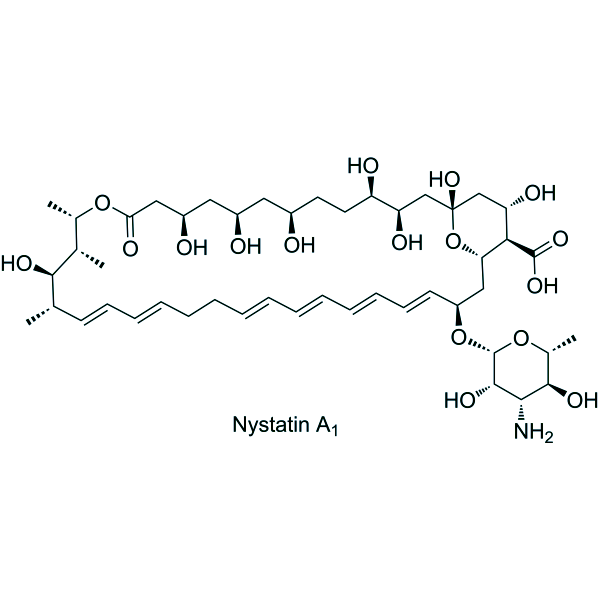
Structure chimique
Poids moléculaire: 926.09
Contrôle Qualité
- Antibiotic Titer ≥ 4400 u/mg
- Cité dans Nature Medicine pour sa qualité supérieure
- COA
- Fiche technique
- SDS
| Cibles apparentées | Integrase Bacterial Antibiotics Anti-infection Fungal Antiviral COVID-19 Parasite Reverse Transcriptase HIV |
|---|---|
| Autre Antibiotics for Mammalian Cell Culture Inhibiteurs | Tylosin tartrate |
Informations chimiques, stockage et stabilité
| Poids moléculaire | 926.09 | Formule | C47H75NO17 |
Stockage (À compter de la date de réception) | |
|---|---|---|---|---|---|
| N° CAS | 1400-61-9 | Télécharger le SDF | Stockage des solutions mères |
|
|
| Synonymes | Fungicidin | Smiles | CC1C=CC=CCCC=CC=CC=CC=CC(CC2C(C(CC(O2)(CC(C(CCC(CC(CC(CC(=O)OC(C(C1OC3CC(C(C(O3)C)O)O)C)C)O)O)O)O)O)O)O)C(=O)O)OC4C(C(C(C(O4)C)O)N)O | ||
Calculateur de molarité
|
In vivo |
|||||
Calculateur de formulation in vivo (Solution claire)
Étape 1 : Saisir les informations ci-dessous (Recommandé : Un animal supplémentaire pour tenir compte des pertes pendant lexpérience)
Étape 2 : Saisir la formulation in vivo (Ceci est seulement le calculateur, pas la formulation. Veuillez nous contacter dabord sil ny a pas de formulation in vivo dans la section Solubilité.)
Résultats du calcul :
Concentration de travail : mg/ml;
Méthode de préparation du liquide maître DMSO : mg médicament prédissous dans μL DMSO ( Concentration du liquide maître mg/mL, Veuillez nous contacter dabord si la concentration dépasse la solubilité du DMSO du lot de médicament. )
Méthode de préparation de la formulation in vivo : Prendre μL DMSO liquide maître, puis ajouterμL PEG300, mélanger et clarifier, puis ajouterμL Tween 80, mélanger et clarifier, puis ajouter μL ddH2O, mélanger et clarifier.
Méthode de préparation de la formulation in vivo : Prendre μL DMSO liquide maître, puis ajouter μL Huile de maïs, mélanger et clarifier.
Note : 1. Veuillez vous assurer que le liquide est clair avant dajouter le solvant suivant.
2. Assurez-vous dajouter le(s) solvant(s) dans lordre. Vous devez vous assurer que la solution obtenue, lors de lajout précédent, est une solution claire avant de procéder à lajout du solvant suivant. Des méthodes physiques telles que le vortex, les ultrasons ou le bain-marie chaud peuvent être utilisées pour faciliter la dissolution.
Mécanisme daction
| In vitro |
Nystatin entraîne une réduction significative de l'adhérence des cellules épithéliales buccales de toutes les six espèces de Candida. Ce composé est un Antibiotique qui augmente la perméabilité des membranes plasmiques aux petits ions monovalents, y compris le chlorure. Il augmente la perméabilité apicale au chlorure au point que le transport transépithélial du chlorure est limité par le transport à travers la membrane basolatérale des cellules épithéliales trachéales, ce qui reflète principalement l'activité du cotransporteur. Ce produit chimique (400 unités/ml) augmente le niveau basal du flux transépithélial de 36Cl d'environ 1,5 fois et élimine la stimulation par l'UTP de ce flux. Ce traitement abolit également la stimulation par l'UTP de la liaison saturable du [3H]bumétanide basolatéral, une mesure du fonctionnement des cotransporteurs Na-K-Cl dans ces cellules; la stimulation de la liaison par l'isoprotérénol n'est que légèrement inhibée par le traitement avec Nystatin. Il améliore significativement l'absorption de l'endostatine par les cellules endothéliales en commutant l'internalisation de l'endostatine principalement vers la voie médiatisée par la clathrine. Cette internalisation améliorée par le composé de l'endostatine augmente également ses effets inhibiteurs sur la formation de tubes et la migration des cellules endothéliales. |
|---|---|
| In vivo |
Nystatin combiné à l'endostatine améliore sélectivement l'absorption et la biodistribution de l'endostatine dans les vaisseaux sanguins tumoraux et les tissus tumoraux, mais pas dans les tissus normaux des souris porteuses de tumeurs, ce qui entraîne finalement des efficacités antiangiogéniques et antitumorales accrues de l'endostatine in vivo. Liposomal this compound, à des doses aussi faibles que 2 mg/kg de poids corporel/jour, protège les souris neutropéniques contre la mort induite par Aspergillus de manière statistiquement significative au point de temps de 50 jours par rapport aux groupes sans traitement, saline ou liposome vide. |
Références |
|
Informations sur lessai clinique
(données du https://clinicaltrials.gov, mis à jour le 2024-05-22)
| Numéro NCT | Recrutement | Conditions | Promoteur/Collaborateurs | Date de début | Phases |
|---|---|---|---|---|---|
| NCT01531192 | Completed | Very Low Birth Weight Infants |
Zekai Tahir Burak Women''s Health Research and Education Hospital |
June 2012 | Phase 4 |
| NCT01411748 | Unknown status | Anticandidal Property of Saccharomyces Boulardii on Very Low Birth Weight Infants |
Zekai Tahir Burak Women''s Health Research and Education Hospital |
July 2011 | Phase 4 |
| NCT01427738 | Completed | HIV-1 Infection |
Advancing Clinical Therapeutics Globally for HIV/AIDS and Other Infections|National Institute of Allergy and Infectious Diseases (NIAID) |
June 2011 | Phase 3 |
| NCT03390374 | Completed | Fungal Infections Systemic |
Dr Cipto Mangunkusumo General Hospital |
October 2010 | Phase 4 |
| NCT02642900 | Completed | Photochemotherapy Reaction |
University of Sao Paulo |
July 2009 | Phase 4 |
Support technique
Tel: +1-832-582-8158 Ext:3
Si vous avez dautres questions, veuillez laisser un message.

Les produits sont destinés à la recherche uniquement. Ne pas utiliser chez lhomme. Nous ne vendons pas aux patients.
©Copyright 2013 Selleck Chemicals. Tous droits réservés.