
pour la recherche uniquement
Eltrombopag Olamine TpoR Agoniste
Réf. Catalogue: S2229
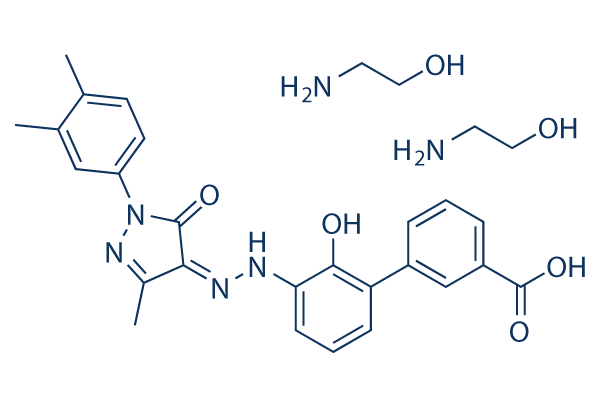
Structure chimique
Poids moléculaire: 564.63
Contrôle Qualité (Quality Control)
| Cibles apparentées | PD-1/PD-L1 CXCR STING AhR Immunology & Inflammation related CD markers Interleukins Anti-infection Antioxidant COX |
|---|---|
| Autre TpoR Inhibiteurs | Butyzamide |
Informations chimiques, stockage et stabilité (Chemical Information, Storage & Stability)
| Poids moléculaire | 564.63 | Formule | C29H36N6O6 |
Stockage (À compter de la date de réception) | |
|---|---|---|---|---|---|
| N° CAS | 496775-62-3 | Télécharger le SDF | Stockage des solutions mères |
|
|
| Synonymes | SB497115,SB-497115-GR | Smiles | CC1=C(C=C(C=C1)N2C(=O)C(=C(N2)C)N=NC3=CC=CC(=C3O)C4=CC(=CC=C4)C(=O)O)C.C(CO)N.C(CO)N | ||
Solubilité (Solubility)
|
In vitro |
DMSO
: 89 mg/mL
(157.62 mM)
Water : Insoluble Ethanol : Insoluble |
Calculateur de molarité
|
In vivo |
|||||
Calculateur de formulation in vivo (Solution claire)
Étape 1 : Saisir les informations ci-dessous (Recommandé : Un animal supplémentaire pour tenir compte des pertes pendant l'expérience)
Étape 2 : Saisir la formulation in vivo (Ceci est seulement le calculateur, pas la formulation. Veuillez nous contacter d'abord s'il n'y a pas de formulation in vivo dans la section Solubilité.)
Résultats du calcul :
Concentration de travail : mg/ml;
Méthode de préparation du liquide maître DMSO : mg médicament prédissous dans μL DMSO ( Concentration du liquide maître mg/mL, Veuillez nous contacter d'abord si la concentration dépasse la solubilité du DMSO du lot de médicament. )
Méthode de préparation de la formulation in vivo : Prendre μL DMSO liquide maître, puis ajouterμL PEG300, mélanger et clarifier, puis ajouterμL Tween 80, mélanger et clarifier, puis ajouter μL ddH2O, mélanger et clarifier.
Méthode de préparation de la formulation in vivo : Prendre μL DMSO liquide maître, puis ajouter μL Huile de maïs, mélanger et clarifier.
Note : 1. Veuillez vous assurer que le liquide est clair avant d'ajouter le solvant suivant.
2. Assurez-vous d'ajouter le(s) solvant(s) dans l'ordre. Vous devez vous assurer que la solution obtenue, lors de l'ajout précédent, est une solution claire avant de procéder à l'ajout du solvant suivant. Des méthodes physiques telles que le vortex, les ultrasons ou le bain-marie chaud peuvent être utilisées pour faciliter la dissolution.
Mécanisme d'action (Mechanism of Action)
| Targets/IC50/Ki |
thrombopoietin receptor
|
|---|---|
| In vitro |
Eltrombopag demonstrates a half maximal effective concentration (EC50) of 0.27 μM in murine BAF3 cells transfected with the luciferase reporter gene under direction of the STAT-activated IRF-1 promoter and human TpoR (BAF3/IRF-1/hTpoR). Eltrombopag activates the receptor by association with metal ions (i.e., Zn2+) and specific amino acids within the transmembrane and juxtamembrane domains of the TpoR. Eltrombopag (30 μM) results in activation of STAT5 in N2C-Tpo cells, as detected with an antiphospho-STAT5 antibody on Western blots. Eltrombopag stimulates proliferation after a 2-day incubation with an EC50 of 0.03 μM in a BrdU assay conducted in BAF3/hTpoR cells. Eltrombopag also induces differentiation of hematopoietic stem cells into committed megakaryocyte progenitor cells. Eltrombopag increases the differentiation of bone marrow CD34+ cells into CD41+ megakaryocytes in a dose-dependent manner with an EC50 of 0.1 μM. Eltrombopag inhibits N2C-Tpo cell and HEL92.1.7 cell proliferating with IC50 of 20.7 μg/mL and 2.3 μg/mL. Eltrombopag (20 μg/mL) leads to a decreased cell division rate, a block in G(1) phase of cell cycle, and increased differentiation in human and murine leukemia cells. Eltrombopag (5 μg/mL) shows clear signs of differentiation, significant changes in the organization of the nuclear contents, and an increase in the cytoplasm/nucleus ratio in HL60 cells. Eltrombopag (5 μg/mL) causes an increase in CD11b, which is consistent with a premacrophage state in U937 cells, and also causes an increase in CD11b in URE cells. Eltrombopag leads to a reduction in free intracellular iron in leukemic cells in a dose-dependent manner in HL60 cells. |
| In vivo |
Eltrombopag (10 mg/kg per day) increases platelet counts over twofold approximately 1 week after the last dose for one chimpanzee and approximately 1.5-fold for the other two chimpanzees. Eltrombopag (1 mg/mL) prolongs survival in mouse models of leukemia. |
Références |
|
Informations sur l'essai clinique (Clinical Trial Information)
(données du https://clinicaltrials.gov, mis à jour le 2025-09-24)
| Numéro NCT | Recrutement | Conditions | Promoteur/Collaborateurs | Date de début | Phases |
|---|---|---|---|---|---|
| NCT07189910 | NOT_YET_RECRUITING | Primary Immune Thrombocytopenia (ITP) |
Union Hospital, Tongji Medical College, Huazhong University of Science and Technology |
2025-12-01 | PHASE4 |
| NCT05961410 | RECRUITING | Lymphoma; Peripheral Blood Stem Cell Transplantation |
National Taiwan University Hospital |
2023-08-15 | PHASE2 |
| NCT01927731 | COMPLETED | Bone Marrow Transplantation Recipient; Cord Blood Transplant Recipient; Hematopoietic Cell Transplantation Recipient |
M.D. Anderson Cancer Center |
2013-10-14 | PHASE2 |
| NCT06768619 | COMPLETED | Thrombocytopenia |
Chia Tai Tianqing Pharmaceutical Group Co., Ltd. |
2023-03-20 | |
| NCT01428635 | COMPLETED | Accelerated Phase Chronic Myelogenous Leukemia, BCR-ABL1 Positive; Blast Phase Chronic Myelogenous Leukemia, BCR-ABL1 Positive; Chronic Phase Chronic Myelogenous Leukemia, BCR-ABL1 Positive; Primary Myelofibrosis; Thrombocytopenia |
M.D. Anderson Cancer Center |
2012-01-13 | PHASE2; PHASE3 |
| NCT01772420 | COMPLETED | Adult Myelodysplastic Syndrome; Anemia; Chronic Myelomonocytic Leukemia |
Albert Einstein College of Medicine |
2012-10 | PHASE2 |

Les produits sont destinés à la recherche uniquement. Ne pas utiliser chez l'homme. Nous ne vendons pas aux patients.
©Copyright 2013 Selleck Chemicals. Tous droits réservés.