
pour la recherche uniquement
S-Ruxolitinib (INCB018424) JAK Inhibiteur
Réf. Catalogue: S2902
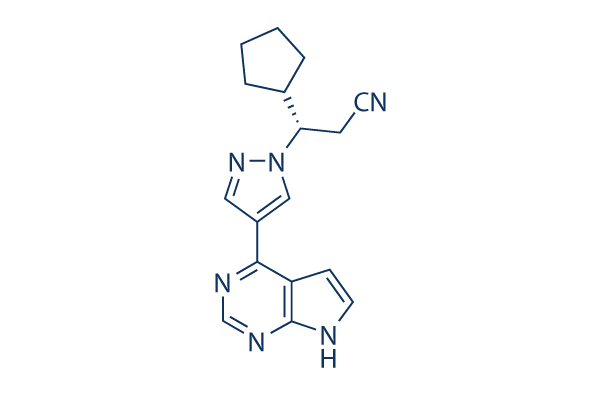
Structure chimique
Poids moléculaire: 306.37
Contrôle Qualité (Quality Control)
| Cibles apparentées | EGFR STAT Pim |
|---|---|
| Autre JAK Inhibiteurs | BMS-986165 (Deucravacitinib) AZD1480 WP1066 Momelotinib (CYT387) Filgotinib (GLPG0634) AT9283 Gandotinib (LY2784544) Pacritinib (SB1518) NVP-BSK805 2HCl TG101209 |
Informations chimiques, stockage et stabilité (Chemical Information, Storage & Stability)
| Poids moléculaire | 306.37 | Formule | C17H18N6 |
Stockage (À compter de la date de réception) | |
|---|---|---|---|---|---|
| N° CAS | 941685-37-6 | Télécharger le SDF | Stockage des solutions mères |
|
|
| Synonymes | N/A | Smiles | C1CCC(C1)C(CC#N)N2C=C(C=N2)C3=C4C=CNC4=NC=N3 | ||
Solubilité (Solubility)
|
In vitro |
DMSO
: 61 mg/mL
(199.1 mM)
Ethanol : 61 mg/mL Water : Insoluble |
Calculateur de molarité
|
In vivo |
|||||
Calculateur de formulation in vivo (Solution claire)
Étape 1 : Saisir les informations ci-dessous (Recommandé : Un animal supplémentaire pour tenir compte des pertes pendant l'expérience)
Étape 2 : Saisir la formulation in vivo (Ceci est seulement le calculateur, pas la formulation. Veuillez nous contacter d'abord s'il n'y a pas de formulation in vivo dans la section Solubilité.)
Résultats du calcul :
Concentration de travail : mg/ml;
Méthode de préparation du liquide maître DMSO : mg médicament prédissous dans μL DMSO ( Concentration du liquide maître mg/mL, Veuillez nous contacter d'abord si la concentration dépasse la solubilité du DMSO du lot de médicament. )
Méthode de préparation de la formulation in vivo : Prendre μL DMSO liquide maître, puis ajouterμL PEG300, mélanger et clarifier, puis ajouterμL Tween 80, mélanger et clarifier, puis ajouter μL ddH2O, mélanger et clarifier.
Méthode de préparation de la formulation in vivo : Prendre μL DMSO liquide maître, puis ajouter μL Huile de maïs, mélanger et clarifier.
Note : 1. Veuillez vous assurer que le liquide est clair avant d'ajouter le solvant suivant.
2. Assurez-vous d'ajouter le(s) solvant(s) dans l'ordre. Vous devez vous assurer que la solution obtenue, lors de l'ajout précédent, est une solution claire avant de procéder à l'ajout du solvant suivant. Des méthodes physiques telles que le vortex, les ultrasons ou le bain-marie chaud peuvent être utilisées pour faciliter la dissolution.
Mécanisme d'action (Mechanism of Action)
| Targets/IC50/Ki |
JAK2
(Cell-free assay) 2.8 nM
JAK1
(Cell-free assay) 3.3 nM
TYK2
(Cell-free assay) 19 nM
|
|---|---|
| In vitro |
S-Ruxolitinib (INCB018424) potently and selectively inhibits JAK2V617F-mediated signaling and proliferation in Ba/F3 cells and HEL cells. It markedly increases apoptosis in a dose dependent manner in Ba/F3 cells. This compound (64 nM) results in a doubling of cells with depolarized mitochondria in Ba/F3 cells. It inhibits proliferating of erythroid progenitors from normal donors and polycythemia vera patients with IC50 of 407 nM and 223 nM, respectively. INCB018424 demonstrates remarkable potency against erythroid colony formation with IC50 of 67nM.
|
| Essai kinase |
Test de liaison
|
|
Les protéines recombinantes sont exprimées à l'aide de cellules Sf21 et de vecteurs de baculovirus et purifiées par chromatographie d'affinité. Les tests de kinase JAK utilisent un test de fluorescence résolue dans le temps homogène avec le substrat peptidique (-EQEDEPEGDYFEWLE). Chaque réaction enzymatique est réalisée avec S-Ruxolitinib (INCB018424) ou un contrôle, l'enzyme JAK, 500 nM de peptide, de l'adénosine triphosphate (ATP ; 1 mM) et 2% de diméthylsulfoxyde (DMSO) pendant 1 heure. La concentration inhibitrice à 50% (IC50) est calculée comme la concentration de ce composé nécessaire pour inhiber 50% du signal fluorescent.
|
|
| In vivo |
S2902 (180 mg/kg, orally, twice a day) results in survive rate of greater than 90% by day 22 in a JAK2V617F-driven mouse model. S2902(180 mg/kg, orally, twice a day) markedly reduces splenomegaly and circulating levels of inflammatory cytokines, and preferentially eliminated neoplastic cells, resulting in significantly prolonged survival without myelosuppressive or immunosuppressive effects in a JAK2V617F-driven mouse model. The primary end point is reached in 41.9% of patients in the S2902 group as compared with 0.7% in the placebo group in the double-blind trial of myelofibrosis. Ruxolitinib results in maintaining of reduction in spleen volume and improvement of 50% or more in the total symptom score. A total of 28% of the patients in the S2902 (15 mg twice daily) group has at least a 35% reduction in spleen volume at week 48 in patients with myelofibrosis, as compared with 0% in the group receiving the best available therapy. The mean palpable spleen length has decreased by 56% with S2902 but has increased by 4% with the best available therapy at week 48. Patients in the S2902 group has an improvement in overall quality-of-life measures and a reduction in symptoms associated with myelofibrosis.
|
Références |
|
Informations sur l'essai clinique (Clinical Trial Information)
(données du https://clinicaltrials.gov, mis à jour le 2026-07-10)
| Numéro NCT | Recrutement | Conditions | Promoteur/Collaborateurs | Date de début | Phases |
|---|---|---|---|---|---|
| NCT03954236 | ACTIVE_NOT_RECRUITING | Non-sclerotic Cutaneous Chronic Graft-versus-host Disease |
Memorial Sloan Kettering Cancer Center |
2019-05-14 | PHASE2 |
| NCT06479135 | RECRUITING | Myelofibrosis; Post-PV MF; Post-ET Myelofibrosis; Primary Myelofibrosis; MF |
Kartos Therapeutics, Inc. |
2024-06-03 | PHASE3 |
| NCT01644110 | COMPLETED | Primary Myelofibrosis; Secondary Myelofibrosis; PMF; SMF; Post-PV MF; Post-ET MF |
University of Ulm |
2013-08 | PHASE1; PHASE2 |
| NCT06310304 | Active not recruiting | Healthy Participants |
Incyte Corporation |
2024-03-26 | Phase 1 |
| NCT02876302 | COMPLETED | Inflammatory Breast Cancer (IBC) |
Dana-Farber Cancer Institute |
2018-01-24 | PHASE2 |
| NCT03697460 | COMPLETED | Lichen Planus |
Aaron R. Mangold |
2018-08-30 | PHASE2 |

Les produits sont destinés à la recherche uniquement. Ne pas utiliser chez l'homme. Nous ne vendons pas aux patients.
©Copyright 2013 Selleck Chemicals. Tous droits réservés.