
pour la recherche uniquement
ARN-509 (Apalutamide) Antagoniste du RA
Réf. CatalogueS2840
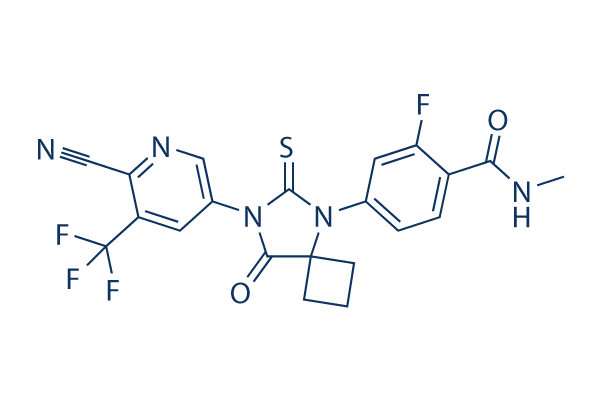
Structure chimique
Poids moléculaire: 477.43
Contrôle Qualité
| Cibles apparentées | Adrenergic Receptor Estrogen/progestogen Receptor GPR Glucocorticoid Receptor ACE RAAS Progesterone Receptor Opioid Receptor PGES THR |
|---|---|
| Autre Androgen Receptor Inhibiteurs | Bavdegalutamide (ARV-110) RU58841 EPI-001 Galeterone Cyproterone Acetate 3,3'-Diindolylmethane Ailanthone Proxalutamide (GT0918) AZD3514 Chlormadinone acetate |
Culture cellulaire, traitement et concentration de travail
| Lignées cellulaires | Type dessai | Concentration | Temps dincubation | Formulation | Description de lactivité | PMID |
|---|---|---|---|---|---|---|
| LNCAP cells | Proliferation assay | 3 days | Antiproliferative activity against human LNCAP cells after 3 days, IC50=0.174 μM | 26046313 | ||
| PSN1 cells | Cytotoxicity assay | 96 h | Cytotoxicity against human PSN1 cells after 96 hrs by ATP-lite luminescence assay, IC50=0.06 μM | 22247788 | ||
| PSN1 cells | Function assay | 30 nM | 24 h | Induction of cell cycle arrest in human PSN1 cells assessed as accumulation at G2/M phase cells at 30 nM after 24 hrs by flow cytometry | 22247788 | |
| LNCaP | Function assay | 30 mins | Displacement of [3H]-R1881 from AR in human LNCaP cells preincubated for 30 mins followed by [3H]-R1881 addition measured after 30 mins by microbeta scintillation counter method, IC50 = 0.01625 μM. | 28478926 | ||
| U-2 OS | qHTS assay | qHTS of pediatric cancer cell lines to identify multiple opportunities for drug repurposing: Primary screen for U-2 OS cells | 29435139 | |||
| A673 | qHTS assay | qHTS of pediatric cancer cell lines to identify multiple opportunities for drug repurposing: Primary screen for A673 cells | 29435139 | |||
| DAOY | qHTS assay | qHTS of pediatric cancer cell lines to identify multiple opportunities for drug repurposing: Primary screen for DAOY cells | 29435139 | |||
| BT-37 | qHTS assay | qHTS of pediatric cancer cell lines to identify multiple opportunities for drug repurposing: Primary screen for BT-37 cells | 29435139 | |||
| RD | qHTS assay | qHTS of pediatric cancer cell lines to identify multiple opportunities for drug repurposing: Primary screen for RD cells | 29435139 | |||
| SK-N-SH | qHTS assay | qHTS of pediatric cancer cell lines to identify multiple opportunities for drug repurposing: Primary screen for SK-N-SH cells | 29435139 | |||
| BT-12 | qHTS assay | qHTS of pediatric cancer cell lines to identify multiple opportunities for drug repurposing: Primary screen for BT-12 cells | 29435139 | |||
| MG 63 (6-TG R) | qHTS assay | qHTS of pediatric cancer cell lines to identify multiple opportunities for drug repurposing: Primary screen for MG 63 (6-TG R) cells | 29435139 | |||
| NB1643 | qHTS assay | qHTS of pediatric cancer cell lines to identify multiple opportunities for drug repurposing: Primary screen for NB1643 cells | 29435139 | |||
| Fibroblast cells | qHTS assay | qHTS of pediatric cancer cell lines to identify multiple opportunities for drug repurposing: Primary screen for control Hh wild type fibroblast cells | 29435139 | |||
| Rh41 | qHTS assay | qHTS of pediatric cancer cell lines to identify multiple opportunities for drug repurposing: Primary screen for Rh41 cells | 29435139 | |||
| Rh30 | qHTS assay | qHTS of pediatric cancer cell lines to identify multiple opportunities for drug repurposing: Primary screen for Rh30 cells | 29435139 | |||
| SJ-GBM2 | qHTS assay | qHTS of pediatric cancer cell lines to identify multiple opportunities for drug repurposing: Primary screen for SJ-GBM2 cells | 29435139 | |||
| SK-N-MC | qHTS assay | qHTS of pediatric cancer cell lines to identify multiple opportunities for drug repurposing: Primary screen for SK-N-MC cells | 29435139 | |||
| NB-EBc1 | qHTS assay | qHTS of pediatric cancer cell lines to identify multiple opportunities for drug repurposing: Primary screen for NB-EBc1 cells | 29435139 | |||
| LAN-5 | qHTS assay | qHTS of pediatric cancer cell lines to identify multiple opportunities for drug repurposing: Primary screen for LAN-5 cells | 29435139 | |||
| Rh18 | qHTS assay | qHTS of pediatric cancer cell lines to identify multiple opportunities for drug repurposing: Primary screen for Rh18 cells | 29435139 | |||
| Cliquez pour voir plus de données expérimentales sur la lignée cellulaire | ||||||
Informations chimiques, stockage et stabilité
| Poids moléculaire | 477.43 | Formule | C21H15F4N5O2S |
Stockage (À compter de la date de réception) | |
|---|---|---|---|---|---|
| N° CAS | 956104-40-8 | Télécharger le SDF | Stockage des solutions mères |
|
|
| Synonymes | N/A | Smiles | CNC(=O)C1=C(C=C(C=C1)N2C(=S)N(C(=O)C23CCC3)C4=CC(=C(N=C4)C#N)C(F)(F)F)F | ||
Solubilité
|
In vitro |
DMSO
: 95 mg/mL
(198.98 mM)
Ethanol : 7 mg/mL Water : Insoluble |
Calculateur de molarité
|
In vivo |
|||||
Calculateur de formulation in vivo (Solution claire)
Étape 1 : Saisir les informations ci-dessous (Recommandé : Un animal supplémentaire pour tenir compte des pertes pendant lexpérience)
Étape 2 : Saisir la formulation in vivo (Ceci est seulement le calculateur, pas la formulation. Veuillez nous contacter dabord sil ny a pas de formulation in vivo dans la section Solubilité.)
Résultats du calcul :
Concentration de travail : mg/ml;
Méthode de préparation du liquide maître DMSO : mg médicament prédissous dans μL DMSO ( Concentration du liquide maître mg/mL, Veuillez nous contacter dabord si la concentration dépasse la solubilité du DMSO du lot de médicament. )
Méthode de préparation de la formulation in vivo : Prendre μL DMSO liquide maître, puis ajouterμL PEG300, mélanger et clarifier, puis ajouterμL Tween 80, mélanger et clarifier, puis ajouter μL ddH2O, mélanger et clarifier.
Méthode de préparation de la formulation in vivo : Prendre μL DMSO liquide maître, puis ajouter μL Huile de maïs, mélanger et clarifier.
Note : 1. Veuillez vous assurer que le liquide est clair avant dajouter le solvant suivant.
2. Assurez-vous dajouter le(s) solvant(s) dans lordre. Vous devez vous assurer que la solution obtenue, lors de lajout précédent, est une solution claire avant de procéder à lajout du solvant suivant. Des méthodes physiques telles que le vortex, les ultrasons ou le bain-marie chaud peuvent être utilisées pour faciliter la dissolution.
Mécanisme daction
| Targets/IC50/Ki |
Androgen Receptor
(Cell-free assay) 16 nM
|
|---|---|
| In vitro |
L'Apalutamide (ARN-509) (< 10 μM) inhibe l'induction ou la répression médiée par les androgènes des niveaux d'expression de l'ARNm pour 13 gènes endogènes, y compris le PSA et le TMPRSS2, dans la lignée cellulaire de cancer de la prostate LNCaP/AR. Il inhibe également l'effet prolifératif du R1881 (30 pM) dans la même lignée cellulaire. À 10 μM, ce composé altère la localisation nucléaire de l'AR et réduit ainsi la concentration d'AR disponible pour se lier aux éléments de réponse aux androgènes (ARE) dans les cellules LNCaP exprimant l'AR-EYFP. Il est capable de concurrencer efficacement le R1881 (1 nM) et d'empêcher l'AR de se lier aux régions promotrices. De plus, il inhibe la transcription médiée par VP16-AR induite par le R1881 avec une IC50 de 0,2 μM dans les cellules Hep-G2 exprimant une protéine de fusion VP16-AR et un rapporteur luciférase piloté par un ARE. |
| In vivo |
L'Apalutamide (ARN-509) (10 mg/kg/j, oral) inhibe la croissance tumorale avec une diminution de l'indice prolifératif et une augmentation du taux apoptotique chez des souris immunodéficientes mâles castrées portant des xénogreffes tumorales LNCaP/AR-luc. Ce composé inhibe la croissance tumorale de manière dose-dépendante avec la plus grande efficacité à une dose de 30 mg/kg/jour chez des souris immunodéficientes mâles castrées portant des xénogreffes tumorales LNCaP/AR-luc. Administré à 10 mg/kg/j pendant 28 jours, il entraîne une réduction de 3 fois du poids des prostates associée à une absence d'activité sécrétoire glandulaire et une réduction de 1,7 fois du poids de l'épididyme chez des chiens mâles adultes. Le composé (10 mg/kg/j, oral) inhibe la prolifération cellulaire des tissus prostatiques chez des chiens mâles adultes. Il est sûr et bien toléré chez 24 patients atteints de CRPC métastatique ayant progressé après des traitements antérieurs et les concentrations plasmatiques maximales sont survenues 2 à 3 heures après l'administration. Cet agent entraîne des diminutions durables du PSA à des doses allant de 30 à 300 mg chez les patients atteints de CRPC métastatique. Il montre une puissante activité anticancéreuse et induit des rémissions durables longtemps après la fin du traitement dans des modèles murins de cancer de la prostate résistant à la castration. |
Références |
|
Support technique
Tel: +1-832-582-8158 Ext:3
Si vous avez dautres questions, veuillez laisser un message.

Les produits sont destinés à la recherche uniquement. Ne pas utiliser chez lhomme. Nous ne vendons pas aux patients.
©Copyright 2013 Selleck Chemicals. Tous droits réservés.