
pour la recherche uniquement
VX-809 (Lumacaftor) CFTR modulateur
Réf. CatalogueS1565

Structure chimique
Poids moléculaire: 452.41
Contrôle Qualité
| Cibles apparentées | CRM1 CD markers AChR Calcium Channel Sodium Channel Potassium Channel GABA Receptor TRP Channel ATPase GluR |
|---|---|
| Autre CFTR Inhibiteurs | Tezacaftor (VX-661) VX-445 (Elexacaftor) Vanzacaftor (VX-121) VX-561(CTP-656) CFTRinh-172 GLPG1837 FDL169 Galicaftor (ABBV-2222) GlyH-101 IOWH032 |
Culture cellulaire, traitement et concentration de travail
| Lignées cellulaires | Type dessai | Concentration | Temps dincubation | Formulation | Description de lactivité | PMID |
|---|---|---|---|---|---|---|
| CFBE41o | Corrector assay | 24 hrs | Corrector activity at CFTR F508-del mutant (unknown origin) expressed in human CFBE41o cells harboring HS-YFP preincubated for 24 hrs followed by forskolin/genistein stimulation for 30 mins by fluorescence assay, EC50 = 2.5704 μM. | 29272749 | ||
| FRT | Corrector assay | 25 mins | Corrector activity at human CFTR F508 deletion mutant expressed in FRT cells incubated for 25 mins with forskolin by YFP-based fluorescence analysis relative to control, EC50 = 2.6 μM. | 26561003 | ||
| TC32 | qHTS assay | qHTS of pediatric cancer cell lines to identify multiple opportunities for drug repurposing: Primary screen for TC32 cells | 29435139 | |||
| U-2 OS | qHTS assay | qHTS of pediatric cancer cell lines to identify multiple opportunities for drug repurposing: Primary screen for U-2 OS cells | 29435139 | |||
| A673 | qHTS assay | qHTS of pediatric cancer cell lines to identify multiple opportunities for drug repurposing: Primary screen for A673 cells | 29435139 | |||
| DAOY | qHTS assay | qHTS of pediatric cancer cell lines to identify multiple opportunities for drug repurposing: Primary screen for DAOY cells | 29435139 | |||
| Saos-2 | qHTS assay | qHTS of pediatric cancer cell lines to identify multiple opportunities for drug repurposing: Primary screen for Saos-2 cells | 29435139 | |||
| BT-37 | qHTS assay | qHTS of pediatric cancer cell lines to identify multiple opportunities for drug repurposing: Primary screen for BT-37 cells | 29435139 | |||
| RD | qHTS assay | qHTS of pediatric cancer cell lines to identify multiple opportunities for drug repurposing: Primary screen for RD cells | 29435139 | |||
| SK-N-SH | qHTS assay | qHTS of pediatric cancer cell lines to identify multiple opportunities for drug repurposing: Primary screen for SK-N-SH cells | 29435139 | |||
| BT-12 | qHTS assay | qHTS of pediatric cancer cell lines to identify multiple opportunities for drug repurposing: Primary screen for BT-12 cells | 29435139 | |||
| MG 63 (6-TG R) | qHTS assay | qHTS of pediatric cancer cell lines to identify multiple opportunities for drug repurposing: Primary screen for MG 63 (6-TG R) cells | 29435139 | |||
| NB1643 | qHTS assay | qHTS of pediatric cancer cell lines to identify multiple opportunities for drug repurposing: Primary screen for NB1643 cells | 29435139 | |||
| BT-12 | qHTS assay | qHTS of pediatric cancer cell lines to identify multiple opportunities for drug repurposing: Confirmatory screen for BT-12 cells | 29435139 | |||
| OHS-50 | qHTS assay | qHTS of pediatric cancer cell lines to identify multiple opportunities for drug repurposing: Primary screen for OHS-50 cells | 29435139 | |||
| fibroblast cells | qHTS assay | qHTS of pediatric cancer cell lines to identify multiple opportunities for drug repurposing: Primary screen for control Hh wild type fibroblast cells | 29435139 | |||
| Rh41 | qHTS assay | qHTS of pediatric cancer cell lines to identify multiple opportunities for drug repurposing: Primary screen for Rh41 cells | 29435139 | |||
| Rh30 | qHTS assay | qHTS of pediatric cancer cell lines to identify multiple opportunities for drug repurposing: Confirmatory screen for Rh30 cells | 29435139 | |||
| U-2 OS | qHTS assay | qHTS of pediatric cancer cell lines to identify multiple opportunities for drug repurposing: Confirmatory screen for U-2 OS cells | 29435139 | |||
| Rh41 | qHTS assay | qHTS of pediatric cancer cell lines to identify multiple opportunities for drug repurposing: Confirmatory screen for Rh41 cells | 29435139 | |||
| RD | qHTS assay | qHTS of pediatric cancer cell lines to identify multiple opportunities for drug repurposing: Confirmatory screen for RD cells | 29435139 | |||
| SJ-GBM2 | qHTS assay | qHTS of pediatric cancer cell lines to identify multiple opportunities for drug repurposing: Primary screen for SJ-GBM2 cells | 29435139 | |||
| SK-N-MC | qHTS assay | qHTS of pediatric cancer cell lines to identify multiple opportunities for drug repurposing: Primary screen for SK-N-MC cells | 29435139 | |||
| NB-EBc1 | qHTS assay | qHTS of pediatric cancer cell lines to identify multiple opportunities for drug repurposing: Primary screen for NB-EBc1 cells | 29435139 | |||
| LAN-5 | qHTS assay | qHTS of pediatric cancer cell lines to identify multiple opportunities for drug repurposing: Primary screen for LAN-5 cells | 29435139 | |||
| Rh18 | qHTS assay | qHTS of pediatric cancer cell lines to identify multiple opportunities for drug repurposing: Primary screen for Rh18 cells | 29435139 | |||
| CFBE41o | Corrector assay | 1 uM | 24 hrs | Corrector activity at CFTR F508-del mutant (unknown origin) expressed in human CFBE41o cells harboring HS-YFP assessed as increase in matured protein levels at cell surface at 1 uM after 24 hrs by electrophoretic mobility assay | 29272749 | |
| HBE | Corrector assay | Corrector activity at CFTR F508del/F508del mutant in primary HBE cells assessed as increase in chloride ion current across apical membrane measured 18 to 24 hrs post compound treatment on basolateral side of cells in presence of channel potentiator GLPG18 | 29251932 | |||
| CFBE41o | Corrector assay | Corrector activity at CFTR F508del mutant (unknown origin) expressed in human CFBE41o cells assessed as increase in fully glycosylated protein by western blot analysis | 26041577 | |||
| CFBE41o | Corrector assay | 1 uM | 24 hrs | Corrector activity at CFTR F508del mutant (unknown origin) expressed in human CFBE41o cells assessed as increase in size of cAMP-dependent current at 1 uM after 24 hrs measured at +100 mV by whole cell patch clamp assay | 26041577 | |
| Cliquez pour voir plus de données expérimentales sur la lignée cellulaire | ||||||
Informations chimiques, stockage et stabilité
| Poids moléculaire | 452.41 | Formule | C24H18F2N2O5 |
Stockage (À compter de la date de réception) | |
|---|---|---|---|---|---|
| N° CAS | 936727-05-8 | Télécharger le SDF | Stockage des solutions mères |
|
|
| Synonymes | VRT 826809 | Smiles | CC1=C(N=C(C=C1)NC(=O)C2(CC2)C3=CC4=C(C=C3)OC(O4)(F)F)C5=CC(=CC=C5)C(=O)O | ||
Solubilité
|
In vitro |
DMSO
: 90 mg/mL
(198.93 mM)
Ethanol : 13 mg/mL Water : Insoluble |
Calculateur de molarité
|
In vivo |
|||||
Calculateur de formulation in vivo (Solution claire)
Étape 1 : Saisir les informations ci-dessous (Recommandé : Un animal supplémentaire pour tenir compte des pertes pendant lexpérience)
Étape 2 : Saisir la formulation in vivo (Ceci est seulement le calculateur, pas la formulation. Veuillez nous contacter dabord sil ny a pas de formulation in vivo dans la section Solubilité.)
Résultats du calcul :
Concentration de travail : mg/ml;
Méthode de préparation du liquide maître DMSO : mg médicament prédissous dans μL DMSO ( Concentration du liquide maître mg/mL, Veuillez nous contacter dabord si la concentration dépasse la solubilité du DMSO du lot de médicament. )
Méthode de préparation de la formulation in vivo : Prendre μL DMSO liquide maître, puis ajouterμL PEG300, mélanger et clarifier, puis ajouterμL Tween 80, mélanger et clarifier, puis ajouter μL ddH2O, mélanger et clarifier.
Méthode de préparation de la formulation in vivo : Prendre μL DMSO liquide maître, puis ajouter μL Huile de maïs, mélanger et clarifier.
Note : 1. Veuillez vous assurer que le liquide est clair avant dajouter le solvant suivant.
2. Assurez-vous dajouter le(s) solvant(s) dans lordre. Vous devez vous assurer que la solution obtenue, lors de lajout précédent, est une solution claire avant de procéder à lajout du solvant suivant. Des méthodes physiques telles que le vortex, les ultrasons ou le bain-marie chaud peuvent être utilisées pour faciliter la dissolution.
Mécanisme daction
| Caractéristiques |
Higher specificity and efficacy relative to other CFTR defect drugs.
|
|---|---|
| Targets/IC50/Ki |
F508del-CFTR
(Fisher rat thyroid cells) 0.1 μM(EC50)
|
| In vitro |
Le Lumacaftor (VX-809) agit au niveau du RE pour permettre à une fraction du F508del-CFTR d'adopter une forme correctement repliée, de sortir du RE et de se mobiliser vers la surface cellulaire pour un fonctionnement normal. Dans les cellules thyroïdiennes de rat Fischer (FRT) exprimant le F508del-CFTR, le traitement par ce composé améliore significativement la maturation du F508del-CFTR de 7,1 fois avec une EC50 de 0,1 μM, et améliore le transport du chlorure médié par le F508del-CFTR d'environ 5 fois avec une EC50 de 0,5 μM, tandis que le VRT-768 a des valeurs d'EC50 plus élevées de 7,9 μM et 16 μM, respectivement. Dans les cellules HEK-293 exprimant le F508del-CFTR, il (3 μM) augmente la sortie du F508del-CFTR du RE de 6 fois, atteignant des niveaux comparables à 34 % du CFTR. Dans les cellules épithéliales bronchiques humaines primaires (HBE) avec la mutation F508del-CFTR, l'agent augmente la maturation du CFTR et améliore la sécrétion de chlorure avec des EC50 de 350 nM et 81 nM, respectivement, plus efficace que le Corr-4a et le VRT-325. Le F508del-CFTR corrigé par lui présente une probabilité d'ouverture de canal unique de 0,39 similaire à celle du CFTR normal de 0,40. Contrairement au VX-770, ce n'est pas un potentialisateur du CFTR, car une addition aiguë n'a aucun effet sur la fonction du F508del-CFTR. Contrairement au VRT-325 et au Corr-4a, il n'améliore pas le traitement des formes normales ou mutantes de hERG ou de P-gp, ainsi que d'autres protéines mal localisées causant des maladies, y compris le mutant α1-antitrypsine Z (E342K-α1-AT) ou la N370S-β-glucosidase, suggérant qu'il est spécifique au CFTR. Il, en combinaison avec le VRT-325 ou le Corr-4a, a un effet additif sur le transport du chlorure médié par le CFTR dans les F508del-HBE cultivées. |
| Essai kinase |
maturation du F508del-CFTR
|
|
Les cellules FRT exprimant de manière stable le F508del-CFTR sont traitées avec des concentrations croissantes de Lumacaftor (VX-809) pendant 48 heures. Après incubation, les cellules sont récoltées dans une solution D-PBS glacée (sans calcium ni magnésium) et centrifugées à 1 000 × g à 4 °C. Les culots cellulaires sont lysés dans 1 % de Nonidet P-40, 0,5 % de désoxycholate de sodium, 200 mM de NaCl, 10 mM de Tris, pH 7,8, et 1 mM d'EDTA plus un mélange d'inhibiteurs de protéase (1:250) pendant 30 minutes sur glace. Les lysats sont centrifugés pendant 10 minutes à 10 000 × g à 4 °C pour culotter les noyaux et les matériaux insolubles. Environ 12 μg de protéines totales sont chauffées dans un tampon de Laemmli avec 5 % de β-mercaptoéthanol à 37 °C pendant 5 minutes et chargées sur un gel Tris-acétate de 3 % à 8 %. Le gel est transféré sur nitrocellulose et traité pour Western blotting en utilisant un anticorps monoclonal CFTR ou polyclonal anti-GAPDH. Les blots sont développés par chimiluminescence améliorée. La quantification des quantités relatives des bandes C et GAPDH est effectuée en utilisant l'analyse NIH ImageJ des films scannés.
|
|
| In vivo |
Lumacaftor (VX-809; VRT 826809) est un modulateur du CFTR qui corrige le repliement et le trafic de la protéine CFTR. |
Références |
Applications
| Méthodes | Biomarqueurs | Images | PMID |
|---|---|---|---|
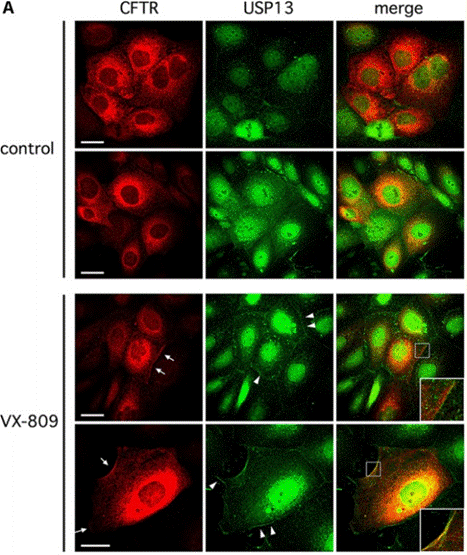
| Immunofluorescence | CFTR / USP13 Cell surface kAE1 / kAE1 |
|
30618756 |
Informations sur lessai clinique
(données du https://clinicaltrials.gov, mis à jour le 2024-05-22)
| Numéro NCT | Recrutement | Conditions | Promoteur/Collaborateurs | Date de début | Phases |
|---|---|---|---|---|---|
| NCT03512119 | Completed | Cystic Fibrosis Homozygous for Phe 508 Del CFTR|Glucose Intolerance or Newly Diagnosis Diabetes |
University Hospital Strasbourg France |
February 11 2016 | -- |
| NCT02589236 | Completed | Cystic Fibrosis |
Nivalis Therapeutics Inc.|Medidata Solutions |
November 2015 | Phase 2 |
| NCT02514473 | Completed | Cystic Fibrosis |
Vertex Pharmaceuticals Incorporated |
July 2015 | Phase 3 |
| NCT01899105 | Completed | Cystic Fibrosis |
Vertex Pharmaceuticals Incorporated |
July 2013 | Phase 1 |
Support technique
Tel: +1-832-582-8158 Ext:3
Si vous avez dautres questions, veuillez laisser un message.

Les produits sont destinés à la recherche uniquement. Ne pas utiliser chez lhomme. Nous ne vendons pas aux patients.
©Copyright 2013 Selleck Chemicals. Tous droits réservés.