
pour la recherche uniquement
Idebenone ROS Chimique
Réf. Catalogue: S2605
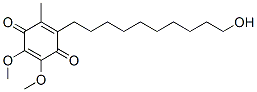
Structure chimique
Poids moléculaire: 338.44
Contrôle Qualité (Quality Control)
Informations chimiques, stockage et stabilité (Chemical Information, Storage & Stability)
| Poids moléculaire | 338.44 | Formule | C19H30O5 |
Stockage (À compter de la date de réception) | |
|---|---|---|---|---|---|
| N° CAS | 58186-27-9 | Télécharger le SDF | Stockage des solutions mères |
|
|
| Synonymes | CV-2619 | Smiles | CC1=C(C(=O)C(=C(C1=O)OC)OC)CCCCCCCCCCO | ||
Solubilité (Solubility)
|
In vitro |
DMSO
: 68 mg/mL
(200.92 mM)
Ethanol : 68 mg/mL Water : Insoluble |
Calculateur de molarité
|
In vivo |
|||||
Calculateur de formulation in vivo (Solution claire)
Étape 1 : Saisir les informations ci-dessous (Recommandé : Un animal supplémentaire pour tenir compte des pertes pendant l'expérience)
Étape 2 : Saisir la formulation in vivo (Ceci est seulement le calculateur, pas la formulation. Veuillez nous contacter d'abord s'il n'y a pas de formulation in vivo dans la section Solubilité.)
Résultats du calcul :
Concentration de travail : mg/ml;
Méthode de préparation du liquide maître DMSO : mg médicament prédissous dans μL DMSO ( Concentration du liquide maître mg/mL, Veuillez nous contacter d'abord si la concentration dépasse la solubilité du DMSO du lot de médicament. )
Méthode de préparation de la formulation in vivo : Prendre μL DMSO liquide maître, puis ajouterμL PEG300, mélanger et clarifier, puis ajouterμL Tween 80, mélanger et clarifier, puis ajouter μL ddH2O, mélanger et clarifier.
Méthode de préparation de la formulation in vivo : Prendre μL DMSO liquide maître, puis ajouter μL Huile de maïs, mélanger et clarifier.
Note : 1. Veuillez vous assurer que le liquide est clair avant d'ajouter le solvant suivant.
2. Assurez-vous d'ajouter le(s) solvant(s) dans l'ordre. Vous devez vous assurer que la solution obtenue, lors de l'ajout précédent, est une solution claire avant de procéder à l'ajout du solvant suivant. Des méthodes physiques telles que le vortex, les ultrasons ou le bain-marie chaud peuvent être utilisées pour faciliter la dissolution.
Mécanisme d'action (Mechanism of Action)
| In vitro |
Idebenone effectively protects from retinal cell injury after oxidative stress or hypoglycemia, whereas the protection afforded after postincubation of both antioxidants is decreased. This compound attenuates delayed retinal cell damage, mediated by chemical ischemia. This chemical, a centrally active antioxidant used to treat multiinfarct dementia, protects cells from this form of glutamate-induced cytotoxicity in vitro. It provides significant protection against the neuronal degeneration induced by intrastriatal injection of kainic acid and quisqualic acid, but not the NMDA receptor agonist, quinolinic acid.
|
|---|---|
| In vivo |
Idebenone prevents the behavioural deficits in Y-maze and water maze, but not passive avoidance, tasks in A beta-(1-42)-infused rats when they are repeatedly administered by mouth once a day from 3 days before the start of A beta infusion to the end of behavioural experiments. This compound (100 and 300 mg/kg) is orally administered to rats for 3 days, it increases the state 3 respiration stimulated by ADP, slightly decreasez the state 4 respiration after the consumption of ADP and resultz in a significant increase of the respiratory control index (RCI) by 14-19% for glutamate oxidation and 10-17% for succinate oxidation, respectively. It significantly suppresses by about 10% the non-respiratory oxygen consumption, which closely associated with non-enzymatic reactions such as lipid peroxidation, membrane lysis and swelling of mitochondria.
|
Références |
|
Informations sur l'essai clinique (Clinical Trial Information)
(données du https://clinicaltrials.gov, mis à jour le 2025-11-25)
| Numéro NCT | Recrutement | Conditions | Promoteur/Collaborateurs | Date de début | Phases |
|---|---|---|---|---|---|
| NCT04534023 | ACTIVE_NOT_RECRUITING | Rapid Eye Movement Sleep Behavior Disorder; Synucleinopathy |
Ruijin Hospital |
2020-08-31 | PHASE2 |
| NCT05987397 | UNKNOWN | Post Stroke Epilepsy |
Xiangya Hospital of Central South University |
2023-07-05 | PHASE4 |
| NCT04151472 | RECRUITING | Migraine Disorders; Headache Disorders |
Second Affiliated Hospital, Zhejiang University, School of Medicine |
2021-12-08 | PHASE3 |
| NCT04071639 | UNKNOWN | Huntington Disease |
Second Affiliated Hospital, Zhejiang University, School of Medicine |
2020-03-12 | PHASE1 |
| NCT05411978 | UNKNOWN | Migraine |
Beijing Tiantan Hospital |
2022-05-09 | PHASE4 |
| NCT04669158 | COMPLETED | Non Alcoholic Steatohepatitis; Fibrosis |
Stanford University |
2021-07-30 | PHASE1; PHASE2 |

Les produits sont destinés à la recherche uniquement. Ne pas utiliser chez l'homme. Nous ne vendons pas aux patients.
©Copyright 2013 Selleck Chemicals. Tous droits réservés.