
pour la recherche uniquement
Dofetilide Potassium Channel Inhibiteur
Réf. Catalogue: S1658
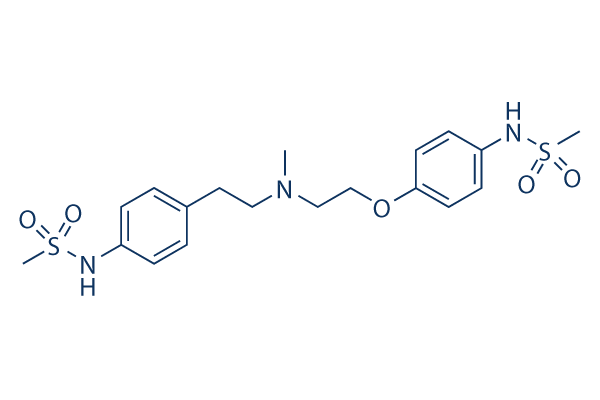
Structure chimique
Poids moléculaire: 441.56
Contrôle Qualité (Quality Control)
| Cibles apparentées | CFTR CRM1 CD markers AChR Calcium Channel Sodium Channel GABA Receptor TRP Channel ATPase GluR |
|---|---|
| Autre Potassium Channel Inhibiteurs | Nigericin TRAM-34 ML133 HCl Nicorandil Hydralazine HCl Sophocarpine Gliquidone Senicapoc (ICA-17043) Butamben E-4031 dihydrochloride |
Informations chimiques, stockage et stabilité (Chemical Information, Storage & Stability)
| Poids moléculaire | 441.56 | Formule | C19H27N3O5S2 |
Stockage (À compter de la date de réception) | |
|---|---|---|---|---|---|
| N° CAS | 115256-11-6 | Télécharger le SDF | Stockage des solutions mères |
|
|
| Synonymes | UK-68798 | Smiles | CN(CCC1=CC=C(C=C1)NS(=O)(=O)C)CCOC2=CC=C(C=C2)NS(=O)(=O)C | ||
Solubilité (Solubility)
|
In vitro |
DMSO
: 88 mg/mL
(199.29 mM)
Water : Insoluble Ethanol : Insoluble |
Calculateur de molarité
|
In vivo |
|||||
Calculateur de formulation in vivo (Solution claire)
Étape 1 : Saisir les informations ci-dessous (Recommandé : Un animal supplémentaire pour tenir compte des pertes pendant l'expérience)
Étape 2 : Saisir la formulation in vivo (Ceci est seulement le calculateur, pas la formulation. Veuillez nous contacter d'abord s'il n'y a pas de formulation in vivo dans la section Solubilité.)
Résultats du calcul :
Concentration de travail : mg/ml;
Méthode de préparation du liquide maître DMSO : mg médicament prédissous dans μL DMSO ( Concentration du liquide maître mg/mL, Veuillez nous contacter d'abord si la concentration dépasse la solubilité du DMSO du lot de médicament. )
Méthode de préparation de la formulation in vivo : Prendre μL DMSO liquide maître, puis ajouterμL PEG300, mélanger et clarifier, puis ajouterμL Tween 80, mélanger et clarifier, puis ajouter μL ddH2O, mélanger et clarifier.
Méthode de préparation de la formulation in vivo : Prendre μL DMSO liquide maître, puis ajouter μL Huile de maïs, mélanger et clarifier.
Note : 1. Veuillez vous assurer que le liquide est clair avant d'ajouter le solvant suivant.
2. Assurez-vous d'ajouter le(s) solvant(s) dans l'ordre. Vous devez vous assurer que la solution obtenue, lors de l'ajout précédent, est une solution claire avant de procéder à l'ajout du solvant suivant. Des méthodes physiques telles que le vortex, les ultrasons ou le bain-marie chaud peuvent être utilisées pour faciliter la dissolution.
Mécanisme d'action (Mechanism of Action)
| Targets/IC50/Ki |
Potassium channel
|
|---|---|
| In vitro |
Dofetilide blocks HERG currents in excised macro patches of Xenopus oocytes. This compound (1 μM) reduces the amplitude of IKr to 61% of control currents in guinea pig cardiomyocytes, as measured by 200-ms test pulses and analysis of the deactivating tail currents of IKr. It increases apico-basal disparity of repolarization, due to a more marked increase of ERPs in the apex than in the base in the intact canine heart.
|
| In vivo |
Dofetilide (100 mg/kg, i.v.) does not suppress automaticity arrhythmias induced by two-stage coronary ligation and epinephrine or the coronary ligation and reperfusion arrhythmias, but suppresses the reentry arrhythmia induced by PES in dogs with old myocardial infarction (MI). This compound also shows antiarrhythmic effect in some dogs with digitalis arrhythmia. It increases QT interval and shows negative chronotropic effect like that of other class III drugs, but is different in antiarrhythmic profiles from those of other class III agents such as D-sotalol, E-4031, and MS-551 in that it does not prevent the occurrence of ventricular fibrillation (VF) immediately after coronary reperfusion and has some antiarrhythmic effects on digitalis arrhythmia. This chemical causes increased resorptions and the same stage-dependent malformations in Sprague-Dawley rats.
|
Références |
|
Informations sur l'essai clinique (Clinical Trial Information)
(données du https://clinicaltrials.gov, mis à jour le 2026-08-28)
| Numéro NCT | Recrutement | Conditions | Promoteur/Collaborateurs | Date de début | Phases |
|---|---|---|---|---|---|
| NCT06096337 | ACTIVE_NOT_RECRUITING | Persistent Atrial Fibrillation |
Boston Scientific Corporation |
2023-12-28 | |
| NCT05906732 | TERMINATED | Long QT Syndrome |
Thryv Therapeutics, Inc. |
2023-03-12 | PHASE1; PHASE2 |
| NCT05906732 | Recruiting | Long QT Syndrome |
Thryv Therapeutics Inc. |
2023-03-12 | Phase 1|Phase 2 |
| NCT03070470 | COMPLETED | Drug-induced QT Prolongation; Pharmacokinetics; Pharmacodynamics |
Food and Drug Administration (FDA) |
2017-03-14 | PHASE1 |
| NCT02365532 | COMPLETED | Long QT Syndrome |
Gilead Sciences |
2015-02 | PHASE1 |
| NCT02308748 | COMPLETED | Drug-induced QT Prolongation; Pharmacokinetics; Pharmacodynamics |
Food and Drug Administration (FDA) |
2014-05 | PHASE1 |

Les produits sont destinés à la recherche uniquement. Ne pas utiliser chez l'homme. Nous ne vendons pas aux patients.
©Copyright 2013 Selleck Chemicals. Tous droits réservés.