
pour la recherche uniquement
Ritonavir HIV Protease inhibiteur
Réf. CatalogueS1185
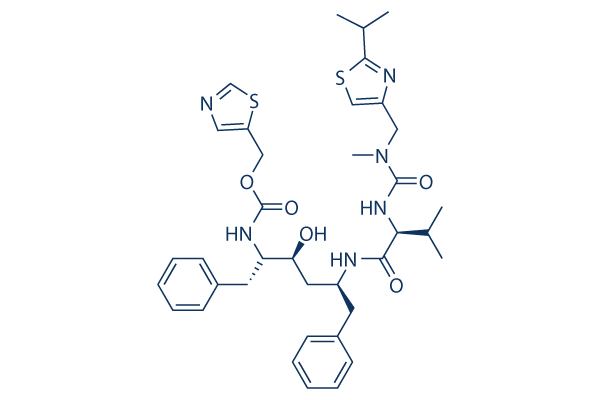
Structure chimique
Poids moléculaire: 720.94
Contrôle Qualité
| Cibles apparentées | HDAC Caspase Proteasome Secretase MMP HCV Protease Cysteine Protease DPP Tyrosinase Serine Protease |
|---|---|
| Autre HIV Protease Inhibiteurs | Pepstatin A Limonin Temsavir (BMS-626529) NBD-556 Bevirimat GS-6207 Rosamultin Dextran sulfate sodium (DSS) Mericitabine Azvudine |
Informations chimiques, stockage et stabilité
| Poids moléculaire | 720.94 | Formule | C37H48N6O5S2 |
Stockage (À compter de la date de réception) | |
|---|---|---|---|---|---|
| N° CAS | 155213-67-5 | Télécharger le SDF | Stockage des solutions mères |
|
|
| Synonymes | ABT-538,A 84538, RTV | Smiles | CC(C)C(NC(=O)N(C)CC1=CSC(=N1)C(C)C)C(=O)NC(CC(O)C(CC2=CC=CC=C2)NC(=O)OCC3=CN=CS3)CC4=CC=CC=C4 | ||
Solubilité
|
In vitro |
DMSO
: 100 mg/mL
(138.7 mM)
Ethanol : 100 mg/mL Water : Insoluble |
Calculateur de molarité
|
In vivo |
|||||
Calculateur de formulation in vivo (Solution claire)
Étape 1 : Saisir les informations ci-dessous (Recommandé : Un animal supplémentaire pour tenir compte des pertes pendant lexpérience)
Étape 2 : Saisir la formulation in vivo (Ceci est seulement le calculateur, pas la formulation. Veuillez nous contacter dabord sil ny a pas de formulation in vivo dans la section Solubilité.)
Résultats du calcul :
Concentration de travail : mg/ml;
Méthode de préparation du liquide maître DMSO : mg médicament prédissous dans μL DMSO ( Concentration du liquide maître mg/mL, Veuillez nous contacter dabord si la concentration dépasse la solubilité du DMSO du lot de médicament. )
Méthode de préparation de la formulation in vivo : Prendre μL DMSO liquide maître, puis ajouterμL PEG300, mélanger et clarifier, puis ajouterμL Tween 80, mélanger et clarifier, puis ajouter μL ddH2O, mélanger et clarifier.
Méthode de préparation de la formulation in vivo : Prendre μL DMSO liquide maître, puis ajouter μL Huile de maïs, mélanger et clarifier.
Note : 1. Veuillez vous assurer que le liquide est clair avant dajouter le solvant suivant.
2. Assurez-vous dajouter le(s) solvant(s) dans lordre. Vous devez vous assurer que la solution obtenue, lors de lajout précédent, est une solution claire avant de procéder à lajout du solvant suivant. Des méthodes physiques telles que le vortex, les ultrasons ou le bain-marie chaud peuvent être utilisées pour faciliter la dissolution.
Mécanisme daction
| Targets/IC50/Ki |
CYP3A4
HIV
|
|---|---|
| In vitro |
Ritonavir est un inhibiteur très puissant de la 6β-hydroxylation de la testostérone médiée par le CYP3A4 avec un Ki moyen de 19 nM et inhibe également l'hydroxylation du tolbutamide avec une IC50 de 4,2 μM. Ce composé est un puissant inhibiteur des biotransformations médiées par le CYP3A (oxydation de la nifédipine avec une IC50 de 0,07 mM, 2-hydroxylation du 17alpha-éthinylestradiol avec une IC50 de 2 mM; hydroxylation de la terfénadine avec une IC50 de 0,14 mM). Il est également un inhibiteur des réactions médiées par le CYP2D6 (IC50 = 2,5 mM) et le CYP2C9/10 (IC50 = 8,0 mM). Cet agent entraîne une augmentation de la viabilité cellulaire dans les cultures de PBMC humaines non infectées. Il diminue nettement la susceptibilité des PBMC à l'apoptose corrélée à des niveaux inférieurs d'expression de la caspase-1, à des diminutions de la coloration à l'annexine V et réduit l'activité de la caspase-3 dans les cultures de PBMC humaines non infectées. Le composé inhibe l'induction de la production de facteur de nécrose tumorale (TNF) par les PBMC et les monocytes de manière dépendante du temps et de la dose à des concentrations non toxiques. Il inhibe l'extrusion de saquinavir médiée par la p-glycoprotéine avec une IC50 de 0,2 μM, indiquant une affinité élevée du ritonavir pour la p-glycoprotéine. Ce produit chimique inhibe puissamment le métabolisme microsomial hépatique humain de l'ABT-378 avec un Ki de 13 nM. Lorsqu'il est combiné à l'ABT-378 (à des rapports de 3:1 et 29:1), il inhibe le CYP3A (IC50 = 1,1 et 4,6 μM), bien que moins puissamment que Ritonavir (IC50 = 0,14 μM). |
Références |
|
Informations sur lessai clinique
(données du https://clinicaltrials.gov, mis à jour le 2024-05-22)
| Numéro NCT | Recrutement | Conditions | Promoteur/Collaborateurs | Date de début | Phases |
|---|---|---|---|---|---|
| NCT06397144 | Not yet recruiting | Biological Availability|Healthy Participants |
Pfizer |
February 14 2025 | Phase 1 |
| NCT06139796 | Not yet recruiting | HIV Infections |
PENTA Foundation|AMS-PHPT Research Collaboration|Institut National de la Santé Et de la Recherche Médicale France|Centre Mère et Enfant de la Fondation Chantal Biya|Centre Hospitalier National d''Enfants Albert Royer|University of Zimbabwe Clinical Research Centre (UZCRC)|Baylor College of Medicine |
June 2024 | Phase 1|Phase 2 |
| NCT05953545 | Not yet recruiting | Chronic Hepatitis Delta |
National Institute of Diabetes and Digestive and Kidney Diseases (NIDDK)|National Institutes of Health Clinical Center (CC) |
May 15 2024 | Phase 2 |
| NCT06291831 | Active not recruiting | COVID-19 |
Pfizer |
March 13 2024 | -- |
| NCT06085924 | Recruiting | COVID-19 |
Pfizer |
November 14 2023 | -- |
| NCT06016556 | Completed | Covid-19 |
Pfizer |
October 17 2023 | -- |
Support technique
Tel: +1-832-582-8158 Ext:3
Si vous avez dautres questions, veuillez laisser un message.

Les produits sont destinés à la recherche uniquement. Ne pas utiliser chez lhomme. Nous ne vendons pas aux patients.
©Copyright 2013 Selleck Chemicals. Tous droits réservés.