
pour la recherche uniquement
A-803467 Sodium Channel inhibiteur
Réf. CatalogueS2785
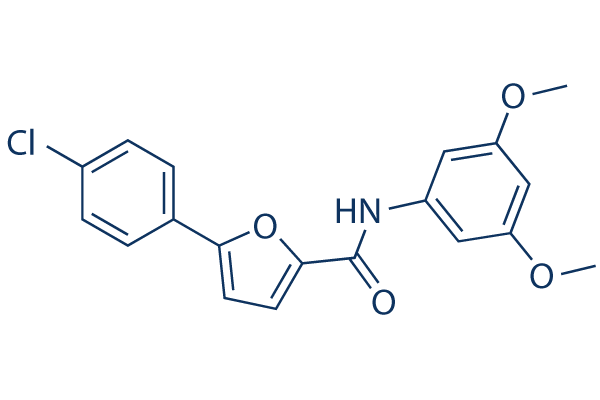
Structure chimique
Poids moléculaire: 357.79
Contrôle Qualité
- Cité dans Nature Medicine pour sa qualité supérieure
- COA
- NMR
- SDS
- Fiche technique
| Cibles apparentées | CFTR CRM1 CD markers AChR Calcium Channel Potassium Channel GABA Receptor TRP Channel ATPase GluR |
|---|---|
| Autre Sodium Channel Inhibiteurs | Camostat Mesilate cariporide Tolperisone HCl Vinpocetine Veratramine Bulleyaconi cine A Ambroxol HCl Benzocaine Nefopam HCl Benzocaine hydrochloride |
Informations chimiques, stockage et stabilité
| Poids moléculaire | 357.79 | Formule | C19H16ClNO4 |
Stockage (À compter de la date de réception) | |
|---|---|---|---|---|---|
| N° CAS | 944261-79-4 | Télécharger le SDF | Stockage des solutions mères |
|
|
| Synonymes | N/A | Smiles | COC1=CC(=CC(=C1)NC(=O)C2=CC=C(O2)C3=CC=C(C=C3)Cl)OC | ||
Solubilité
|
In vitro |
DMSO
: 72 mg/mL
(201.23 mM)
Ethanol : 11 mg/mL Water : Insoluble |
Calculateur de molarité
|
In vivo |
|||||
Calculateur de formulation in vivo (Solution claire)
Étape 1 : Saisir les informations ci-dessous (Recommandé : Un animal supplémentaire pour tenir compte des pertes pendant lexpérience)
Étape 2 : Saisir la formulation in vivo (Ceci est seulement le calculateur, pas la formulation. Veuillez nous contacter dabord sil ny a pas de formulation in vivo dans la section Solubilité.)
Résultats du calcul :
Concentration de travail : mg/ml;
Méthode de préparation du liquide maître DMSO : mg médicament prédissous dans μL DMSO ( Concentration du liquide maître mg/mL, Veuillez nous contacter dabord si la concentration dépasse la solubilité du DMSO du lot de médicament. )
Méthode de préparation de la formulation in vivo : Prendre μL DMSO liquide maître, puis ajouterμL PEG300, mélanger et clarifier, puis ajouterμL Tween 80, mélanger et clarifier, puis ajouter μL ddH2O, mélanger et clarifier.
Méthode de préparation de la formulation in vivo : Prendre μL DMSO liquide maître, puis ajouter μL Huile de maïs, mélanger et clarifier.
Note : 1. Veuillez vous assurer que le liquide est clair avant dajouter le solvant suivant.
2. Assurez-vous dajouter le(s) solvant(s) dans lordre. Vous devez vous assurer que la solution obtenue, lors de lajout précédent, est une solution claire avant de procéder à lajout du solvant suivant. Des méthodes physiques telles que le vortex, les ultrasons ou le bain-marie chaud peuvent être utilisées pour faciliter la dissolution.
Mécanisme daction
| Caractéristiques |
The 1st small-molecule blocker of sodium channels showing both high potency and significant subtype-selectivity among the sodium channel family.
|
|---|---|
| Targets/IC50/Ki |
Na(V1.8) channel
8 nM
|
| In vitro |
A-803467 bloque potentiellement les NaV1.8 channels recombinants humains ou de rat avec une IC50 de 8 nM et 45 nM, respectivement, à un potentiel de maintien de -40 mV. À l'état de repos, ce composé bloque également potentiellement les NaV1.8 channels humains avec une IC50 de 79 nM. Il bloque les courants résistants à la tétrodotoxine (TTX-R) dans les neurones du ganglion de la racine dorsale de rat de manière concentration-dépendante avec une IC50 de 140 nM, plus puissamment que la mexilétine et la lamotrigine avec une IC50 >30 μM. Ce produit chimique présente une sélectivité 300 à 1 000 fois supérieure pour hNaV1.8 par rapport aux NaV1.2, hNaV1.3, hNaV1.5 et hNaV1.7 channels humains avec une IC50 de 7,38 μM, 2,45 μM, 7,34 μM et 6,74 μM, respectivement. Il ne montre aucune activité significative contre d'autres canaux et récepteurs exprimés dans les neurones sensoriels périphériques, y compris les canaux TRPV1, P2X2/3, CaV2.2 et KCNQ2/3 avec une IC50 >10 μM. Ce composé ne montre également aucune ou une faible activité contre un large panel de dépistage de récepteurs de surface cellulaire, de canaux ioniques et d'enzymes avec une IC50 >2 μM. À 0,3 μM, mais pas à 0,1 μM, il inhibe significativement la génération de potentiels d'action spontanés et évoqués électriquement.
|
| In vivo |
Conformément à ses effets sur l'électrogenèse du potentiel d'action neuronal in vitro, l'administration systémique de A-8033467 (20 mg/kg, i.v.) à des rats avec ligature du nerf spinal réduit significativement le tir spontané et évoqué par le poil de von Frey des neurones à large gamme dynamique de la corne dorsale spinale de 66 % et 53 %, respectivement, par rapport aux niveaux de base. L'administration de ce composé réduit également de manière dose-dépendante l'allodynie mécanique dans une variété de modèles de douleur chez le rat, y compris la ligature du nerf spinal (ED50 = 47 mg/kg, i.p.), la lésion du nerf sciatique (ED50 = 85 mg/kg, i.p.), l'allodynie mécanique secondaire induite par la capsaïcine (ED50 ≈ 100 mg/kg, i.p.) et l'hyperalgésie thermique après injection intraplantaire d'adjuvant complet de Freund (ED50 = 41 mg/kg, i.p.). Ce produit chimique est inactif contre la nociception induite par le formol et la douleur thermique aiguë et postopératoire, ainsi que dans un modèle de douleur induite par la chimiothérapie (vincristine).
|
Références |
|
Applications
| Méthodes | Biomarqueurs | Images | PMID |
|---|---|---|---|
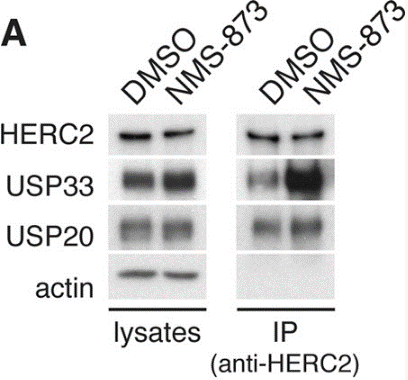
| Western blot | HERC2 / USP33 / USP20 |
|
24855649 |
Support technique
Tel: +1-832-582-8158 Ext:3
Si vous avez dautres questions, veuillez laisser un message.

Les produits sont destinés à la recherche uniquement. Ne pas utiliser chez lhomme. Nous ne vendons pas aux patients.
©Copyright 2013 Selleck Chemicals. Tous droits réservés.