
pour la recherche uniquement
Xevinapant (AT406) IAP Antagoniste
Réf. Catalogue: S2754
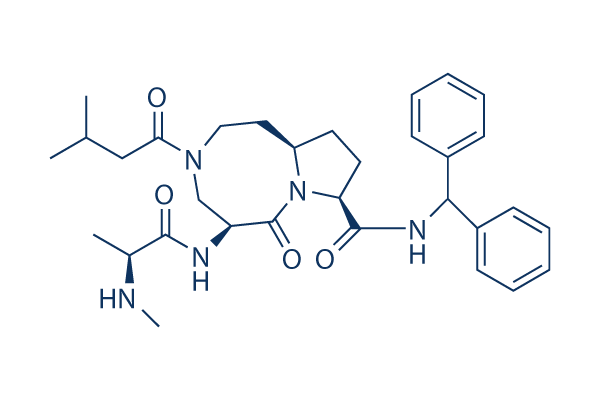
Structure chimique
Poids moléculaire: 561.71
Contrôle Qualité (Quality Control)
| Cibles apparentées | Bcl-2 Caspase PD-1/PD-L1 Ferroptosis p53 Apoptosis related Synthetic Lethality STAT TNF-alpha Ras |
|---|---|
| Autre IAP Inhibiteurs | BV6 SM-164 Birinapant (TL32711) LCL161 GDC-0152 AZD5582 Tolinapant (ASTX660) |
Culture cellulaire, traitement et concentration de travail
(Cell Culture, Treatment & Working Concentration)
| Lignées cellulaires | Type d'essai | Concentration | Temps d'incubation | Formulation | Description de l'activité | PMID |
|---|---|---|---|---|---|---|
| EVSA-T | Cytotoxicity assay | 72 hrs | Cytotoxicity against human sensitive EVSA-T cells assessed as inhibition of cell growth after 72 hrs by Alamar Blue assay, EC50 = 0.0021 μM. | 26218264 | ||
| MDA-MB-231 | Cytotoxicity assay | 72 hrs | Cytotoxicity against human sensitive MDA-MB-231 cells assessed as inhibition of cell growth after 72 hrs by Alamar Blue assay, EC50 = 0.019 μM. | 26218264 | ||
| HEK293 | Function assay | 2 hrs | Antagonist activity at full-length FLAG-tagged XIAP (unknown origin) transfected in HEK293 cells assessed as inhibition of interaction with caspase 9 after 2 hrs by immunoprecipitation assay, EC50 = 0.034 μM. | 26218264 | ||
| SKOV3 | Growth inhibition assay | 4 days | Growth inhibition of human SKOV3 cells after 4 days by WST8 assay, IC50 = 0.142 μM. | 21443232 | ||
| MDA-MB-231 | Growth inhibition assay | 4 days | Growth inhibition of human MDA-MB-231 cells after 4 days by WST8 assay, IC50 = 0.144 μM. | 21443232 | ||
| MDA-MB-231 | Function assay | 10 nM | Induction of degradation of cIAP1 in human MDA-MB-231 cells at 10 nM by Western blot analysis | 21443232 | ||
| MDA-MB-231 | Function assay | 100 nM | 15 mins | Induction of degradation of cIAP1 in human MDA-MB-231 cells at 100 nM after 15 mins by Western blot analysis | 21443232 | |
| MDA-MB-231 | Apoptosis assay | 1.5 uM | 12 hrs | Induction of apoptosis in human MDA-MB-231 cells assessed as activation of caspase-3 activity at 1.5 uM after 12 hrs by Western blot analysis | 21443232 | |
| MDA-MB-231 | Apoptosis assay | 1.5 uM | 12 hrs | Induction of apoptosis in human MDA-MB-231 cells assessed as activation of PARP cleavage at 1.5 uM after 12 hrs by Western blot analysis | 21443232 | |
| MDA-MB-231 | Antitumor assay | 30 mg/kg | 2 weeks | Antitumor activity against human MDA-MB-231 cells xenografted in SCID mouse assessed inhibition of tumor growth at 30 mg/kg, po administered daily for 5 days/week for 2 weeks | 21443232 | |
| MDA-MB-231 | Antitumor assay | 100 mg/kg | 2 weeks | Antitumor activity against human MDA-MB-231 cells xenografted in SCID mouse assessed inhibition of tumor growth at 100 mg/kg, po administered daily for 5 days/week for 2 weeks | 21443232 | |
| MDA-MB-231 | Antitumor assay | 100 mg/kg | every 3 days | Antitumor activity against human MDA-MB-231 cells xenografted in Balb/c SCID mouse assessed as tumor growth inhibition at 100 mg/kg, po qd measured every 3 days | 26218264 | |
| DAOY | qHTS assay | qHTS of pediatric cancer cell lines to identify multiple opportunities for drug repurposing: Primary screen for DAOY cells | 29435139 | |||
| SJ-GBM2 | qHTS assay | qHTS of pediatric cancer cell lines to identify multiple opportunities for drug repurposing: Primary screen for SJ-GBM2 cells | 29435139 | |||
| A673 | qHTS assay | qHTS of pediatric cancer cell lines to identify multiple opportunities for drug repurposing: Primary screen for A673 cells | 29435139 | |||
| SK-N-MC | qHTS assay | qHTS of pediatric cancer cell lines to identify multiple opportunities for drug repurposing: Primary screen for SK-N-MC cells | 29435139 | |||
| BT-37 | qHTS assay | qHTS of pediatric cancer cell lines to identify multiple opportunities for drug repurposing: Primary screen for BT-37 cells | 29435139 | |||
| NB-EBc1 | qHTS assay | qHTS of pediatric cancer cell lines to identify multiple opportunities for drug repurposing: Primary screen for NB-EBc1 cells | 29435139 | |||
| Saos-2 | qHTS assay | qHTS of pediatric cancer cell lines to identify multiple opportunities for drug repurposing: Primary screen for Saos-2 cells | 29435139 | |||
| LAN-5 | qHTS assay | qHTS of pediatric cancer cell lines to identify multiple opportunities for drug repurposing: Primary screen for LAN-5 cells | 29435139 | |||
| BT-12 | qHTS assay | qHTS of pediatric cancer cell lines to identify multiple opportunities for drug repurposing: Primary screen for BT-12 cells | 29435139 | |||
| OHS-50 | qHTS assay | qHTS of pediatric cancer cell lines to identify multiple opportunities for drug repurposing: Primary screen for OHS-50 cells | 29435139 | |||
| SK-N-MC | qHTS assay | qHTS of pediatric cancer cell lines to identify multiple opportunities for drug repurposing: Confirmatory screen for SK-N-MC cells | 29435139 | |||
| TC32 | qHTS assay | qHTS of pediatric cancer cell lines to identify multiple opportunities for drug repurposing: Confirmatory screen for TC32 cells | 29435139 | |||
| Cliquez pour voir plus de données expérimentales sur la lignée cellulaire | ||||||
Informations chimiques, stockage et stabilité (Chemical Information, Storage & Stability)
| Poids moléculaire | 561.71 | Formule | C32H43N5O4 |
Stockage (À compter de la date de réception) | |
|---|---|---|---|---|---|
| N° CAS | 1071992-99-8 | Télécharger le SDF | Stockage des solutions mères |
|
|
| Synonymes | ARRY-334543, Debio1143, SM-406 | Smiles | CC(C)CC(=O)N1CCC2CCC(N2C(=O)C(C1)NC(=O)C(C)NC)C(=O)NC(C3=CC=CC=C3)C4=CC=CC=C4 | ||
Solubilité (Solubility)
|
In vitro |
DMSO
: 112 mg/mL
(199.39 mM)
Ethanol : 112 mg/mL Water : Insoluble |
Calculateur de molarité
|
In vivo |
|||||
Calculateur de formulation in vivo (Solution claire)
Étape 1 : Saisir les informations ci-dessous (Recommandé : Un animal supplémentaire pour tenir compte des pertes pendant l'expérience)
Étape 2 : Saisir la formulation in vivo (Ceci est seulement le calculateur, pas la formulation. Veuillez nous contacter d'abord s'il n'y a pas de formulation in vivo dans la section Solubilité.)
Résultats du calcul :
Concentration de travail : mg/ml;
Méthode de préparation du liquide maître DMSO : mg médicament prédissous dans μL DMSO ( Concentration du liquide maître mg/mL, Veuillez nous contacter d'abord si la concentration dépasse la solubilité du DMSO du lot de médicament. )
Méthode de préparation de la formulation in vivo : Prendre μL DMSO liquide maître, puis ajouterμL PEG300, mélanger et clarifier, puis ajouterμL Tween 80, mélanger et clarifier, puis ajouter μL ddH2O, mélanger et clarifier.
Méthode de préparation de la formulation in vivo : Prendre μL DMSO liquide maître, puis ajouter μL Huile de maïs, mélanger et clarifier.
Note : 1. Veuillez vous assurer que le liquide est clair avant d'ajouter le solvant suivant.
2. Assurez-vous d'ajouter le(s) solvant(s) dans l'ordre. Vous devez vous assurer que la solution obtenue, lors de l'ajout précédent, est une solution claire avant de procéder à l'ajout du solvant suivant. Des méthodes physiques telles que le vortex, les ultrasons ou le bain-marie chaud peuvent être utilisées pour faciliter la dissolution.
Mécanisme d'action (Mechanism of Action)
| Targets/IC50/Ki |
cIAP1-BIR3
(cell-free assay) 1.9 nM(Ki)
cIAP2-BIR3
(cell-free assay) 5.1 nM(Ki)
XIAP-BIR3
(cell-free assay) 66.4 nM(Ki)
|
|---|---|
| In vitro |
AT-406 is a Smac mimetic and appears to mimic closely the AVPI peptide in both hydrogen bonding and hydrophobic interactions with XIAP, with additional hydrophobic contacts with W323 of XIAP. AT-406 is more sensitive to these IAPs than Smac AVPI peptide with 50-100 fold binding affinities. AT-406 (at 1 μM) completely restores the activity of caspase-9, which is suppressed by 500 nM XIAP BIR3 in a cell-free system. In MDA-MB-231 cell, AT-406 induces rapid cellular cIAP1 degradation and also pulls down the cellular XIAP protein. AT-406 effectively inhibits lots of human cancer cell lines and shows IC50 of 144 and 142 nM in MDA-MB-231 cell and SK-OV-3 ovarian cell, with low toxicity against normal-like human breast epithelial MCF-12F cells and primary human normal prostate epithelial cells. AT-406 induces apoptosis in MDA-MB-231 cell by inducing activation of caspase-3 and cleavage of PARP.
|
| Essai kinase |
Essais basés sur la polarisation de fluorescence pour les protéines XIAP, cIAP1 et cIAP2 BIR3
|
|
FL-AT-406 (l'AT-406 marqué fluorescent) est utilisé pour développer un ensemble de nouveaux essais FP pour la détermination des affinités de liaison des mimétiques de Smac aux protéines XIAP, cIAP-1 et cIAP-2 BIR3. La valeur Kd de FL-AT-406 pour chaque protéine IAP est déterminée par des expériences de titration utilisant une concentration fixe de FL-AT-406 et différentes concentrations de la protéine jusqu'à saturation complète. Les valeurs de polarisation de fluorescence sont mesurées à l'aide d'un lecteur de plaques Infinite M-1000 dans des plaques Microfluor 2 à 96 puits, noires, à fond rond. Dans chaque puits, FL-AT-406 (2, 1 et 1 nM pour les expériences avec XIAP BIR3, cIAP-1 BIR3 et cIAP-2 BIR3, respectivement) et différentes concentrations de la protéine sont ajoutés à un volume final de 125 μL dans le tampon d'essai (100 mM phosphate de potassium, pH 7,5, 100 μg/mL γ-globuline bovine, 0,02 % d'azide de sodium, avec 4 % de DMSO). Les plaques sont mélangées et incubées à température ambiante pendant 2-3 heures avec une légère agitation. Les valeurs de polarisation en unités de millipolarisation (mP) sont mesurées à une longueur d'onde d'excitation de 485 nm et une longueur d'onde d'émission de 530 nm. Les constantes de dissociation à l'équilibre (Kd) sont ensuite calculées en ajustant les augmentations sigmoïdes de FP dépendantes de la dose en fonction des concentrations de protéines à l'aide du logiciel Graphpad Prism 5.0. Dans les expériences de liaison compétitive pour XIAP3 BIR3, l'AT-406 est incubé avec 20 nM de protéine XIAP BIR3 et 2 nM de FL-AT-406 dans le tampon d'essai (100 mM phosphate de potassium, pH 7,5 ; 100 μg/mL de γ-globuline bovine ; 0,02 % d'azide de sodium). Dans les expériences de liaison compétitive pour la protéine cIAP1 BIR3, 3 nM de protéine et 1 nM de FL-AT-406 sont utilisés. Dans les expériences de liaison compétitive pour cIAP2 BIR3, 5 nM de protéine et 1 nM de FL-AT-406 sont utilisés. Pour chaque expérience de liaison compétitive, les valeurs de polarisation sont mesurées après 2-3 heures d'incubation à l'aide d'un lecteur de plaques Infinite M-1000. La valeur IC50, la concentration d'inhibiteur à laquelle 50 % du traceur lié est déplacé, est déterminée à partir du graphique en utilisant une analyse par les moindres carrés non linéaires. L'ajustement de la courbe est effectué à l'aide du logiciel PRISM. Une valeur Ki pour AT-406 est calculée.
|
|
| In vivo |
AT-406 has good pharmacokinetic (PK) properties and oral bioavailability in mice, rats, non-human primates, and dogs. In the MDA-MB-231 xenograft, AT-406 effectively induces cIAP1 degradation and processing of procaspase-8, cleavage of PARP in tumor tissues at 100 mg/kg with well toleration even at 200 mg/kg. AT-406 induces significant tumor growth inhibition with p of 0.0012 at 100 mg/kg.
|
Références |
Applications (Applications)
| Méthodes | Biomarqueurs | Images | PMID |
|---|---|---|---|
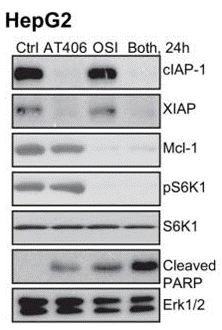
| Western blot | cIAP-1 / XIAP / Mcl-1 / pS6K1 / Cleaved PARP |
|
28036295 |
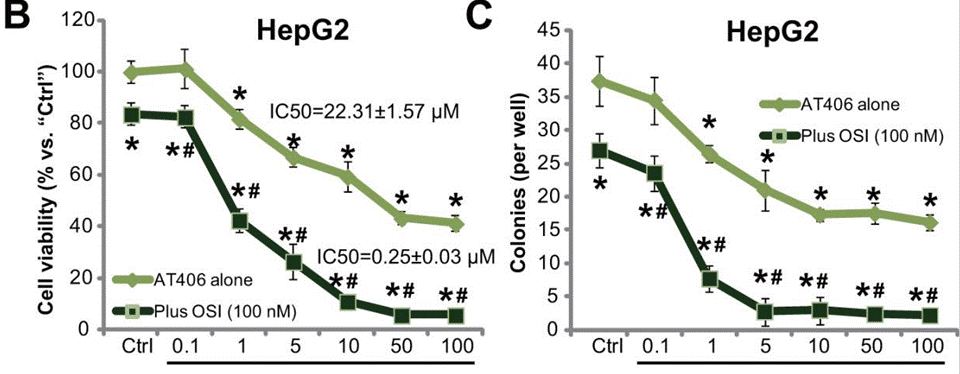
| Growth inhibition assay | Cell viability |
|
28036295 |
Informations sur l'essai clinique (Clinical Trial Information)
(données du https://clinicaltrials.gov, mis à jour le 2024-07-25)
| Numéro NCT | Recrutement | Conditions | Promoteur/Collaborateurs | Date de début | Phases |
|---|---|---|---|---|---|
| NCT06084845 | WITHDRAWN | Head and Neck Squamous Cell Carcinoma; Hypopharyngeal Squamous Cell Carcinoma; Laryngeal Squamous Cell Carcinoma; Oral Cavity Squamous Cell Carcinoma; Oropharyngeal Squamous Cell Carcinoma; Stage III Cutaneous Squamous Cell Carcinoma of the Head and Neck AJCC v8; Stage III Hypopharyngeal Carcinoma AJCC v8; Stage III Laryngeal Cancer AJCC v8; Stage III Lip and Oral Cavity Cancer AJCC v8; Stage III Oropharyngeal (p16-Negative) Carcinoma AJCC v8; Stage IV Cutaneous Squamous Cell Carcinoma of the Head and Neck AJCC v8; Stage IV Hypopharyngeal Carcinoma AJCC v8; Stage IV Laryngeal Cancer AJCC v8; Stage IV Lip and Oral Cavity Cancer AJCC v8; Stage IV Oropharyngeal (p16-Negative) Carcinoma AJCC v8 |
ECOG-ACRIN Cancer Research Group |
2024-04-12 | PHASE2 |
| NCT06463184 | WITHDRAWN | Recurrent High-grade Glioma |
H. Lee Moffitt Cancer Center and Research Institute |
2024-07-22 | PHASE1 |
| NCT06145412 | COMPLETED | Head and Neck Cancer |
Memorial Sloan Kettering Cancer Center |
2023-11-16 | PHASE2 |
| NCT06110195 | TERMINATED | Head and Neck Cancer; Head and Neck Neoplasms; Squamous Cell Carcinoma of Head and Neck |
University of Chicago |
2024-01-24 | PHASE1 |
| NCT05724602 | TERMINATED | Locally Advanced Head and Neck Squamous Cell Carcinoma |
European Organisation for Research and Treatment of Cancer - EORTC |
2023-11-15 | PHASE2 |
| NCT05930938 | TERMINATED | Squamous Cell Carcinoma of the Head and Neck |
Groupe Oncologie Radiotherapie Tete et Cou |
2023-12-12 | PHASE3 |

Les produits sont destinés à la recherche uniquement. Ne pas utiliser chez l'homme. Nous ne vendons pas aux patients.
©Copyright 2013 Selleck Chemicals. Tous droits réservés.