
pour la recherche uniquement
Emtricitabine (FTC) inhibiteur de NRT
Réf. CatalogueS1704
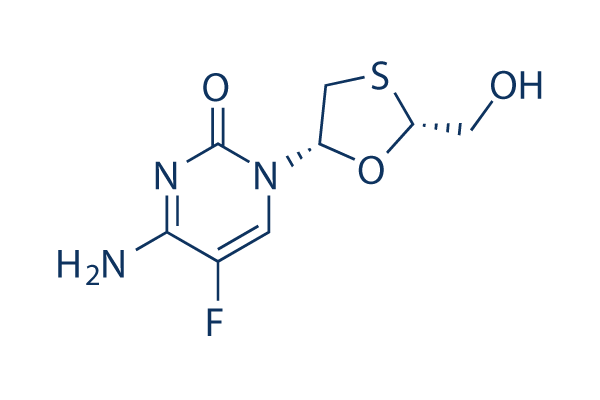
Structure chimique
Poids moléculaire: 247.25
Contrôle Qualité
| Cibles apparentées | Integrase Bacterial Antibiotics Anti-infection Fungal Antiviral COVID-19 Parasite HIV HCV Protease |
|---|---|
| Autre Reverse Transcriptase Inhibiteurs | Dapivirine (TMC120) Fangchinoline Salicylanilide 3'-Fluoro-3'-deoxythymidine (Alovudine) Ulonivirine Lersivirine (UK-453061) Bifendate 4-Chloro-2-(trifluoroacetyl)aniline hydrochloride |
Culture cellulaire, traitement et concentration de travail
| Lignées cellulaires | Type dessai | Concentration | Temps dincubation | Formulation | Description de lactivité | PMID |
|---|---|---|---|---|---|---|
| HepAD38 cell | Function assay | Inhibition of hepatitis B virus replication in the HepAD38 cell line, ED50=0.03 μM | ||||
| MT2 cells | Function assay | Antiviral activity against HIV1 infected in human MT2 cells assessed as inhibition of viral replication, IC50=0.044 μM | ||||
| HeLa P4/R5 cells | Function assay | Antiviral activity against HIV1 infected in human HeLa P4/R5 cells assessed as inhibition of viral replication, IC50=0.17 μM | ||||
| HepG2 cells | Cytotoxicity assay | 9 days | Cytotoxicity against human HepG2 cells after 9 days by MTT assay, IC50=27.7 μM | |||
| MDCK2 cells | Function assay | 10 μM | Inhibition of human MRP3 expressed in MDCK2 cells assessed as increase in intracellular CMF fluorescence at 10 uM by CMFDA assay | |||
| Cliquez pour voir plus de données expérimentales sur la lignée cellulaire | ||||||
Informations chimiques, stockage et stabilité
| Poids moléculaire | 247.25 | Formule | C8H10FN3O3S |
Stockage (À compter de la date de réception) | |
|---|---|---|---|---|---|
| N° CAS | 143491-57-0 | Télécharger le SDF | Stockage des solutions mères |
|
|
| Synonymes | BW 1592 | Smiles | C1C(OC(S1)CO)N2C=C(C(=NC2=O)N)F | ||
Solubilité
|
In vitro |
DMSO
: 49 mg/mL
(198.17 mM)
Water : 49 mg/mL Ethanol : 13 mg/mL |
Calculateur de molarité
|
In vivo |
|||||
Calculateur de formulation in vivo (Solution claire)
Étape 1 : Saisir les informations ci-dessous (Recommandé : Un animal supplémentaire pour tenir compte des pertes pendant lexpérience)
Étape 2 : Saisir la formulation in vivo (Ceci est seulement le calculateur, pas la formulation. Veuillez nous contacter dabord sil ny a pas de formulation in vivo dans la section Solubilité.)
Résultats du calcul :
Concentration de travail : mg/ml;
Méthode de préparation du liquide maître DMSO : mg médicament prédissous dans μL DMSO ( Concentration du liquide maître mg/mL, Veuillez nous contacter dabord si la concentration dépasse la solubilité du DMSO du lot de médicament. )
Méthode de préparation de la formulation in vivo : Prendre μL DMSO liquide maître, puis ajouterμL PEG300, mélanger et clarifier, puis ajouterμL Tween 80, mélanger et clarifier, puis ajouter μL ddH2O, mélanger et clarifier.
Méthode de préparation de la formulation in vivo : Prendre μL DMSO liquide maître, puis ajouter μL Huile de maïs, mélanger et clarifier.
Note : 1. Veuillez vous assurer que le liquide est clair avant dajouter le solvant suivant.
2. Assurez-vous dajouter le(s) solvant(s) dans lordre. Vous devez vous assurer que la solution obtenue, lors de lajout précédent, est une solution claire avant de procéder à lajout du solvant suivant. Des méthodes physiques telles que le vortex, les ultrasons ou le bain-marie chaud peuvent être utilisées pour faciliter la dissolution.
Mécanisme daction
| Targets/IC50/Ki |
Reverse transcriptase
|
|---|---|
| In vitro |
L'Emtricitabine (FTC) réduit modérément la prolifération des hépatocytes indépendamment des effets sur l'ADNmt dans les cellules d'hépatome humain HepG2, et, lorsqu'elle est combinée au ténofovir, elle réduit légèrement la prolifération cellulaire sans affecter les paramètres mitochondriaux. Elle se convertit efficacement en ses métabolites actifs dans les PBMC et les cellules CEM, et présente une activité additive à synergique contre la réplication du HIV dans les PBMC lorsqu'elle est combinée au ténofovir, ce qui entraîne une activité anti-HIV fortement synergique dans les cellules MT-2 contre les virus de type sauvage et mutants. Ce composé démontre une activité antivirale contre les souches adaptées en laboratoire de HIV-1 et HIV-2 dans divers systèmes cellulaires, et présente également une activité antivirale en culture cellulaire contre les virus de l'immunodéficience féline et simienne (SIVs). Il montre constamment une activité jusqu'à 10 fois supérieure à celle de la lamivudine contre tous les virus testés dans toutes les lignées de cellules T, et démontre généralement une plus grande puissance in vitro dans les PBMC humains que dans les lignées MT-4. De plus, il présente une activité anti-HBV in vitro (EC50, 0,01–0,04 µM) comparable à l'activité anti-HBV du 3TC. Il est environ quatre fois plus actif que le 3TC dans les essais sur la lignée de cellules T transformées MT-4 infectées par le HIV-(1IIIB), tandis que la zidovudine est plus active que ce composé. L'Emtricitabine, la lamivudine et la zidovudine sont également actives contre un panel de huit isolats primaires de HIV-1 provenant de sujets naïfs aux antirétroviraux dans les PBMC.
|
Références |
|
Informations sur lessai clinique
(données du https://clinicaltrials.gov, mis à jour le 2024-05-22)
| Numéro NCT | Recrutement | Conditions | Promoteur/Collaborateurs | Date de début | Phases |
|---|---|---|---|---|---|
| NCT06005610 | Recruiting | HIV I Infection |
National Institute of Allergy and Infectious Diseases (NIAID) |
January 4 2024 | Phase 2 |
| NCT05924438 | Recruiting | HIV-1-infection |
Professor Francois Venter|Africa Health Research Institute|Merck Sharp & Dohme LLC|University of Witwatersrand South Africa |
November 8 2023 | Phase 3 |
Support technique
Tel: +1-832-582-8158 Ext:3
Si vous avez dautres questions, veuillez laisser un message.

Les produits sont destinés à la recherche uniquement. Ne pas utiliser chez lhomme. Nous ne vendons pas aux patients.
©Copyright 2013 Selleck Chemicals. Tous droits réservés.