
pour la recherche uniquement
Honokiol Antineoplastic and Immunosuppressive Antibiotics inhibiteur
Réf. CatalogueS2310
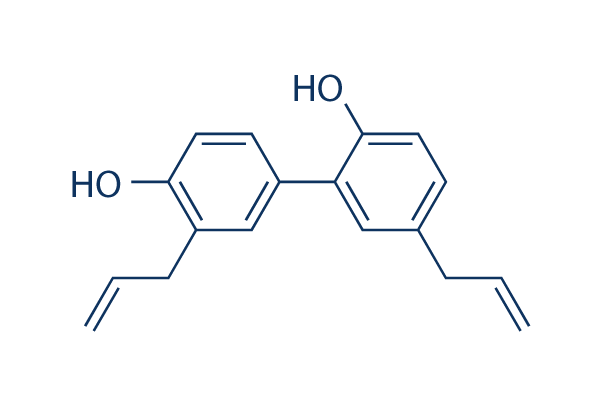
Structure chimique
Poids moléculaire: 266.334
Contrôle Qualité
| Cibles apparentées | PI3K Akt mTOR GSK-3 ATM/ATR DNA-PK AMPK PDPK1 PTEN PP2A |
|---|---|
| Autre Antineoplastic and Immunosuppressive Antibiotics Inhibiteurs | Staurosporine (STS) Cyclosporin A Oligomycin A (MCH 32) Puromycin Dihydrochloride Nigericin sodium salt Geldanamycin (NSC 122750) Streptozotocin (STZ) Sodium Monensin (NSC 343257) Cephalomannine Pirarubicin |
Culture cellulaire, traitement et concentration de travail
| Lignées cellulaires | Type dessai | Concentration | Temps dincubation | Formulation | Description de lactivité | PMID |
|---|---|---|---|---|---|---|
| human UACC-903 cells | Cytotoxicity assay | Cytotoxicity against human UACC-903 cells after 72 hrs by MTS assay, IC50=5.1 μM | ||||
| Vero E6 cells | Function assay | Antiviral activity against SARS coronavirus in Vero E6 cells assessed as inhibition of viral replication by ELISA, EC50=6.5 μM | ||||
| human UACC-903 cells | Cytotoxicity assay | Cytotoxicity against human UACC-903 cells after 24 hrs by MTS assay, IC50=7.45 μM | ||||
| human A549 cells | Cytotoxicity assay | Cytotoxicity against human A549 cells after 72 hrs by MTS assay, IC50=7.75 μM | ||||
| human CEM cells | Cytotoxicity assay | Cytotoxicity against human CEM cells, IC50=10.9 μM | ||||
| HEK293 cells | Function assay | Agonist activity at RXRalpha in HEK293 cells assessed as transcriptional activation after 48 hrs by luciferase reporter gene assay, EC50=11.8 μM | ||||
| human A549 cell | Cytotoxicity assay | 24 h | Cytotoxicity against human A549 cells after 24 hrs by MTS assay, IC50=12.51 μM | |||
| human HT-29 cells | Cytotoxicity assay | 72 h | Cytotoxicity against human HT-29 cells after 72 hrs by MTS assay, IC50=13.24 μM | |||
| human PBM cells | Cytotoxicity assay | Cytotoxicity against human PBM cells, IC50=16.1 μM | ||||
| Hep-G2 cells | Cytotoxicity assay | Cytotoxicity of compound against human liver tumor cell line (Hep-G2) was determined, IC50=16.5 μM | ||||
| human HepG2 cells | Proliferation assay | 24 h | Antiproliferative activity against human HepG2 cells after 24 hrs by MTT assay, IC50=16.5 μM | |||
| human K562 cells | Proliferation assay | Antiproliferative activity against human K562 cells by MTT assay, IC50=21.1 μM | ||||
| Vero cells | Cytotoxicity assay | Cytotoxicity against Vero cells, IC50=22.5 μM | ||||
| human A2780 cells | Proliferation assay | Antiproliferative activity against cisplatin-sensitive human A2780 cells by MTT assay, IC50=30.5 μM | ||||
| human SPC-A1 cells | Proliferation assay | Antiproliferative activity against human SPC-A1 cells by MTT assay, IC50=36.1 μM | ||||
| HUVEC cells | Function assay | 20 μM | 24 h | Antimigratory activity against human HUVEC cells at 20 uM after 24 hrs by wound-healing assay | ||
| HEK293 cells | Function assay | 24-48 h | Agonist activity at human RXR-alpha expressed in HEK293 cells coexpressing with pCMX-beta-gal after 24 to 48 hrs by luciferase reporter gene assay | |||
| human SH-SY5Y cells | Function assay | 10 μM | 30 mins | Neuroprotective activity in human SH-SY5Y cells assessed as inhibition of CHP and TBHP-induced cell death at 10 uM incubated for 30 mins prior to challenge measured after 3 hrs by MTT assay | ||
| Cliquez pour voir plus de données expérimentales sur la lignée cellulaire | ||||||
Informations chimiques, stockage et stabilité
| Poids moléculaire | 266.334 | Formule | C18H18O2 |
Stockage (À compter de la date de réception) | |
|---|---|---|---|---|---|
| N° CAS | 35354-74-6 | Télécharger le SDF | Stockage des solutions mères |
|
|
| Synonymes | NSC 293100 | Smiles | C=CCC1=CC(=C(C=C1)O)C2=CC(=C(C=C2)O)CC=C | ||
Solubilité
|
In vitro |
DMSO
: 53 mg/mL
(198.99 mM)
Water : Insoluble Ethanol : Insoluble |
Calculateur de molarité
|
In vivo |
|||||
Calculateur de formulation in vivo (Solution claire)
Étape 1 : Saisir les informations ci-dessous (Recommandé : Un animal supplémentaire pour tenir compte des pertes pendant lexpérience)
Étape 2 : Saisir la formulation in vivo (Ceci est seulement le calculateur, pas la formulation. Veuillez nous contacter dabord sil ny a pas de formulation in vivo dans la section Solubilité.)
Résultats du calcul :
Concentration de travail : mg/ml;
Méthode de préparation du liquide maître DMSO : mg médicament prédissous dans μL DMSO ( Concentration du liquide maître mg/mL, Veuillez nous contacter dabord si la concentration dépasse la solubilité du DMSO du lot de médicament. )
Méthode de préparation de la formulation in vivo : Prendre μL DMSO liquide maître, puis ajouterμL PEG300, mélanger et clarifier, puis ajouterμL Tween 80, mélanger et clarifier, puis ajouter μL ddH2O, mélanger et clarifier.
Méthode de préparation de la formulation in vivo : Prendre μL DMSO liquide maître, puis ajouter μL Huile de maïs, mélanger et clarifier.
Note : 1. Veuillez vous assurer que le liquide est clair avant dajouter le solvant suivant.
2. Assurez-vous dajouter le(s) solvant(s) dans lordre. Vous devez vous assurer que la solution obtenue, lors de lajout précédent, est une solution claire avant de procéder à lajout du solvant suivant. Des méthodes physiques telles que le vortex, les ultrasons ou le bain-marie chaud peuvent être utilisées pour faciliter la dissolution.
Mécanisme daction
| Targets/IC50/Ki |
Akt-phosphorylation
MEK
|
|---|---|
| In vitro |
L'honokiol présente des effets pro-apoptotiques dans les lignées cellulaires de mélanome, sarcome, myélome, leucémie, vessie, poumon, prostate, carcinome épidermoïde oral et cancer du côlon. Ce composé est efficace pour induire l'apoptose dans les cellules d'angiosarcome SVR. Le traitement des cellules SVR avec cette substance chimique entraîne une diminution de la phosphorylation de la MAP kinase, d'Akt et de c-src. De plus, il potentialise l'apoptose médiatisée par TRAIL, et sa cytotoxicité est partiellement abrogée par des anticorps neutralisants de TRAIL. Ce composé a également une activité anti-angiogénique directe, en ce sens qu'il bloque la phosphorylation et l'activation de rac dues aux interactions VEGF-VEGFR2. Il provoque l'apoptose dans les cellules de LLC par activation de la caspase 8, suivie de l'activation des caspases 9 et 3. Cette substance chimique empêche la survie des cellules de LLC médiatisée par l'interleukine-4, et potentialise la cytotoxicité de CB-1348, FaraA et 2-CdA. Il tue les cellules de myélome provenant de patients en rechute à des doses qui ne tuent pas les PBMC. Les caspases 3, 7, 8 et 9 sont induites par ce traitement, ainsi que le clivage de PARP. Il a été constaté qu'il induit l'apoptose dans les lignées cellulaires de cancer du côlon RKO. Cette substance chimique potentialise l'apoptose, supprime l'ostéoclastogenèse et inhibe l'invasion par la modulation de la voie d'activation du facteur nucléaire-kappaB. Il peut agir comme un puissant agent anti-inflammatoire avec des activités multipotentielles en raison d'un effet inhibiteur sur la voie PI3K/Akt. |
| In vivo |
L'honokiol est très efficace contre l'angiosarcome SVR chez les souris nues. Ce composé inhibe la croissance des cellules RKO dans les xénogreffes murines. Il prévient la croissance des cellules de cancer du sein MDA-MD-231 dans les xénogreffes murines. |
Références |
|
Applications
| Méthodes | Biomarqueurs | Images | PMID |
|---|---|---|---|
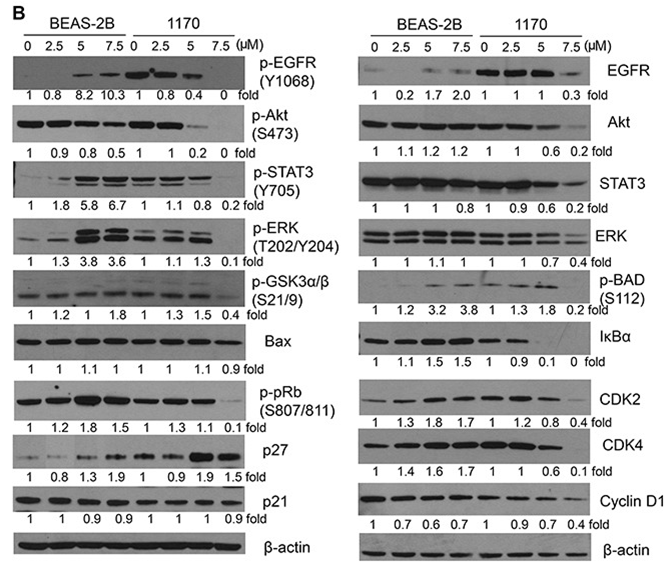
| Western blot | p-EGFR / p-AKT / p-STAT3 / p-ERK / p-GSK3α/β / Bax / p-pRb / p-BAD / IκBα / CDK2 / CDK4 / Cyclin D1 p-Lyn / Lyn / p-PI3K |
|
27458163 |
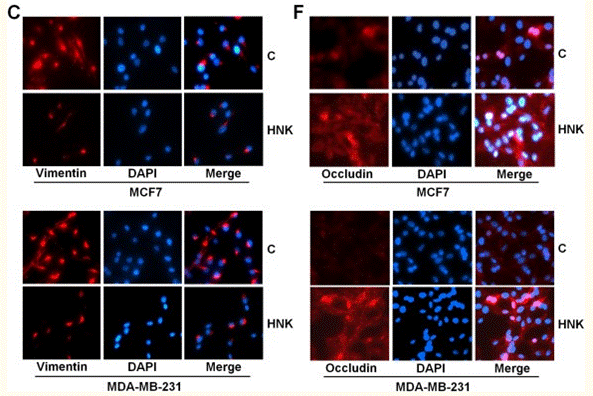
| Immunofluorescence | Vimentin / Occludin IκBα / NF-κB p65 |
|
24508063 |
Support technique
Tel: +1-832-582-8158 Ext:3
Si vous avez dautres questions, veuillez laisser un message.

Les produits sont destinés à la recherche uniquement. Ne pas utiliser chez lhomme. Nous ne vendons pas aux patients.
©Copyright 2013 Selleck Chemicals. Tous droits réservés.