
pour la recherche uniquement
Isradipine Calcium Channel inhibiteur
Réf. CatalogueS1662
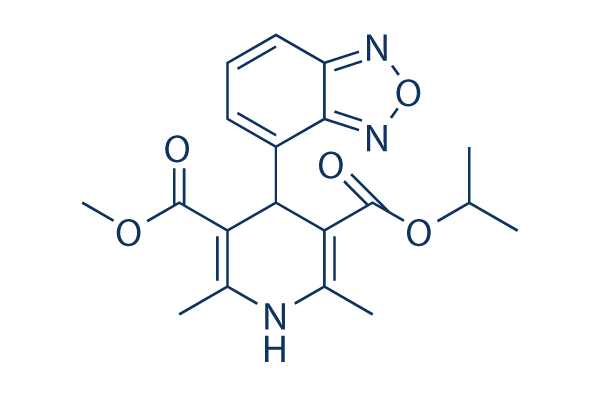
Structure chimique
Poids moléculaire: 371.39
Contrôle Qualité
| Cibles apparentées | CFTR CRM1 CD markers AChR Sodium Channel Potassium Channel GABA Receptor TRP Channel ATPase GluR |
|---|---|
| Autre Calcium Channel Inhibiteurs | Bay K 8644 Tetrandrine Nilvadipine Flunarizine 2HCl Cilnidipine YM-58483 (BTP2) Ionomycin Imperatorin Manidipine 2HCl Astragaloside A |
Informations chimiques, stockage et stabilité
| Poids moléculaire | 371.39 | Formule | C19H21N3O5 |
Stockage (À compter de la date de réception) | |
|---|---|---|---|---|---|
| N° CAS | 75695-93-1 | Télécharger le SDF | Stockage des solutions mères |
|
|
| Synonymes | PN 200-110 | Smiles | CC1=C(C(C(=C(N1)C)C(=O)OC(C)C)C2=CC=CC3=NON=C32)C(=O)OC | ||
Solubilité
|
In vitro |
DMSO
: 74 mg/mL
(199.25 mM)
Ethanol : 74 mg/mL Water : Insoluble |
Calculateur de molarité
|
In vivo |
|||||
Calculateur de formulation in vivo (Solution claire)
Étape 1 : Saisir les informations ci-dessous (Recommandé : Un animal supplémentaire pour tenir compte des pertes pendant lexpérience)
Étape 2 : Saisir la formulation in vivo (Ceci est seulement le calculateur, pas la formulation. Veuillez nous contacter dabord sil ny a pas de formulation in vivo dans la section Solubilité.)
Résultats du calcul :
Concentration de travail : mg/ml;
Méthode de préparation du liquide maître DMSO : mg médicament prédissous dans μL DMSO ( Concentration du liquide maître mg/mL, Veuillez nous contacter dabord si la concentration dépasse la solubilité du DMSO du lot de médicament. )
Méthode de préparation de la formulation in vivo : Prendre μL DMSO liquide maître, puis ajouterμL PEG300, mélanger et clarifier, puis ajouterμL Tween 80, mélanger et clarifier, puis ajouter μL ddH2O, mélanger et clarifier.
Méthode de préparation de la formulation in vivo : Prendre μL DMSO liquide maître, puis ajouter μL Huile de maïs, mélanger et clarifier.
Note : 1. Veuillez vous assurer que le liquide est clair avant dajouter le solvant suivant.
2. Assurez-vous dajouter le(s) solvant(s) dans lordre. Vous devez vous assurer que la solution obtenue, lors de lajout précédent, est une solution claire avant de procéder à lajout du solvant suivant. Des méthodes physiques telles que le vortex, les ultrasons ou le bain-marie chaud peuvent être utilisées pour faciliter la dissolution.
Mécanisme daction
| Targets/IC50/Ki |
Calcium channel
|
|---|---|
| In vitro |
L'isradipine inhibe à la fois la croissance des cultures et la consommation d'oxygène sur les épimastigotes de la souche Trypanosoma cruzi Tulahuen, à des concentrations micromolaires. Ce composé est le dérivé le plus puissant, tant dans les cultures de croissance (I50 = 20,8 mM) que dans la consommation d'oxygène in vivo (I50 = 31,1 mM).
|
| In vivo |
L'isradipine réduit l'activation, induite par l'hypoxie, des xanthine oxydases dépendantes du calcium, des monoamine oxydases, de la phospholipase A(2) cytosolique et des cyclooxygénases (COX-2), ainsi qu'une diminution concomitante de la génération de radicaux libres et de la libération du cytochrome c. Ce composé prévient l'hypoxie hypobare ainsi qu'une neurodégénérescence et une altération de la mémoire augmentées, induisant une expression accrue de la calpaïne et de la caspase 3. Il (à la dose de 1 mg/kg trois fois par jour) réduit la consommation d'éthanol de plus de 70 % chez les rats préférant l'éthanol, la réduction de la consommation d'éthanol est compensée par une augmentation proportionnelle de la consommation d'eau et l'effet inhibiteur a persisté pendant les 5 jours de traitement. Ce produit chimique réduit significativement la teneur en collagène de la paroi artérielle dans les deux souches, avec des augmentations marquées de la teneur en élastine dans la carotide mais pas dans la paroi aortique chez les rats spontanément hypertendus. Il supprime les propriétés de renforcement de la morphine et de la cocaïne et peut être une pharmacothérapie efficace pour le traitement de l'abus de cocaïne et d'héroïne chez la souris.
|
Références |
|
Informations sur lessai clinique
(données du https://clinicaltrials.gov, mis à jour le 2024-05-22)
| Numéro NCT | Recrutement | Conditions | Promoteur/Collaborateurs | Date de début | Phases |
|---|---|---|---|---|---|
| NCT00753636 | Completed | Parkinson''s Disease |
Northwestern University|Northwestern Memorial Hospital |
April 2008 | Phase 2 |
Support technique
Tel: +1-832-582-8158 Ext:3
Si vous avez dautres questions, veuillez laisser un message.

Les produits sont destinés à la recherche uniquement. Ne pas utiliser chez lhomme. Nous ne vendons pas aux patients.
©Copyright 2013 Selleck Chemicals. Tous droits réservés.