
pour la recherche uniquement
KU-60019 Inhibiteur d'ATM
Réf. CatalogueS1570
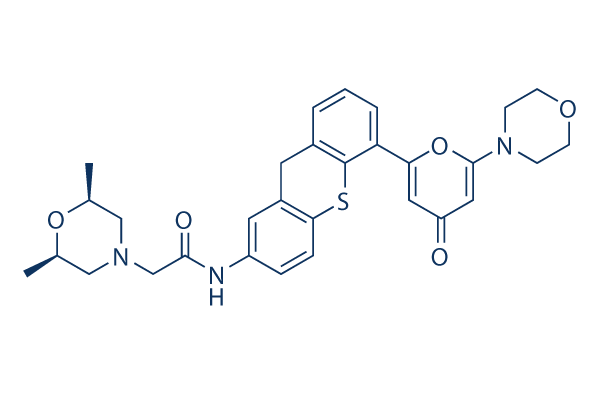
Structure chimique
Poids moléculaire: 547.67
Contrôle Qualité
| Cibles apparentées | HDAC PARP DNA-PK WRN DNA/RNA Synthesis Topoisomerase PPAR Sirtuin Casein Kinase eIF |
|---|---|
| Autre ATM/ATR Inhibiteurs | Ceralasertib (AZD6738) AZD1390 Berzosertib (VE-822) Lartesertib (M4076) Camonsertib (RP-3500) KU-55933 VE-821 AZ20 AZD0156 Mirin |
Culture cellulaire, traitement et concentration de travail
| Lignées cellulaires | Type dessai | Concentration | Temps dincubation | Formulation | Description de lactivité | PMID |
|---|---|---|---|---|---|---|
| BAECs | Function Assay | 10 μM | 1 h | DMSO | abolishes the phosphorylation of ATM-Ser1981 | 25498542 |
| BAECs | Function Assay | 10 μM | 1 h | DMSO | inhibits the increase in NOS activity | 25498542 |
| U1242 | Kinase Assay | 3 μM | 0.5 h | DMSO | inhibits the ATM kinase | 23620409 |
| U87 | Kinase Assay | 3 μM | 0.5 h | DMSO | inhibits the ATM kinase | 23620409 |
| U1242 | Apoptosis Assay | 3 μM | 1 h | DMSO | radiosensitizes human glioma cells | 23620409 |
| U87 | Apoptosis Assay | 3 μM | 1 h | DMSO | radiosensitizes human glioma cells | 23620409 |
| U1242 | Kinase Assay | 0.01-3 μM | 1 h | DMSO | blocks ATM kinase activity at low concentrations | 22370485 |
| glioma | Function assay | Inhibition of ATM kinase in human glioma cells, IC50 = 0.006 μM. | 25387153 | |||
| A673 | qHTS assay | qHTS of pediatric cancer cell lines to identify multiple opportunities for drug repurposing: Primary screen for A673 cells | 29435139 | |||
| Saos-2 | qHTS assay | qHTS of pediatric cancer cell lines to identify multiple opportunities for drug repurposing: Primary screen for Saos-2 cells | 29435139 | |||
| OHS-50 | qHTS assay | qHTS of pediatric cancer cell lines to identify multiple opportunities for drug repurposing: Primary screen for OHS-50 cells | 29435139 | |||
| SJ-GBM2 | qHTS assay | qHTS of pediatric cancer cell lines to identify multiple opportunities for drug repurposing: Primary screen for SJ-GBM2 cells | 29435139 | |||
| SK-N-MC | qHTS assay | qHTS of pediatric cancer cell lines to identify multiple opportunities for drug repurposing: Primary screen for SK-N-MC cells | 29435139 | |||
| NB-EBc1 | qHTS assay | qHTS of pediatric cancer cell lines to identify multiple opportunities for drug repurposing: Primary screen for NB-EBc1 cells | 29435139 | |||
| LAN-5 | qHTS assay | qHTS of pediatric cancer cell lines to identify multiple opportunities for drug repurposing: Primary screen for LAN-5 cells | 29435139 | |||
| Rh18 | qHTS assay | qHTS of pediatric cancer cell lines to identify multiple opportunities for drug repurposing: Primary screen for Rh18 cells | 29435139 | |||
| Cliquez pour voir plus de données expérimentales sur la lignée cellulaire | ||||||
Informations chimiques, stockage et stabilité
| Poids moléculaire | 547.67 | Formule | C30H33N3O5S |
Stockage (À compter de la date de réception) | |
|---|---|---|---|---|---|
| N° CAS | 925701-49-1 | Télécharger le SDF | Stockage des solutions mères |
|
|
| Synonymes | N/A | Smiles | CC1CN(CC(O1)C)CC(=O)NC2=CC3=C(C=C2)SC4=C(C3)C=CC=C4C5=CC(=O)C=C(O5)N6CCOCC6 | ||
Solubilité
|
In vitro |
DMSO
: 100 mg/mL
(182.59 mM)
Water : Insoluble Ethanol : Insoluble |
Calculateur de molarité
|
In vivo |
|||||
Calculateur de formulation in vivo (Solution claire)
Étape 1 : Saisir les informations ci-dessous (Recommandé : Un animal supplémentaire pour tenir compte des pertes pendant lexpérience)
Étape 2 : Saisir la formulation in vivo (Ceci est seulement le calculateur, pas la formulation. Veuillez nous contacter dabord sil ny a pas de formulation in vivo dans la section Solubilité.)
Résultats du calcul :
Concentration de travail : mg/ml;
Méthode de préparation du liquide maître DMSO : mg médicament prédissous dans μL DMSO ( Concentration du liquide maître mg/mL, Veuillez nous contacter dabord si la concentration dépasse la solubilité du DMSO du lot de médicament. )
Méthode de préparation de la formulation in vivo : Prendre μL DMSO liquide maître, puis ajouterμL PEG300, mélanger et clarifier, puis ajouterμL Tween 80, mélanger et clarifier, puis ajouter μL ddH2O, mélanger et clarifier.
Méthode de préparation de la formulation in vivo : Prendre μL DMSO liquide maître, puis ajouter μL Huile de maïs, mélanger et clarifier.
Note : 1. Veuillez vous assurer que le liquide est clair avant dajouter le solvant suivant.
2. Assurez-vous dajouter le(s) solvant(s) dans lordre. Vous devez vous assurer que la solution obtenue, lors de lajout précédent, est une solution claire avant de procéder à lajout du solvant suivant. Des méthodes physiques telles que le vortex, les ultrasons ou le bain-marie chaud peuvent être utilisées pour faciliter la dissolution.
Mécanisme daction
| Caractéristiques |
Improved analog of KU-55933, and is more effective at blocking ATM-mediated DDR events.
|
|---|---|
| Targets/IC50/Ki |
ATM
(Cell-free assay) 6.3 nM
|
| In vitro |
Comparé au KU-55933, le KU-60019 est un inhibiteur amélioré de la kinase ATM, tout en présentant une sélectivité de cible similaire. Ce composé a peu d'activité contre la DNA-PKcs et l'ATR avec des valeurs d'IC50 de 1,7 μM et >10 μM, respectivement, ainsi que 229 autres protéines kinases telles que PI3K, mTOR et mTOR/FKBP12. Il affiche une puissance 3 à 10 fois supérieure à celle du KU-55933 pour bloquer la phosphorylation induite par les radiations des cibles protéiques clés de l'ATM telles que p53, γ-H2AX et CHK2, dans les cellules de gliome humain U87 et U1242, car 1 μM de cet inhibiteur induit significativement une diminution de >70% de la phosphorylation de p53 (S15), ce qui nécessite environ 10 μM de KU-55933. Ce produit chimique radiosensibilise efficacement les cellules de gliome humain avec un rapport d'amélioration de la dose de 1,7 et 4,4 à 1 μM et 10 μM, respectivement, et radiosensibilise également les fibroblastes normaux mais pas les fibroblastes A-T. Son traitement (3 μM) bloque la phosphorylation basale et induite par l'insuline d'AKT S473 de 70% et ~50%, respectivement, et réduit complètement la phosphorylation d'AKT induite par les radiations en dessous du niveau de contrôle. L'effet de cet agent sur la phosphorylation d'AKT S473 peut être observé dans les lignées cellulaires de gliome et les fibroblastes normaux mais pas dans les cellules A-T (h-TERT), et peut être significativement bloqué par l'inhibiteur de phosphatase acide okadaïque, suggérant un rôle critique de la kinase ATM dans la régulation de la phosphorylation d'AKT via une phosphatase inconnue. Conformément à l'inhibition de la signalisation prosurvie d'AKT, il inhibe significativement à 3 μM la migration et l'invasion des cellules de gliome humain U87 de >70% et ~60%, respectivement, ainsi que des cellules U1242 de >50% et ~60% respectivement. |
| In vivo |
Dans les modèles de xénogreffe orthotopique de gliome U1242/luc-GFP, la combinaison de KU-60019 et de radiations augmente significativement la survie des souris par rapport à ce composé seul, aux radiations seules ou à l'absence de traitement. De plus, les gliomes mutants p53 sont beaucoup plus sensibles à cette radiosensibilisation chimique que les gliomes de type sauvage. |
Références |
|
Applications
| Méthodes | Biomarqueurs | Images | PMID |
|---|---|---|---|
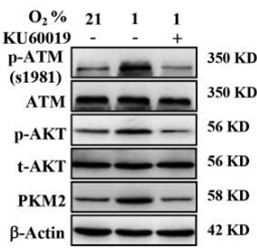
| Western blot | p-ATM / ATM / p-AKT / AKT / PKM2 |
|
30799198 |
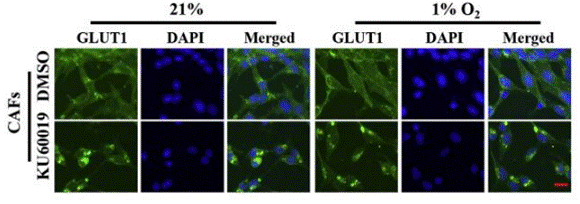
| Immunofluorescence | GLUT1 |
|
30799198 |
Support technique
Tel: +1-832-582-8158 Ext:3
Si vous avez dautres questions, veuillez laisser un message.
Foire aux questions
Question 1:
what vehicle do you recommend for in vivo use of this compound?
Réponse :
The formula for i.p. injections of this compound: 5% stock solution (100mg/ml) +30% PEG 300+ddH2O could reach a final concentration of 5mg/ml.

Les produits sont destinés à la recherche uniquement. Ne pas utiliser chez lhomme. Nous ne vendons pas aux patients.
©Copyright 2013 Selleck Chemicals. Tous droits réservés.