
pour la recherche uniquement
Ralimetinib (LY2228820) dimesylate p38 MAPK inhibiteur
Réf. CatalogueS1494
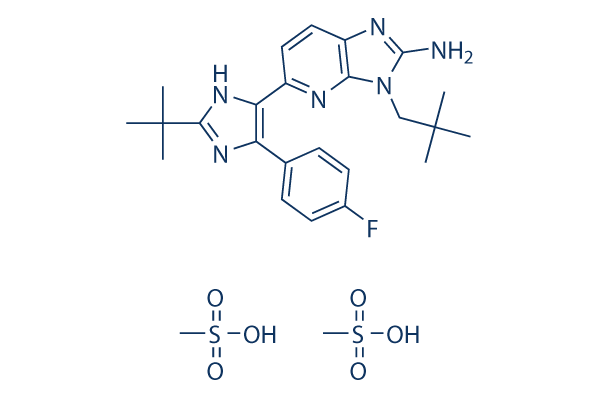
Structure chimique
Poids moléculaire: 612.74
Contrôle Qualité
| Cibles apparentées | ERK Raf JNK MEK Ras KRas S6 Kinase MAP4K TAK1 Mixed Lineage Kinase |
|---|---|
| Autre p38 MAPK Inhibiteurs | SB202190 SB203580 (Adezmapimod) PH-797804 Doramapimod (BIRB 796) VX-702 Losmapimod SB239063 Neflamapimod (VX-745) BMS-582949 Skepinone-L |
Culture cellulaire, traitement et concentration de travail
| Lignées cellulaires | Type dessai | Concentration | Temps dincubation | Formulation | Description de lactivité | PMID |
|---|---|---|---|---|---|---|
| RPMI-8226 | Kinase assay | ~800 nM | DMSO | inhibits phosphorylation of HSP27 | 18397345 | |
| U266 | Kinase assay | ~800 nM | DMSO | inhibits phosphorylation of HSP27 | 18397345 | |
| MM.1S | Kinase assay | ~800 nM | DMSO | inhibits phosphorylation of HSP27 | 18397345 | |
| RPMI-Dox40 | Kinase assay | ~800 nM | DMSO | inhibits phosphorylation of HSP27 | 18397345 | |
| RPMI-LR5 | Kinase assay | ~800 nM | DMSO | inhibits phosphorylation of HSP27 | 18397345 | |
| INA-6 | Kinase assay | ~800 nM | DMSO | inhibits phosphorylation of HSP27 | 18397345 | |
| RPMI-8226 | Cytoxicity assay | ~1000 nM | DMSO | no significant cytotoxicity | 18397345 | |
| U266 | Cytoxicity assay | ~1000 nM | DMSO | no significant cytotoxicity | 18397345 | |
| MM.1S | Cytoxicity assay | ~1000 nM | DMSO | no significant cytotoxicity | 18397345 | |
| RPMI-Dox40 | Cytoxicity assay | ~1000 nM | DMSO | no significant cytotoxicity | 18397345 | |
| RPMI-LR5 | Cytoxicity assay | ~1000 nM | DMSO | no significant cytotoxicity | 18397345 | |
| INA-6 | Cytoxicity assay | ~1000 nM | DMSO | no significant cytotoxicity | 18397345 | |
| CD14+ | Function assay | ~800 nM | DMSO | inhibits osteoclastogenesis from CD14 positive cells | 18397345 | |
| U-87-MG | Function assay | 1 μM | DMSO | reduces tumor-driven cord formation | 23335506 | |
| MDA-MB-231 | Function assay | 1 μM | DMSO | reduces tumor-driven cord formation | 23335506 | |
| A-2780 | Function assay | 1 μM | DMSO | reduces tumor-driven cord formation | 23335506 | |
| SK-OV-3 | Function assay | 1 μM | DMSO | reduces tumor-driven cord formation | 23335506 | |
| LXFA-629 | Function assay | 1 μM | DMSO | reduces tumor-driven cord formation | 23335506 | |
| NCI-H1650 | Function assay | 1 μM | DMSO | reduces tumor-driven cord formation | 23335506 | |
| PC-3 | Function assay | 1 μM | DMSO | reduces tumor-driven cord formation | 23335506 | |
| RAW264.7 | Function assay | ~20 μM | DMSO | inhibits Anisomycin-stimulated MK2 phosphorylation with IC50 of 35.3 nM | 24356814 | |
| mouse peritoneal macrophages | Function assay | ~20 μM | DMSO | LPS/IFN-γ–stimulated TNF-α production with IC50 of 6.3 nM | 24356814 | |
| A549 | Function assay | ~20 μM | DMSO | inhibits LPS-induced CXCL8 production with IC50 of 144.9 nM | 24356814 | |
| MDA-231 | Function assay | ~10 μM | suppresses DKK-1 expression | 26407843 | ||
| MCF-7 | Function assay | ~10 μM | suppresses DKK-1 expression | 26407843 | ||
| MDA-435 | Function assay | ~10 μM | suppresses DKK-1 expression | 26407843 | ||
| PC3 | Function assay | ~10 μM | DMSO | suppresses DKK-1 expression | 26913608 | |
| TC32 | qHTS assay | qHTS of pediatric cancer cell lines to identify multiple opportunities for drug repurposing: Primary screen for TC32 cells | 29435139 | |||
| A673 | qHTS assay | qHTS of pediatric cancer cell lines to identify multiple opportunities for drug repurposing: Primary screen for A673 cells | 29435139 | |||
| DAOY | qHTS assay | qHTS of pediatric cancer cell lines to identify multiple opportunities for drug repurposing: Primary screen for DAOY cells | 29435139 | |||
| BT-37 | qHTS assay | qHTS of pediatric cancer cell lines to identify multiple opportunities for drug repurposing: Primary screen for BT-37 cells | 29435139 | |||
| RD | qHTS assay | qHTS of pediatric cancer cell lines to identify multiple opportunities for drug repurposing: Primary screen for RD cells | 29435139 | |||
| BT-12 | qHTS assay | qHTS of pediatric cancer cell lines to identify multiple opportunities for drug repurposing: Primary screen for BT-12 cells | 29435139 | |||
| NB1643 | qHTS assay | qHTS of pediatric cancer cell lines to identify multiple opportunities for drug repurposing: Primary screen for NB1643 cells | 29435139 | |||
| OHS-50 | qHTS assay | qHTS of pediatric cancer cell lines to identify multiple opportunities for drug repurposing: Primary screen for OHS-50 cells | 29435139 | |||
| Rh41 | qHTS assay | qHTS of pediatric cancer cell lines to identify multiple opportunities for drug repurposing: Primary screen for Rh41 cells | 29435139 | |||
| Rh30 | qHTS assay | qHTS of pediatric cancer cell lines to identify multiple opportunities for drug repurposing: Primary screen for Rh30 cells | 29435139 | |||
| Cliquez pour voir plus de données expérimentales sur la lignée cellulaire | ||||||
Informations chimiques, stockage et stabilité
| Poids moléculaire | 612.74 | Formule | C24H29FN6.2CH4O3S |
Stockage (À compter de la date de réception) | |
|---|---|---|---|---|---|
| N° CAS | 862507-23-1 | Télécharger le SDF | Stockage des solutions mères |
|
|
| Synonymes | N/A | Smiles | CC(C)(C)CN1C2=C(C=CC(=N2)C3=C(N=C(N3)C(C)(C)C)C4=CC=C(C=C4)F)N=C1N.CS(=O)(=O)O.CS(=O)(=O)O | ||
Solubilité
|
In vitro |
Water : 123 mg/mL
DMSO
: 35 mg/mL
(57.12 mM)
Ethanol : 3 mg/mL |
Calculateur de molarité
|
In vivo |
|||||
Calculateur de formulation in vivo (Solution claire)
Étape 1 : Saisir les informations ci-dessous (Recommandé : Un animal supplémentaire pour tenir compte des pertes pendant lexpérience)
Étape 2 : Saisir la formulation in vivo (Ceci est seulement le calculateur, pas la formulation. Veuillez nous contacter dabord sil ny a pas de formulation in vivo dans la section Solubilité.)
Résultats du calcul :
Concentration de travail : mg/ml;
Méthode de préparation du liquide maître DMSO : mg médicament prédissous dans μL DMSO ( Concentration du liquide maître mg/mL, Veuillez nous contacter dabord si la concentration dépasse la solubilité du DMSO du lot de médicament. )
Méthode de préparation de la formulation in vivo : Prendre μL DMSO liquide maître, puis ajouterμL PEG300, mélanger et clarifier, puis ajouterμL Tween 80, mélanger et clarifier, puis ajouter μL ddH2O, mélanger et clarifier.
Méthode de préparation de la formulation in vivo : Prendre μL DMSO liquide maître, puis ajouter μL Huile de maïs, mélanger et clarifier.
Note : 1. Veuillez vous assurer que le liquide est clair avant dajouter le solvant suivant.
2. Assurez-vous dajouter le(s) solvant(s) dans lordre. Vous devez vous assurer que la solution obtenue, lors de lajout précédent, est une solution claire avant de procéder à lajout du solvant suivant. Des méthodes physiques telles que le vortex, les ultrasons ou le bain-marie chaud peuvent être utilisées pour faciliter la dissolution.
Mécanisme daction
| Targets/IC50/Ki |
p38α
(Cell-free assay) 7 nM
|
|---|---|
| In vitro |
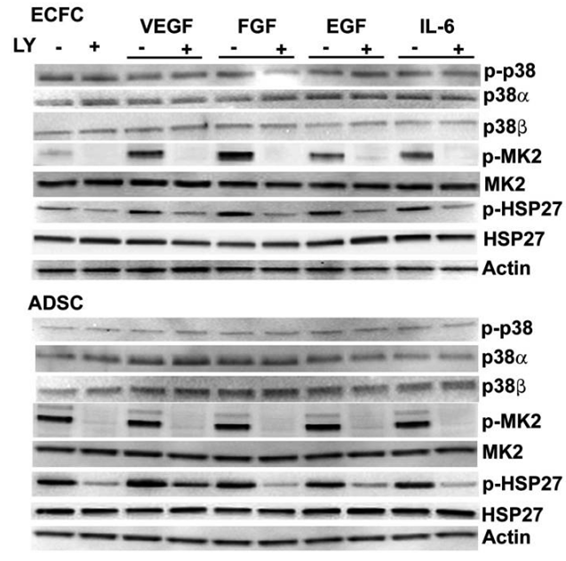
LY2228820 inhibe la p38α, ainsi que le niveau de phosphoMAPKAPK-2 (pMK2) dans les cellules RAW 264.7, avec des valeurs IC50 de 7 nM et 34,3 nM, respectivement. De plus, LY2228820 inhibe la formation de TNFα induite par le lipopolysaccharide (LPS) dans les macrophages péritonéaux murins, avec une IC50 de 5,2 nM. Dans les cellules de myélome multiple (MM), y compris INA6, RPMI-8226, U266 et RPMI-Dox40, LY2228820 (200 nM–800 nM) bloque significativement la signalisation p38MAPK, comme le révèle son inhibition de la phosphorylation de HSP27, une cible en aval de la p38MAPK, sans affecter le niveau d'expression de HSP27. LY2228820 (200 nM–400 nM) améliore la cytotoxicité et l'apoptose, mais LY2228820 seul n'inhibe pas la croissance des cellules MM.1S. LY2228820 (200 nM–800 nM) inhibe également la sécrétion d'IL-6 et de MIP-1α dans les cellules stromales de moelle osseuse (LT-BMSC) à long terme, les cellules mononucléaires de moelle osseuse (BMMNC), les cellules CD138+, CD138− du sang périphérique (PB) ou les cellules CD14+ du PB. LY2228820 (400 nM–800 nM) bloque également l'ostéoclastogenèse à partir des cellules CD14+. |
| Essai kinase |
Inhibition de la p38α
|
|
L'inhibition de la p38α est déterminée à l'aide de p38α humaine recombinante dans un protocole de liaison sur filtre standard utilisant l'ATP[γ-33P] et le peptide de 21 acides aminés de l'EGFR comme substrat. L'inhibition fonctionnelle du TNFα dans les macrophages péritonéaux murins est déterminée en utilisant une stimulation par LPS en présence de LY2228820. Pour évaluer l'activité de la p38α dans les cellules plus directement, les cellules RAW 264.7 sont traitées avec LY2228820 puis stimulées avec l'anisomycine. Le niveau d'activité de la p38α est détecté à l'aide d'un anticorps anti-phosphoMAPKAPK-2 (pMK2) (Thr 334) qui réagit avec un résidu spécifiquement phosphorylé par la p38α.
|
|
| In vivo |
Chez les souris induites par le LPS, LY2228820 inhibe efficacement la formation de TNFα avec une dose minimale efficace seuil (TMED50) inférieure à 1 mg/kg. Dans un modèle de rat atteint d'arthrite induite par le collagène (AIC), LY2228820 présente des effets puissants sur le gonflement des pattes, l'érosion osseuse et la destruction du cartilage, avec une dose minimale efficace seuil (TMED50) de 1,5 mg/kg. |
Références |
|
Applications
| Méthodes | Biomarqueurs | Images | PMID |
|---|---|---|---|
| Western blot | p-p38 / p38α / p38β / p-MK2 / MK2 / p-HSP27 / HSP27 p-S6K |
|
23335506 |
Informations sur lessai clinique
(données du https://clinicaltrials.gov, mis à jour le 2024-05-22)
| Numéro NCT | Recrutement | Conditions | Promoteur/Collaborateurs | Date de début | Phases |
|---|---|---|---|---|---|
| NCT02860780 | Completed | Advanced Cancer|Metastatic Cancer|Colorectal Cancer|Non-small Cell Lung Cancer |
Eli Lilly and Company |
August 10 2016 | Phase 1 |
| NCT02364206 | Completed | Adult Glioblastoma |
Centre Jean Perrin|National Cancer Institute France|ARC Foundation for Cancer Research |
June 8 2015 | Phase 1|Phase 2 |
| NCT02322853 | Terminated | Postmenopausal|Metastatic Breast Cancer |
Centre Francois Baclesse|National Cancer Institute France|ARC Foundation for Cancer Research |
January 2015 | Phase 2 |
| NCT01393990 | Completed | Advanced Cancer |
Eli Lilly and Company |
September 4 2008 | Phase 1 |
Support technique
Tel: +1-832-582-8158 Ext:3
Si vous avez dautres questions, veuillez laisser un message.

Les produits sont destinés à la recherche uniquement. Ne pas utiliser chez lhomme. Nous ne vendons pas aux patients.
©Copyright 2013 Selleck Chemicals. Tous droits réservés.