
pour la recherche uniquement
Crenolanib (CP-868596) Inhibiteur de PDGFR/FLT3
Réf. Catalogue: S2730
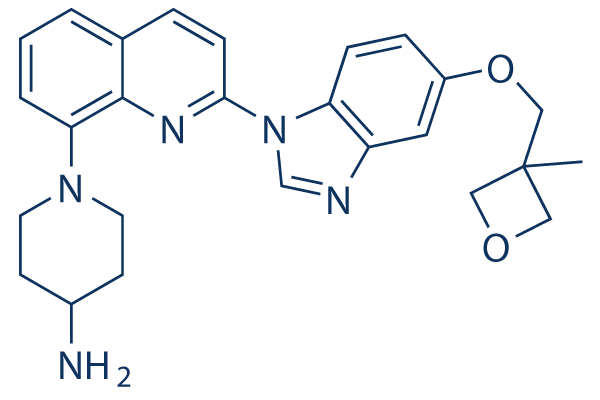
Structure chimique
Poids moléculaire: 443.54
Contrôle Qualité (Quality Control)
| Cibles apparentées | EGFR VEGFR JAK FGFR PDGFR Src HIF HER2 FLT Bcr-Abl |
|---|---|
| Autre FLT3 Inhibiteurs | UNC2025 Dovitinib (TKI-258) Dovitinib (TKI258) Lactate monohydrate Tandutinib (MLN518) ENMD-2076 KW-2449 AST-487 (NVP-AST487) TCS 359 G-749 FF-10101 |
Culture cellulaire, traitement et concentration de travail
(Cell Culture, Treatment & Working Concentration)
| Lignées cellulaires | Type d'essai | Concentration | Temps d'incubation | Formulation | Description de l'activité | PMID |
|---|---|---|---|---|---|---|
| A549 cells | Cell viability assay | 3.9-1000 nM | 72 h | a dose-dependent inhibition of cancer cell viability | 25328409 | |
| MV4-11 | Function assay | a decrease in mitochondrial matrix protein aconitase hydratase 2 (ACO2) | 25328409 | |||
| MV4-11 | Cytotoxicity assay | Cytotoxicity against human MV4-11 cells expressing FLT3 ITD mutant, IC50=0.0015μM | 31207462 | |||
| MOLM13 | Cytotoxicity assay | Cytotoxicity against human MOLM13 cells expressing FLT3 ITD mutant, IC50=0.0049μM | 31207462 | |||
| MV4-11 | Cytotoxicity assay | 72 hrs | Cytotoxicity in human MV4-11 cells assessed as inhibition of cellular viability incubated for 72 hrs by CellTiter-Blue assay, IC50=0.012μM | 30742435 | ||
| DAOY | qHTS assay | qHTS of pediatric cancer cell lines to identify multiple opportunities for drug repurposing: Primary screen for DAOY cells | 29435139 | |||
| SJ-GBM2 | qHTS assay | qHTS of pediatric cancer cell lines to identify multiple opportunities for drug repurposing: Primary screen for SJ-GBM2 cells | 29435139 | |||
| SK-N-MC | qHTS assay | qHTS of pediatric cancer cell lines to identify multiple opportunities for drug repurposing: Primary screen for SK-N-MC cells | 29435139 | |||
| BT-37 | qHTS assay | qHTS of pediatric cancer cell lines to identify multiple opportunities for drug repurposing: Primary screen for BT-37 cells | 29435139 | |||
| NB-EBc1 | qHTS assay | qHTS of pediatric cancer cell lines to identify multiple opportunities for drug repurposing: Primary screen for NB-EBc1 cells | 29435139 | |||
| U-2 OS | qHTS assay | qHTS of pediatric cancer cell lines to identify multiple opportunities for drug repurposing: Primary screen for U-2 OS cells | 29435139 | |||
| Saos-2 | qHTS assay | qHTS of pediatric cancer cell lines to identify multiple opportunities for drug repurposing: Primary screen for Saos-2 cells | 29435139 | |||
| LAN-5 | qHTS assay | qHTS of pediatric cancer cell lines to identify multiple opportunities for drug repurposing: Primary screen for LAN-5 cells | 29435139 | |||
| BT-12 | qHTS assay | qHTS of pediatric cancer cell lines to identify multiple opportunities for drug repurposing: Primary screen for BT-12 cells | 29435139 | |||
| Rh18 | qHTS assay | qHTS of pediatric cancer cell lines to identify multiple opportunities for drug repurposing: Primary screen for Rh18 cells | 29435139 | |||
| OHS-50 | qHTS assay | qHTS of pediatric cancer cell lines to identify multiple opportunities for drug repurposing: Primary screen for OHS-50 cells | 29435139 | |||
| RD | qHTS assay | qHTS of pediatric cancer cell lines to identify multiple opportunities for drug repurposing: Primary screen for RD cells | 29435139 | |||
| A673 | qHTS assay | qHTS of pediatric cancer cell lines to identify multiple opportunities for drug repurposing: Confirmatory screen for A673 cells) | 29435139 | |||
| DAOY | qHTS assay | qHTS of pediatric cancer cell lines to identify multiple opportunities for drug repurposing: Confirmatory screen for DAOY cells | 29435139 | |||
| U-2 OS | qHTS assay | qHTS of pediatric cancer cell lines to identify multiple opportunities for drug repurposing: Confirmatory screen for U-2 OS cells | 29435139 | |||
| Rh41 | qHTS assay | qHTS of pediatric cancer cell lines to identify multiple opportunities for drug repurposing: Confirmatory screen for Rh41 cells | 29435139 | |||
| SK-N-SH | qHTS assay | qHTS of pediatric cancer cell lines to identify multiple opportunities for drug repurposing: Confirmatory screen for SK-N-SH cells | 29435139 | |||
| MV4-11 | Cytotoxicity assay | 0.5 to 5000 nM | 2 to 8 hrs | Cytotoxicity in human MV4-11 cells assessed as inhibition of cellular viability at 0.5 to 5000 nM incubated for 2 to 8 hrs followed by compound washout by CellTiter-Glo luminescent assay | 30742435 | |
| Cliquez pour voir plus de données expérimentales sur la lignée cellulaire | ||||||
Informations chimiques, stockage et stabilité (Chemical Information, Storage & Stability)
| Poids moléculaire | 443.54 | Formule | C26H29N5O2 |
Stockage (À compter de la date de réception) | |
|---|---|---|---|---|---|
| N° CAS | 670220-88-9 | Télécharger le SDF | Stockage des solutions mères |
|
|
| Synonymes | CP-868596, ARO 002 | Smiles | CC1(COC1)COC2=CC3=C(C=C2)N(C=N3)C4=NC5=C(C=CC=C5N6CCC(CC6)N)C=C4 | ||
Solubilité (Solubility)
|
In vitro |
DMSO
: 88 mg/mL
(198.4 mM)
Ethanol : 88 mg/mL Water : Insoluble |
Calculateur de molarité
|
In vivo |
|||||
Calculateur de formulation in vivo (Solution claire)
Étape 1 : Saisir les informations ci-dessous (Recommandé : Un animal supplémentaire pour tenir compte des pertes pendant l'expérience)
Étape 2 : Saisir la formulation in vivo (Ceci est seulement le calculateur, pas la formulation. Veuillez nous contacter d'abord s'il n'y a pas de formulation in vivo dans la section Solubilité.)
Résultats du calcul :
Concentration de travail : mg/ml;
Méthode de préparation du liquide maître DMSO : mg médicament prédissous dans μL DMSO ( Concentration du liquide maître mg/mL, Veuillez nous contacter d'abord si la concentration dépasse la solubilité du DMSO du lot de médicament. )
Méthode de préparation de la formulation in vivo : Prendre μL DMSO liquide maître, puis ajouterμL PEG300, mélanger et clarifier, puis ajouterμL Tween 80, mélanger et clarifier, puis ajouter μL ddH2O, mélanger et clarifier.
Méthode de préparation de la formulation in vivo : Prendre μL DMSO liquide maître, puis ajouter μL Huile de maïs, mélanger et clarifier.
Note : 1. Veuillez vous assurer que le liquide est clair avant d'ajouter le solvant suivant.
2. Assurez-vous d'ajouter le(s) solvant(s) dans l'ordre. Vous devez vous assurer que la solution obtenue, lors de l'ajout précédent, est une solution claire avant de procéder à l'ajout du solvant suivant. Des méthodes physiques telles que le vortex, les ultrasons ou le bain-marie chaud peuvent être utilisées pour faciliter la dissolution.
Mécanisme d'action (Mechanism of Action)
| Targets/IC50/Ki |
FLT3
(CHO cells) 0.74 nM(Kd)
PDGFRα
(CHO cells) 2.1 nM(Kd)
PDGFRβ
(CHO cells) 3.2 nM(Kd)
|
|---|---|
| In vitro |
Crenolanib is significantly more potent in inhibiting the kinase activity of resistant PDGFRα kinases (D842I, D842V, D842Y, D1842-843IM, and deletion I843). This compound is more potent against D842V in the isogenic model system, with an IC50 of approximately 10 nM. It inhibits the kinase activity of the fusion oncogene in EOL-1 cell line, which is derived from a patient with chronic eosinophilic leukemia and expresses the constitutively activated FIP1L1- PDGFRα fusion kinase, with IC50 = 21 nM. This chemical also inhibits the proliferation of EOL-1 cells with IC50 = 0.2 pM. It inhibits the activation of V561D or D842V-mutant kinases expressed in BaF3 cells with IC50 with 85 nM or 272 nM, respectively. This compound inhibits PDGFRα activation in H1703 non-small cell lung cancer cell line which has 24-fold amplification of the 4q12 region that contains the PDGFRα locus, with IC50 with 26 nM. It is an orally bioavailable, highly potent and selective PDGFR TKI. This benzimidazole compound has IC50s of 0.9 nM and 1.8 nM for PDGFRA and PDGFRB, respectively. |
| Essai kinase |
Évaluation biochimique de l'activité kinase de PDGFRα
|
|
Des cellules ovariennes de hamster chinois (CHO) sont transfectées transitoirement avec des constructions PDGFRα mutées ou de type sauvage et traitées avec diverses concentrations de Crenolanib. Les expériences impliquant de l'ADN recombinant sont réalisées dans des conditions de niveau de biosécurité 2 conformément aux directives. Des lysats protéiques de lignées cellulaires sont préparés et soumis à une immunoprécipitation à l'aide d'anticorps anti-PDGFRα suivie d'un immunobuvardage séquentiel pour PDGFRα. La densitométrie est réalisée pour quantifier l'effet du médicament à l'aide du logiciel Photoshop, le niveau de phosphor-PDGFRα étant normalisé par rapport à la protéine totale. Les résultats des expériences de densitométrie et de prolifération sont analysés à l'aide du logiciel Calcusyn 2.1 pour déterminer mathématiquement les valeurs d'IC50. Le test de somme des rangs de Wilcoxon est utilisé pour comparer les valeurs d'IC50 de ce composé pour une mutation donnée.
|
|
| In vivo |
This compound, a PDGFR inhibitor, suppresses lung cancer cell proliferation and inhibits tumor growth in vivo |
Références |
|
Applications (Applications)
| Méthodes | Biomarqueurs | Images | PMID |
|---|---|---|---|
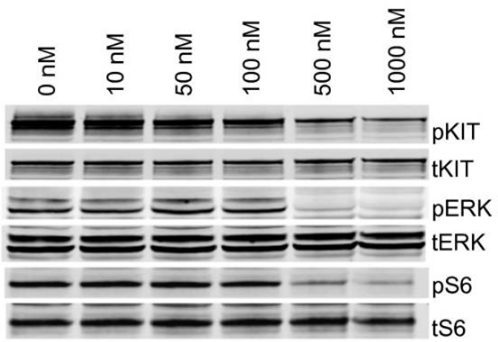
| Western blot | pKIT / KIT pFLT3 / FLT3 / pERK / ERK / pS6 / S6 pAKT / AKT / pMAPK / MAPK / pSTAT5 / STAT5 |
|
24623852 |
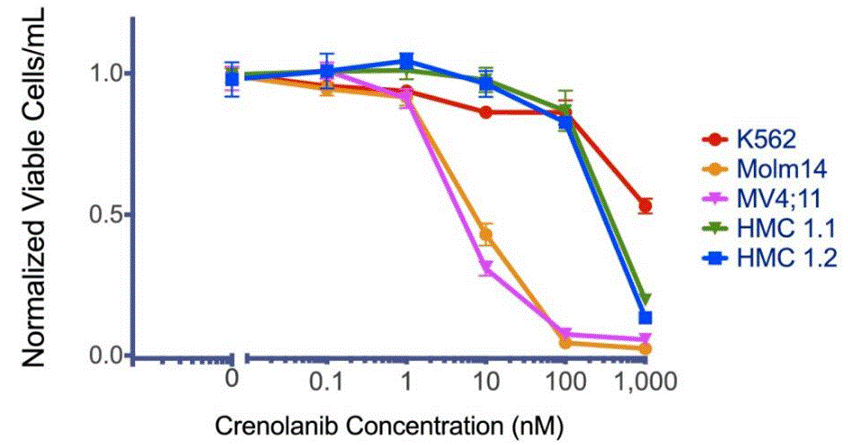
| Growth inhibition assay | Cell viability |
|
24623852 |
Informations sur l'essai clinique (Clinical Trial Information)
(données du https://clinicaltrials.gov, mis à jour le 2026-04-09)
| Numéro NCT | Recrutement | Conditions | Promoteur/Collaborateurs | Date de début | Phases |
|---|---|---|---|---|---|
| NCT03258931 | COMPLETED | Newly Diagnosed FLT3 Mutated AML |
Arog Pharmaceuticals, Inc. |
2018-08-15 | PHASE3 |
| NCT03250338 | COMPLETED | Relapsed/Refractory Acute Myeloid Leukemia With FLT3 Activating Mutations |
Arog Pharmaceuticals, Inc. |
2018-08-16 | PHASE3 |
| NCT02400255 | COMPLETED | Acute Myeloid Leukemia |
Arog Pharmaceuticals, Inc. |
2015-09 | PHASE2 |
| NCT02847429 | UNKNOWN | GIST With D842V Mutated PDGFRA Gene |
Arog Pharmaceuticals, Inc. |
2016-08 | PHASE3 |
| NCT03324243 | WITHDRAWN | Relapsed/Refractory FLT3-mutated AML |
Arog Pharmaceuticals, Inc. |
2018-01 | PHASE2 |
| NCT03193918 | COMPLETED | Esophagogastric Adenocarcinoma |
Arog Pharmaceuticals, Inc. |
2017-04-14 | PHASE1 |

Les produits sont destinés à la recherche uniquement. Ne pas utiliser chez l'homme. Nous ne vendons pas aux patients.
©Copyright 2013 Selleck Chemicals. Tous droits réservés.