
pour la recherche uniquement
BMS-777607 c-Met inhibiteur
Réf. CatalogueS1561
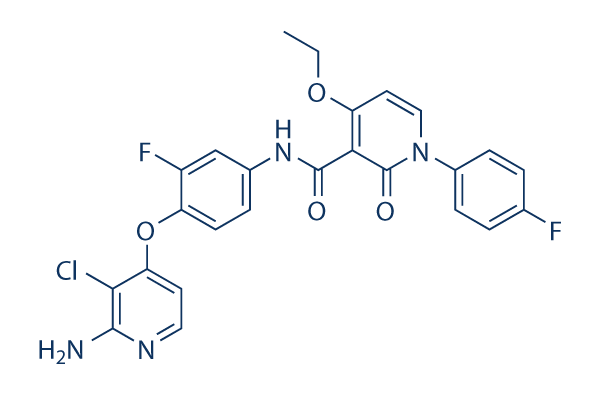
Structure chimique
Poids moléculaire: 512.89
Contrôle Qualité
| Cibles apparentées | EGFR VEGFR PDGFR FGFR Src MEK CSF-1R FLT3 HER2 c-Kit |
|---|---|
| Autre c-Met Inhibiteurs | Tepotinib Dihexa SGX-523 PHA-665752 Foretinib SU11274 JNJ-38877605 Tivantinib PF-04217903 Savolitinib (AZD6094) |
Culture cellulaire, traitement et concentration de travail
| Lignées cellulaires | Type dessai | Concentration | Temps dincubation | Formulation | Description de lactivité | PMID |
|---|---|---|---|---|---|---|
| PC-3 | Function assay | 0.1 μM | DMSO | exhibits inhibitory effect on HGF-induced cell scattering | 20515943 | |
| DU145 | Function assay | 0.1 μM | DMSO | exhibits inhibitory effect on HGF-induced cell scattering | 20515943 | |
| PC-3 | Function assay | 0.01 μM | DMSO | suppresses HGF-induced cell migration | 20515943 | |
| DU145 | Function assay | 0.01 μM | DMSO | suppresses HGF-induced cell migration | 20515943 | |
| PC-3 | Function assay | 0.1 μM | DMSO | impairs HGF-mediated cell invasion | 20515943 | |
| DU145 | Function assay | 0.1 μM | DMSO | impairs HGF-mediated cell invasion | 20515943 | |
| PC-3 | Growth inhibitory assay | ~10 μM | DMSO | reduces cell proliferation | 20515943 | |
| KHT | Kinase assay | DMSO | blocks the c-Met signaling pathway with IC50 of 10 nM | 22286523 | ||
| KHT | Function assay | ~1 μM | DMSO | prevents spontaneous KHT cell scattering with IC50 of 0.1-0.5 μM | 22286523 | |
| KHT | Function assay | ~0.5 μM | DMSO | inhibits cell migration | 22286523 | |
| KHT | Function assay | ~0.5 μM | DMSO | inhibits cell invasion | 22286523 | |
| KHT | Growth inhibitory assay | ~10 μM | DMSO | inhibits KHT cell proliferation | 22286523 | |
| T-47D | Growth inhibitory assay | ~5 μM | DMSO | inhibits cell proliferation | 23468529 | |
| ZR-75-1 | Growth inhibitory assay | ~5 μM | DMSO | inhibits cell proliferation | 23468529 | |
| T-47D | Function assay | 10 μM | DMSO | Induces polyploidy by 86 % | 23468529 | |
| ZR-75-1 | Function assay | 10 μM | DMSO | Induces polyploidy by 88% | 23468529 | |
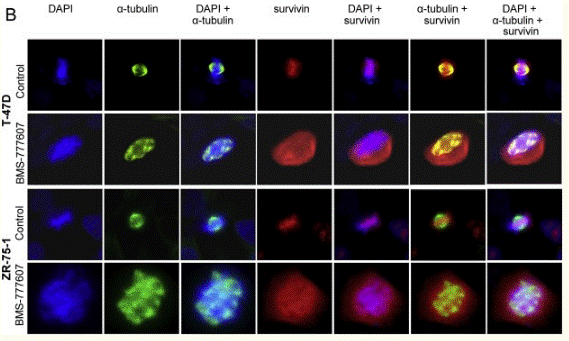
| T-47D | Function assay | 10 μM | DMSO | inhibits AURK-B function and induces its protein degradation | 23468529 | |
| CHRF | Function assay | 10 μM | DMSO | inhibits cell division | 25304900 | |
| HPDE | Function assay | 10 μM | DMSO | blocks constitutive activation and decreased AKT signaling | 26477314 | |
| U118MG | Kinase assay | ~3 μM | DMSO | blocks AXL phosphorylation | 26848524 | |
| SF126 | Kinase assay | ~3 μM | DMSO | blocks AXL phosphorylation | 26848524 | |
| U118MG | Cytoxicity assay | 12.5 μM | DMSO | decreases glioma cell viability | 26848524 | |
| SF126 | Cytoxicity assay | 12.5 μM | DMSO | decreases glioma cell viability | 26848524 | |
| U118MG | Apoptosis assay | 12.5 μM | DMSO | induces glioma cell apoptosis | 26848524 | |
| SF126 | Apoptosis assay | 12.5 μM | DMSO | induces glioma cell apoptosis | 26848524 | |
| U118MG | Function assay | 12.5 μM | DMSO | blocks glioma cell migration and invasive growth pattern | 26848524 | |
| SF126 | Function assay | 12.5 μM | DMSO | blocks glioma cell migration and invasive growth pattern | 26848524 | |
| GTL16 | Function assay | 30 mins | Inhibition of Met phosphorylation in human GTL16 cells after 30 mins, IC50 = 0.02 μM. | 19260711 | ||
| GTL16 | Antiproliferative assay | 72 hrs | Antiproliferative activity against Met-dependent human GTL16 cells after 72 hrs by MTS assay, IC50 = 0.1 μM. | 19260711 | ||
| NCI-H1993 | Antiproliferative assay | 72 hrs | Antiproliferative activity against Met-dependent human NCI-H1993 cells after 72 hrs by MTS assay, IC50 = 0.15 μM. | 19260711 | ||
| U87 | Antiproliferative assay | 72 hrs | Antiproliferative activity against Met-driven human U87 cells after 72 hrs by MTS assay, IC50 = 0.16 μM. | 19260711 | ||
| BAF3 | Cytotoxicity assay | 72 hrs | Cytotoxicity against mouse BAF3 cells expressing TPR-Met assessed as growth inhibition after 72 hrs, IC50 = 0.1884 μM. | 24792774 | ||
| DU145 | Antiinvasive assay | 1 hr | Antiinvasive activity in human DU145 cells assessed as inhibition of HGF-induced cell motility preincubated for 1 hr before HGF treatment measured after 24 hrs by cell scattering assay, IC50 = 0.2 μM. | 24900830 | ||
| MKN45 | Cytotoxicity assay | 72 hrs | Cytotoxicity against human MKN45 cells assessed as growth inhibition after 72 hrs, IC50 = 0.2858 μM. | 24792774 | ||
| NCI-H1993 | Cytotoxicity assay | 48 hrs | Cytotoxicity against human NCI-H1993 cells after 48 hrs by MTT assay, IC50 = 1.108 μM. | 24900830 | ||
| GTL16 | Function assay | 6.25 mg/kg | Cmax in human GTL16 cells xenografted athymic mouse at 6.25 mg/kg, po, Cmax = 4.5 μM. | 19260711 | ||
| GTL16 | Function assay | 50 mg/kg | Cmax in human GTL16 cells xenografted athymic mouse at 50 mg/kg, po, Cmax = 43.7 μM. | 19260711 | ||
| SJ-GBM2 | qHTS assay | qHTS of pediatric cancer cell lines to identify multiple opportunities for drug repurposing: Primary screen for SJ-GBM2 cells | 29435139 | |||
| A673 | qHTS assay | qHTS of pediatric cancer cell lines to identify multiple opportunities for drug repurposing: Primary screen for A673 cells | 29435139 | |||
| SK-N-MC | qHTS assay | qHTS of pediatric cancer cell lines to identify multiple opportunities for drug repurposing: Primary screen for SK-N-MC cells | 29435139 | |||
| Saos-2 | qHTS assay | qHTS of pediatric cancer cell lines to identify multiple opportunities for drug repurposing: Primary screen for Saos-2 cells | 29435139 | |||
| LAN-5 | qHTS assay | qHTS of pediatric cancer cell lines to identify multiple opportunities for drug repurposing: Primary screen for LAN-5 cells | 29435139 | |||
| OHS-50 | qHTS assay | qHTS of pediatric cancer cell lines to identify multiple opportunities for drug repurposing: Primary screen for OHS-50 cells | 29435139 | |||
| A673 | qHTS assay | qHTS of pediatric cancer cell lines to identify multiple opportunities for drug repurposing: Confirmatory screen for A673 cells) | 29435139 | |||
| SK-N-MC | qHTS assay | qHTS of pediatric cancer cell lines to identify multiple opportunities for drug repurposing: Confirmatory screen for SK-N-MC cells | 29435139 | |||
| SJ-GBM2 | qHTS assay | qHTS of pediatric cancer cell lines to identify multiple opportunities for drug repurposing: Confirmatory screen for SJ-GBM2 cells | 29435139 | |||
| TC32 | qHTS assay | qHTS of pediatric cancer cell lines to identify multiple opportunities for drug repurposing: Confirmatory screen for TC32 cells | 29435139 | |||
| MG 63 (6-TG R) | qHTS assay | qHTS of pediatric cancer cell lines to identify multiple opportunities for drug repurposing: Confirmatory screen for MG 63 (6-TG R) cells | 29435139 | |||
| MGHU3 | Antiproliferative assay | 72 hrs | Antiproliferative activity against human MGHU3 cells after 72 hrs by CellTiter-Glo assay | 30309671 | ||
| RT112 | Antiproliferative assay | 72 hrs | Antiproliferative activity against human RT112 cells after 72 hrs by CellTiter-Glo assay | 30309671 | ||
| Cliquez pour voir plus de données expérimentales sur la lignée cellulaire | ||||||
Informations chimiques, stockage et stabilité
| Poids moléculaire | 512.89 | Formule | C25H19ClF2N4O4 |
Stockage (À compter de la date de réception) | |
|---|---|---|---|---|---|
| N° CAS | 1025720-94-8 | Télécharger le SDF | Stockage des solutions mères |
|
|
| Synonymes | BMS 817378 | Smiles | CCOC1=C(C(=O)N(C=C1)C2=CC=C(C=C2)F)C(=O)NC3=CC(=C(C=C3)OC4=C(C(=NC=C4)N)Cl)F | ||
Solubilité
|
In vitro |
DMSO
: 100 mg/mL
(194.97 mM)
Water : Insoluble Ethanol : Insoluble |
Calculateur de molarité
|
In vivo |
|||||
Calculateur de formulation in vivo (Solution claire)
Étape 1 : Saisir les informations ci-dessous (Recommandé : Un animal supplémentaire pour tenir compte des pertes pendant lexpérience)
Étape 2 : Saisir la formulation in vivo (Ceci est seulement le calculateur, pas la formulation. Veuillez nous contacter dabord sil ny a pas de formulation in vivo dans la section Solubilité.)
Résultats du calcul :
Concentration de travail : mg/ml;
Méthode de préparation du liquide maître DMSO : mg médicament prédissous dans μL DMSO ( Concentration du liquide maître mg/mL, Veuillez nous contacter dabord si la concentration dépasse la solubilité du DMSO du lot de médicament. )
Méthode de préparation de la formulation in vivo : Prendre μL DMSO liquide maître, puis ajouterμL PEG300, mélanger et clarifier, puis ajouterμL Tween 80, mélanger et clarifier, puis ajouter μL ddH2O, mélanger et clarifier.
Méthode de préparation de la formulation in vivo : Prendre μL DMSO liquide maître, puis ajouter μL Huile de maïs, mélanger et clarifier.
Note : 1. Veuillez vous assurer que le liquide est clair avant dajouter le solvant suivant.
2. Assurez-vous dajouter le(s) solvant(s) dans lordre. Vous devez vous assurer que la solution obtenue, lors de lajout précédent, est une solution claire avant de procéder à lajout du solvant suivant. Des méthodes physiques telles que le vortex, les ultrasons ou le bain-marie chaud peuvent être utilisées pour faciliter la dissolution.
Mécanisme daction
| Caractéristiques |
A potent inhibitor of the Met family, and >40-fold selectivity vs. Lck, VEGFR2, and TrkA/B and >500-fold selective vs. other receptor and non-receptor kinases.
|
|---|---|
| Targets/IC50/Ki |
Axl
(Cell-free assay) 1.1 nM
RON
(Cell-free assay) 1.8 nM
Met
(Cell-free assay) 3.9 nM
Tyro3
(Cell-free assay) 4.3 nM
Mer
(Cell-free assay) 14 nM
FLT3
(Cell-free assay) 16 nM
Aurora B
(Cell-free assay) 78 nM
|
| In vitro |
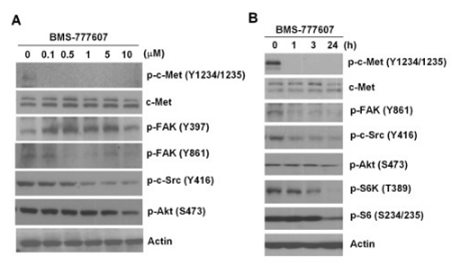
BMS-777607 est un inhibiteur sélectif de la kinase Met, compétitif de l'ATP, qui bloque puissamment l'autophosphorylation de c-Met avec une IC50 de 20 nM dans les lysats cellulaires GTL-16, et démontre une inhibition sélective de la prolifération dans les lignées cellulaires tumorales dépendantes de Met, telles que la lignée cellulaire GTL-16, H1993 et U87. Ce composé inhibe l'autophosphorylation de c-Met déclenchée par le facteur de croissance des hépatocytes (HGF) avec une IC50 de <1 nM dans les cellules cancéreuses de la prostate PC-3 et DU145. Ce composé a peu d'effet sur la croissance des cellules tumorales, mais exerce un effet inhibiteur sur la dispersion cellulaire induite par le HGF dans les cellules PC-3 et DU145, avec une inhibition presque complète à 0,5 μM. Il supprime également la migration et l'invasion cellulaires stimulées de manière dose-dépendante (IC50 < 0,1 μM) dans les deux lignées cellulaires. L'application de ce composé (~10 μM) aux cellules murines KHT hautement métastatiques pendant 2 heures élimine puissamment les niveaux basaux de c-Met autophosphorylé avec une IC50 de 10 nM sans affecter le c-Met total, entraînant une inhibition dose-dépendante de la phosphorylation des molécules de signalisation en aval, y compris ERK, Akt, p70S6K et S6. Le traitement avec ce composé (~1 μM) pendant 24 heures inhibe puissamment la dispersion, la motilité et l'invasion des cellules KHT à des doses de l'ordre du nanomolaire, ce qui correspond au "knockdown" du gène MET, et affecte modestement la prolifération cellulaire et la formation de colonies. |
| Essai kinase |
Essai de la kinase Met
|
|
La réaction de la kinase consiste en du GST-Met exprimé par baculovirus, 3 μg de poly(Glu/Tyr), 0,12 μCi de 33P γ-ATP, 1 μM d'ATP dans 30 μL de tampon de kinase (20 mM Tris-Cl, 5 mM MnCl2, 0,1 mg/mL BSA, 0,5 mM DTT). Les réactions sont incubées pendant 1 heure à 30 °C et arrêtées par l'ajout d'acide trichloroacétique froid (TCA) à une concentration finale de 8 %. Les précipités de TCA sont recueillis sur des plaques unifiltres GF/C à l'aide d'un "Filtermate universal harvester", et les filtres sont quantifiés à l'aide d'un compteur à scintillation liquide TopCount 96 puits. Des courbes dose-réponse sont générées pour déterminer la concentration requise pour inhiber 50 % de la phosphorylation du substrat (IC50). Ce composé est dissous à 10 mM dans du DMSO et évalué à 10 concentrations, en double.
|
|
| In vivo |
L'administration orale de BMS 777607 (6,25-50 mg/kg) réduit significativement les volumes tumoraux des xénogreffes tumorales humaines GTL-16 chez les souris athymiques sans toxicité observée. L'administration de ce composé (25 mg/kg/jour) diminue le nombre de nodules tumoraux pulmonaires KHT (28,3 %), améliore l'hémorragie morphologique et altère significativement le phénotype métastatique chez les souris C3H/HeJ femelles âgées de 6 à 8 semaines injectées avec des cellules de fibrosarcome de rongeur KHT sans toxicité systémique apparente par rapport au traitement témoin. Une faible dose de ce produit chimique (10 mg/kg) offre également une inhibition légère mais non significative de la formation de nodules pulmonaires par rapport au contrôle du véhicule. |
Références |
|
Applications
| Méthodes | Biomarqueurs | Images | PMID |
|---|---|---|---|
| Western blot | p-c-Met / c-Met / p-FAK / p-c-Src / p-Akt / p-S6K / p-S6 p53 / p21 / Survivin / p-Rb / Rb |
|
22639908 |
| Immunofluorescence | α-tubulin / survivin |
|
24444656 |
Informations sur lessai clinique
(données du https://clinicaltrials.gov, mis à jour le 2024-05-22)
| Numéro NCT | Recrutement | Conditions | Promoteur/Collaborateurs | Date de début | Phases |
|---|---|---|---|---|---|
| NCT01721148 | Completed | Malignant Solid Tumour |
ASLAN Pharmaceuticals |
October 2012 | Phase 1 |
| NCT00605618 | Completed | Advanced Solid Tumors |
Bristol-Myers Squibb |
March 2008 | Phase 1|Phase 2 |
Support technique
Tel: +1-832-582-8158 Ext:3
Si vous avez dautres questions, veuillez laisser un message.
Foire aux questions
Question 1:
What formulation can we use to dissolve it for mice in vivo study?
Réponse :
S1561 in 1% DMSO+30% polyethylene glycol+1% Tween 80 at 30 mg/ml is a suspension. It is fine for oral gavage. If you are going to use it for injection, please try the following vehicle: 4% DMSO+30% PEG 300+ddH2O. This compound can be dissolved in it at 5 mg/ml as a clear solution.

Les produits sont destinés à la recherche uniquement. Ne pas utiliser chez lhomme. Nous ne vendons pas aux patients.
©Copyright 2013 Selleck Chemicals. Tous droits réservés.