
pour la recherche uniquement
Bupivacaine HCl Sodium Channel Inhibiteur
Réf. Catalogue: S2454
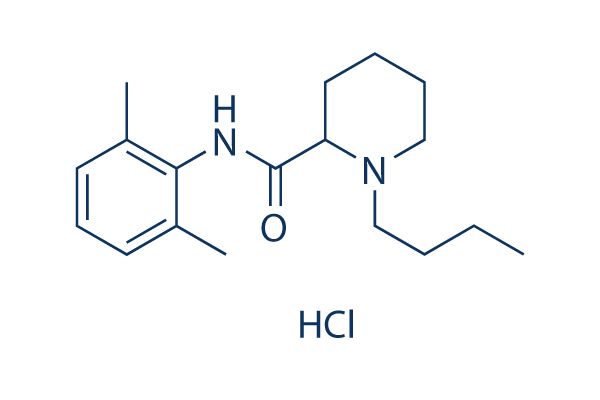
Structure chimique
Poids moléculaire: 324.89
Contrôle Qualité (Quality Control)
| Cibles apparentées | CFTR CRM1 CD markers AChR Calcium Channel Potassium Channel GABA Receptor TRP Channel ATPase GluR |
|---|---|
| Autre Sodium Channel Inhibiteurs | Camostat Mesilate A-803467 cariporide Tolperisone HCl Vinpocetine Veratramine Bulleyaconi cine A GS967 Ambroxol HCl Benzocaine |
Informations chimiques, stockage et stabilité (Chemical Information, Storage & Stability)
| Poids moléculaire | 324.89 | Formule | C18H28N2O.HCl |
Stockage (À compter de la date de réception) | |
|---|---|---|---|---|---|
| N° CAS | 18010-40-7 | Télécharger le SDF | Stockage des solutions mères |
|
|
| Synonymes | N/A | Smiles | CCCCN1CCCCC1C(=O)NC2=C(C=CC=C2C)C.Cl | ||
Solubilité (Solubility)
|
In vitro |
DMSO
: 65 mg/mL
(200.06 mM)
Water : 65 mg/mL Ethanol : 65 mg/mL |
Calculateur de molarité
|
In vivo |
|||||
Calculateur de formulation in vivo (Solution claire)
Étape 1 : Saisir les informations ci-dessous (Recommandé : Un animal supplémentaire pour tenir compte des pertes pendant l'expérience)
Étape 2 : Saisir la formulation in vivo (Ceci est seulement le calculateur, pas la formulation. Veuillez nous contacter d'abord s'il n'y a pas de formulation in vivo dans la section Solubilité.)
Résultats du calcul :
Concentration de travail : mg/ml;
Méthode de préparation du liquide maître DMSO : mg médicament prédissous dans μL DMSO ( Concentration du liquide maître mg/mL, Veuillez nous contacter d'abord si la concentration dépasse la solubilité du DMSO du lot de médicament. )
Méthode de préparation de la formulation in vivo : Prendre μL DMSO liquide maître, puis ajouterμL PEG300, mélanger et clarifier, puis ajouterμL Tween 80, mélanger et clarifier, puis ajouter μL ddH2O, mélanger et clarifier.
Méthode de préparation de la formulation in vivo : Prendre μL DMSO liquide maître, puis ajouter μL Huile de maïs, mélanger et clarifier.
Note : 1. Veuillez vous assurer que le liquide est clair avant d'ajouter le solvant suivant.
2. Assurez-vous d'ajouter le(s) solvant(s) dans l'ordre. Vous devez vous assurer que la solution obtenue, lors de l'ajout précédent, est une solution claire avant de procéder à l'ajout du solvant suivant. Des méthodes physiques telles que le vortex, les ultrasons ou le bain-marie chaud peuvent être utilisées pour faciliter la dissolution.
Mécanisme d'action (Mechanism of Action)
| Targets/IC50/Ki |
Sodium channel
|
|---|---|
| In vitro |
Bupivacaine solution is cytotoxic to bovine articular chondrocytes and articular cartilage in vitro after only 15 to 30 minutes exposure. Bupivacaine acts in isolated mitochondria, as uncouplers between oxygen consumption and phosphorylation of adenosine diphosphate. Bupivacaine causes a concentration-dependent mitochondrial depolarization and pyridine nucleotide oxidation in isolated mitochondria, which are matched by an increased oxygen consumption at bupivacaine concentrations of 1.5 mm or less at pH 7.4, whereas respiration is inhibited at higher concentrations. Bupivacaine causes the opening of the permeability transition pore (PTP), a cyclosporin A-sensitive inner membrane channel that plays a key role in many forms of cell death. Bupivacaine causes mitochondrial depolarization and pyridine nucleotides oxidation that are matched by increased concentrations of cytosolic free Ca(2+), release of cytochrome c, and eventually, hypercontracture in intact flexor digitorum brevis fibers. Bupivacaine inhibits GIRK channels within seconds of application, regardless of whether channels are activated through the muscarinic receptor or directly via coexpressed G protein G(beta)gamma subunits. Bupivacaine also inhibits alcohol-induced GIRK currents in the absence of functional pertussis toxin-sensitive G proteins. Bupivacaine HCl also potently inhibits cAMP production with an IC50 of 2.3 μM.
|
| In vivo |
Bupivacaine does not only induce Ca2+ release from the sarcoplasmic reticulum (SR) in rats, but also inhibits Ca2+ uptake by the SR, which is mainly regulated by SR Ca2+ adenosine triphosphatase activity.
|
Références |
|
Informations sur l'essai clinique (Clinical Trial Information)
(données du https://clinicaltrials.gov, mis à jour le 2024-05-22)
| Numéro NCT | Recrutement | Conditions | Promoteur/Collaborateurs | Date de début | Phases |
|---|---|---|---|---|---|
| NCT05038956 | Not yet recruiting | Video-assisted Thoracic Surgery (VATS) |
University of Utah |
2024-05-01 | -- |
| NCT06252662 | Not yet recruiting | Breast Cancer |
United States Naval Medical Center Portsmouth |
2024-04 | Phase 4 |
| NCT06350981 | Not yet recruiting | Back Pain|Surgery-Complications|Narcotic Use|Physical Stress|Post Operative Pain |
Foundation for Orthopaedic Research and Education|Pacira Pharmaceuticals Inc |
2024-04-01 | Phase 2|Phase 3 |
| NCT04003506 | Not yet recruiting | Pain Postoperative |
The University of Hong Kong |
2024-03-01 | Phase 4 |
| NCT06293404 | Not yet recruiting | Hip Fractures|Spinal Anesthesia |
Ankara City Hospital Bilkent |
2024-03-01 | Not Applicable |

Les produits sont destinés à la recherche uniquement. Ne pas utiliser chez l'homme. Nous ne vendons pas aux patients.
©Copyright 2013 Selleck Chemicals. Tous droits réservés.