
pour la recherche uniquement
Latrepirdine 2HCl GluR Antagoniste
Réf. Catalogue: S1245
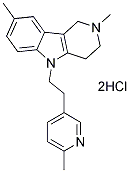
Structure chimique
Poids moléculaire: 392.37
Contrôle Qualité (Quality Control)
Informations chimiques, stockage et stabilité (Chemical Information, Storage & Stability)
| Poids moléculaire | 392.37 | Formule | C21H25N3.2HCl |
Stockage (À compter de la date de réception) | |
|---|---|---|---|---|---|
| N° CAS | 97657-92-6 | -- | Stockage des solutions mères |
|
|
| Synonymes | N/A | Smiles | CC1=CC2=C(C=C1)N(C3=C2CN(CC3)C)CCC4=CN=C(C=C4)C.Cl.Cl | ||
Solubilité (Solubility)
|
In vitro |
DMSO
: 78 mg/mL
(198.79 mM)
Ethanol : 26 mg/mL Water : Insoluble |
Calculateur de molarité
|
In vivo |
|||||
Calculateur de formulation in vivo (Solution claire)
Étape 1 : Saisir les informations ci-dessous (Recommandé : Un animal supplémentaire pour tenir compte des pertes pendant l'expérience)
Étape 2 : Saisir la formulation in vivo (Ceci est seulement le calculateur, pas la formulation. Veuillez nous contacter d'abord s'il n'y a pas de formulation in vivo dans la section Solubilité.)
Résultats du calcul :
Concentration de travail : mg/ml;
Méthode de préparation du liquide maître DMSO : mg médicament prédissous dans μL DMSO ( Concentration du liquide maître mg/mL, Veuillez nous contacter d'abord si la concentration dépasse la solubilité du DMSO du lot de médicament. )
Méthode de préparation de la formulation in vivo : Prendre μL DMSO liquide maître, puis ajouterμL PEG300, mélanger et clarifier, puis ajouterμL Tween 80, mélanger et clarifier, puis ajouter μL ddH2O, mélanger et clarifier.
Méthode de préparation de la formulation in vivo : Prendre μL DMSO liquide maître, puis ajouter μL Huile de maïs, mélanger et clarifier.
Note : 1. Veuillez vous assurer que le liquide est clair avant d'ajouter le solvant suivant.
2. Assurez-vous d'ajouter le(s) solvant(s) dans l'ordre. Vous devez vous assurer que la solution obtenue, lors de l'ajout précédent, est une solution claire avant de procéder à l'ajout du solvant suivant. Des méthodes physiques telles que le vortex, les ultrasons ou le bain-marie chaud peuvent être utilisées pour faciliter la dissolution.
Mécanisme d'action (Mechanism of Action)
| Targets/IC50/Ki |
GluR
Histamine receptor
5-HT
|
|---|---|
| In vitro |
Latrepirdine increases succinate dehydrogenase activity (MTT-assay), mitochondrial membrane potential (DeltaPsim), and cellular ATP levels in primary mouse cortical neurons and human neuroblastoma cells (SH-SY5Y). Latrepirdine enhances mitochondrial function both in the absence and presence of stress and Dimebon-treated cells are partially protected to maintain cell viability. Latrepirdine leads to enhanced mTOR- and Atg5-dependent autophagy in cultured mammalian cells. latrepirdine stimulates MTOR- and ATG5-dependent autophagy, leading to the reduction of intracellular levels of APP metabolites, including Aβ in cultured cells. Latrepirdine stimulates the degradation of α-syn in differentiated SH-SY5Y neurons, and in mouse brain following chronic administration, in parallel with elevation of the levels of markers of autophagic activity. Latrepirdine increases intracellular ATP levels and glucose transporter 3 translocation to the plasma membrane in primary neuron.
|
| In vivo |
Latrepirdine treatment of TgCRND8 transgenic mice is associated with improved learning behavior and with a reduction in accumulation of Aβ42 and α-synuclein. Latrepirdine administration results in increased levels of the biomarkers thought to correlate with autophagy activation in the brains of TgCRND8 (APP K670M, N671L, V717F) or wild-type mice, and that treatment is associated with abrogation of behavioral deficit, reduction in Aβ neuropathology, and prevention of autophagic failure among TgCRND8 mice.
|
Références |
|
Informations sur l'essai clinique (Clinical Trial Information)
(données du https://clinicaltrials.gov, mis à jour le 2025-12-10)
| Numéro NCT | Recrutement | Conditions | Promoteur/Collaborateurs | Date de début | Phases |
|---|---|---|---|---|---|
| NCT07251023 | RECRUITING | Alzheimer Type Dementia |
Bigespas LTD |
2025-11-20 | PHASE3 |
| NCT01152216 | TERMINATED | Alzheimer's Disease |
Medivation, Inc. |
2010-04 | PHASE3 |
| NCT01085266 | TERMINATED | Huntington Disease |
Medivation, Inc. |
2010-02 | PHASE3 |
| NCT00954590 | TERMINATED | Moderate to Severe Alzheimer |
Medivation, Inc. |
2009-10 | PHASE3 |
| NCT01066546 | TERMINATED | Alzheimer's Disease |
Pfizer |
2010-04 | PHASE3 |
| NCT00975481 | COMPLETED | Alzheimer's Disease; Huntington's Disease |
Pfizer |
2009-10 | PHASE1 |

Les produits sont destinés à la recherche uniquement. Ne pas utiliser chez l'homme. Nous ne vendons pas aux patients.
©Copyright 2013 Selleck Chemicals. Tous droits réservés.