
pour la recherche uniquement
Enoxacin Topoisomerase inhibiteur
Réf. CatalogueS1756
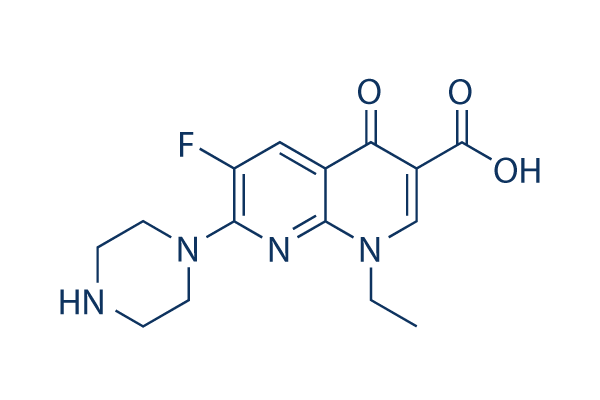
Structure chimique
Poids moléculaire: 320.32
Contrôle Qualité
| Cibles apparentées | HDAC PARP ATM/ATR DNA-PK WRN DNA/RNA Synthesis PPAR Sirtuin Casein Kinase eIF |
|---|---|
| Autre Topoisomerase Inhibiteurs | Camptothecin (CPT) Betulinic acid Beta-Lapachone (S)-10-Hydroxycamptothecin Amonafide Voreloxin (SNS-595) hydrochloride Ellagic acid Cu(II)-Elesclomol Hydroxy Camptothecine Rubitecan |
Informations chimiques, stockage et stabilité
| Poids moléculaire | 320.32 | Formule | C15H17FN4O3 |
Stockage (À compter de la date de réception) | |
|---|---|---|---|---|---|
| N° CAS | 74011-58-8 | Télécharger le SDF | Stockage des solutions mères |
|
|
| Synonymes | AT-2266, CI919, Pd107779, NSC 629661 | Smiles | CCN1C=C(C(=O)C2=CC(=C(N=C21)N3CCNCC3)F)C(=O)O | ||
Solubilité
|
In vitro |
DMSO
: 32 mg/mL
(99.9 mM)
Water : Insoluble Ethanol : Insoluble |
Calculateur de molarité
|
In vivo |
|||||
Calculateur de formulation in vivo (Solution claire)
Étape 1 : Saisir les informations ci-dessous (Recommandé : Un animal supplémentaire pour tenir compte des pertes pendant lexpérience)
Étape 2 : Saisir la formulation in vivo (Ceci est seulement le calculateur, pas la formulation. Veuillez nous contacter dabord sil ny a pas de formulation in vivo dans la section Solubilité.)
Résultats du calcul :
Concentration de travail : mg/ml;
Méthode de préparation du liquide maître DMSO : mg médicament prédissous dans μL DMSO ( Concentration du liquide maître mg/mL, Veuillez nous contacter dabord si la concentration dépasse la solubilité du DMSO du lot de médicament. )
Méthode de préparation de la formulation in vivo : Prendre μL DMSO liquide maître, puis ajouterμL PEG300, mélanger et clarifier, puis ajouterμL Tween 80, mélanger et clarifier, puis ajouter μL ddH2O, mélanger et clarifier.
Méthode de préparation de la formulation in vivo : Prendre μL DMSO liquide maître, puis ajouter μL Huile de maïs, mélanger et clarifier.
Note : 1. Veuillez vous assurer que le liquide est clair avant dajouter le solvant suivant.
2. Assurez-vous dajouter le(s) solvant(s) dans lordre. Vous devez vous assurer que la solution obtenue, lors de lajout précédent, est une solution claire avant de procéder à lajout du solvant suivant. Des méthodes physiques telles que le vortex, les ultrasons ou le bain-marie chaud peuvent être utilisées pour faciliter la dissolution.
Mécanisme daction
| Targets/IC50/Ki |
Topoisomerase II
Topoisomerase IV
|
|---|---|
| In vitro |
Enoxacin, une fluoroquinolone utilisée comme composé antibactérien, améliore la production de miRNA avec des fonctions de suppression tumorale en se liant à la protéine de biosynthèse de miRNA TAR RNA-binding protein 2 (TRBP). Ce composé se lie au site actif de l'ADN et altère l'activité de coupure/réunion de l'enzyme. Il stimule le clivage des formes relâchées et superenroulées de l'ADN en l'absence d'ATP, tandis que CcdB induit le clivage seulement après de nombreux cycles de coupure et de réunion dépendants de l'ATP. Cette substance réduit de manière dose-dépendante le nombre d'ostéoclastes se différenciant dans des cultures de moelle osseuse de souris stimulées avec du 1,25-dihydroxyvitamine D(3), ainsi que les marqueurs d'activité ostéoclastique, et le nombre de lacunes de résorption formées sur des coupes osseuses. Il inhibe la formation d'ostéoclastes à des concentrations où la formation d'ostéoblastes n'est pas altérée. Cet agent réduit de manière dose-dépendante le nombre de cellules multinucléées exprimant l'activité de la phosphatase acide résistante au tartrate (TRAP) produites par des précurseurs ostéoclastiques stimulés par RANK-L. Il inhibe directement la formation d'ostéoclastes sans affecter la viabilité cellulaire par un nouveau mécanisme qui implique des changements dans le traitement post-traductionnel et le trafic de plusieurs protéines ayant des rôles connus dans la fonction ostéoclastique. Ce composé est capable de diminuer la viabilité cellulaire, d'induire l'apoptose, de provoquer l'arrêt du cycle cellulaire et d'inhiber l'invasivité des lignées cellulaires de cancer de la prostate (PCa). Il est également efficace pour restaurer l'expression globale des miRNA dans les lignées cellulaires de cancer de la prostate (PCa).
|
Références |
|
Informations sur lessai clinique
(données du https://clinicaltrials.gov, mis à jour le 2024-05-22)
| Numéro NCT | Recrutement | Conditions | Promoteur/Collaborateurs | Date de début | Phases |
|---|---|---|---|---|---|
| NCT04840823 | Completed | Amyotrophic Lateral Sclerosis |
McGill University|Weizmann Institute of Science|Apotex Inc. |
March 26 2021 | Phase 1|Phase 2 |
Support technique
Tel: +1-832-582-8158 Ext:3
Si vous avez dautres questions, veuillez laisser un message.

Les produits sont destinés à la recherche uniquement. Ne pas utiliser chez lhomme. Nous ne vendons pas aux patients.
©Copyright 2013 Selleck Chemicals. Tous droits réservés.