
pour la recherche uniquement
Mitoxantrone Dihydrochloride (NSC 301739) inhibiteur de PKC/Topoisomerase II
Réf. CatalogueS2485
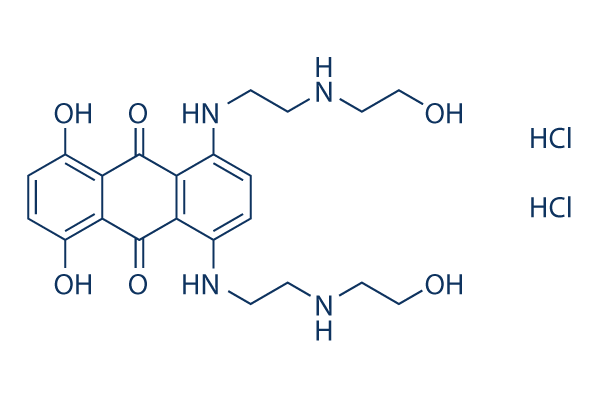
Structure chimique
Poids moléculaire: 517.4
Contrôle Qualité
| Cibles apparentées | HDAC PARP ATM/ATR DNA-PK WRN DNA/RNA Synthesis PPAR Sirtuin Casein Kinase eIF |
|---|---|
| Autre Topoisomerase Inhibiteurs | Camptothecin (CPT) Betulinic acid Beta-Lapachone (S)-10-Hydroxycamptothecin Amonafide Voreloxin (SNS-595) hydrochloride Ellagic acid Cu(II)-Elesclomol Hydroxy Camptothecine Rubitecan |
Culture cellulaire, traitement et concentration de travail
| Lignées cellulaires | Type dessai | Concentration | Temps dincubation | Formulation | Description de lactivité | PMID |
|---|---|---|---|---|---|---|
| L1210 cell | Cytotoxicity assay | 48 h | Cytotoxic potency required to inhibit L1210 cell growth by 50% after cell drug contact for 48 hrs, IC50=4e-05 μM | |||
| HL60 cells | Cytotoxicity assay | 48 h | Cytotoxicity against human HL60 cells after 48 hrs by MTT assay, GI50=0.33 μM | |||
| MDA435/LCC6 cells | Proliferation assay | Antiproliferative activity against MDA435/LCC6 cells by ELISA, IC50=0.35 nM | ||||
| A2780-cell | Growth inhibition assay | Concentration required to inhibit A2780-cell growth by 50%, IC50=0.55 nM | ||||
| G-361 cell | Growth inhibition assay | Cytotoxic potency required to inhibit G-361 cell growth by 50%, IC50=0.65 nM | ||||
| human HL60 cells | Proliferation assay | 72 h | Antiproliferative activity against human HL60 cells after 72 hrs by SRB assay, IC50=2.5 nM | |||
| human K562 cells | Cytotoxicity assay | 5 days | Cytotoxicity against human K562 cells after 5 days by XTT assay, IC50=2.6 nM | |||
| CH1 cell | Cytotoxicity assay | Cytotoxic potency required to inhibit CH1 cell growth by 50%, IC50=2.65 nM | ||||
| MES-SA cells | Proliferation assay | 72 h | Antiproliferative activity against MES-SA cells by MTT assay after 72 hrs, IC50=3 nM | |||
| A549 cells | Function assay | Activity against A549 cancer cell line, IC50=3.1 nM | ||||
| LoVo cells | Cytotoxicity assay | 144 h | Cytotoxicity against human LoVo cancer cell line was determined after 144 hr, IC50=3.3 nM | |||
| P388 cells | Proliferation assay | Antiproliferative activity against P388 cells by ELISA, IC50=4.3 nM | ||||
| human Daudi cells | Proliferation assay | 72 h | Antiproliferative activity against human Daudi cells after 72 hrs by MTT assay, IC50=5 nM | |||
| SKOV-3 cell | Cytotoxicity assay | Cytotoxic potency required to inhibit SKOV-3 cell growth 50%, IC50=5.3 nM | ||||
| OVCAR-3 cell | Function assay | Antitumor activity against human ovarian OVCAR-3 cell lines, IC50=5.8 nM | ||||
| human MES-SA cells | Proliferation assay | 72 h | Antiproliferative activity against human MES-SA cells after 72 hrs by MTT assay, IC50=6 nM | |||
| PC3 cancer cell | Cytotoxicity assay | 144 h | Cytotoxicity against human PC3 cancer cell line was determined after 144 hr, IC50=7 nM | |||
| MXF7 breast cell | Function assay | Antitumor activity against human mammary carcinoma sensitive MXF7 breast cell line, IC50=8.7 nM | ||||
| HT-29 cell | Cytotoxicity assay | 144 h | Cytotoxic potency required to inhibit HT-29 cell growth by 50% after cell drug contact for 144 hrs, IC5=0.01 μM | |||
| HEK293 cells | Cytotoxicity assay | 72 h | Cytotoxicity against HEK293 cells after 72 hrs by MTT assay, IC50=0.01 μM | |||
| MKN45 cells | Cytotoxicity assay | 144 h | Cytotoxicity against human MKN45 cancer cell line was determined after 144 hr, IC50=0.012 μM | |||
| MES-SA cells | Cytotoxicity assay | 72 h | Cytotoxicity against human MES-SA cells assessed as inhibition of cell proliferation after 72 hrs by MTT assay, IC50=0.012 μM | |||
| FM3 cells | Proliferation assay | 72 h | Antiproliferative activity against human FM3 cells after 72 hrs by MTT assay, IC50=0.013 μM | |||
| MCF-7 cells | Growth inhibition assay | Inhibitory activity against human tumor cell line MCF-7 breast adenocarcinoma, IC50=0.02 μM | ||||
| human small-cell lung cancer | Cytotoxicity assay | Cytotoxicity against human small-cell lung cancer (SCLC), IC50=0.02 μM | ||||
| human HCT116 cells | Cytotoxicity assay | 72 h | Cytotoxicity against human HCT116 cells assessed as inhibition of cell proliferation after 72 hrs by MTT assay, IC50=0.022 μM | |||
| human HCT116 cells | Proliferation assay | 72 h | Antiproliferative activity against human HCT116 cells after 72 hrs by MTT assay, IC50=0.025 μM | |||
| NCI-H460 cells | Cytotoxicity assay | 48 h | Cytotoxicity against human NCI-H460 cells after 48 hrs by resazurin dye assay, EC50=0.03 μM | |||
| CCRF-CEM cells | Cytotoxicity assay | 48 h | Cytotoxicity against human CCRF-CEM cells assessed as cell viability after 48 hrs by celltiter-blue assay, IC50=0.036 μM | |||
| HeLa cells | Proliferation assay | 72 h | Antiproliferative activity against human HeLa cells after 72 hrs by MTT assay, IC50=0.044 μM | |||
| NCI60 cells | Function assay | 48 h | Antitumor activity against human NCI60 cells after 48 hrs by SRB assay, GI50=47.86 nM | |||
| UACC375 cell | Function assay | Antitumor activity against human melanoma UACC375 cell line, IC50=0.048 μM | ||||
| HT1080 cell | Growth inhibition assay | Inhibitory activity against human tumor cell line HT1080, IC50=0.066 μM | ||||
| MES-SA/Dx5 cells | Proliferation assay | 72 h | Antiproliferative activity against human MES-SA/Dx5 cells after 72 hrs by MTT assay, IC50=0.073 μM | |||
| SF268 cells | Proliferation assay | 48 h | Antiproliferative activity against human SF268 cells after 48 hrs, EC50=0.32 μM | |||
| KB/HeLa cells | Proliferation assay | 48 h | Antiproliferative activity against human KB/HeLa cells after 48 hrs, EC50=0.36 μM | |||
| K562 cells | Growth inhibition assay | 72 h | Growth inhibition of human K562 cells after 72 hrs by MTS method, IC50=0.42 μM | |||
| MDA-MB-231 cells | Proliferation assay | 72 h | Antiproliferative activity against human MDA-MB-231 cells by WST-1 method after 72 hrs, IC50=0.96 μM | |||
| SF268 cells | Cytotoxicity assay | 48 h | Cytotoxicity against human SF268 cells after 48 hrs by SRB assay, GI50=0.97 μM | |||
| HCT116 cells | Cytotoxicity assay | Cytotoxicity against human HCT116 cells by MTT assay, IC50=3.96 μM | ||||
| U937 cells | Cytotoxicity assay | Cytotoxicity against human U937 cells by MTT assay, IC50=6.2 μM | ||||
| HepG2 cells | Proliferation assay | 48 h | Antiproliferative activity against human HepG2 cells after 48 hrs by MTT assay, IC50=11.05 μM | |||
| Cliquez pour voir plus de données expérimentales sur la lignée cellulaire | ||||||
Informations chimiques, stockage et stabilité
| Poids moléculaire | 517.4 | Formule | C22H29ClN4O6.2HCl |
Stockage (À compter de la date de réception) | |
|---|---|---|---|---|---|
| N° CAS | 70476-82-3 | Télécharger le SDF | Stockage des solutions mères |
|
|
| Synonymes | NSC-301739 2HCl, Mitozantrone 2HCl | Smiles | C1=CC(=C2C(=C1NCCNCCO)C(=O)C3=C(C=CC(=C3C2=O)O)O)NCCNCCO.Cl.Cl | ||
Solubilité
|
In vitro |
DMSO
: 104 mg/mL
(201.0 mM)
Water : 104 mg/mL Ethanol : Insoluble |
Calculateur de molarité
|
In vivo |
|||||
Calculateur de formulation in vivo (Solution claire)
Étape 1 : Saisir les informations ci-dessous (Recommandé : Un animal supplémentaire pour tenir compte des pertes pendant lexpérience)
Étape 2 : Saisir la formulation in vivo (Ceci est seulement le calculateur, pas la formulation. Veuillez nous contacter dabord sil ny a pas de formulation in vivo dans la section Solubilité.)
Résultats du calcul :
Concentration de travail : mg/ml;
Méthode de préparation du liquide maître DMSO : mg médicament prédissous dans μL DMSO ( Concentration du liquide maître mg/mL, Veuillez nous contacter dabord si la concentration dépasse la solubilité du DMSO du lot de médicament. )
Méthode de préparation de la formulation in vivo : Prendre μL DMSO liquide maître, puis ajouterμL PEG300, mélanger et clarifier, puis ajouterμL Tween 80, mélanger et clarifier, puis ajouter μL ddH2O, mélanger et clarifier.
Méthode de préparation de la formulation in vivo : Prendre μL DMSO liquide maître, puis ajouter μL Huile de maïs, mélanger et clarifier.
Note : 1. Veuillez vous assurer que le liquide est clair avant dajouter le solvant suivant.
2. Assurez-vous dajouter le(s) solvant(s) dans lordre. Vous devez vous assurer que la solution obtenue, lors de lajout précédent, est une solution claire avant de procéder à lajout du solvant suivant. Des méthodes physiques telles que le vortex, les ultrasons ou le bain-marie chaud peuvent être utilisées pour faciliter la dissolution.
Mécanisme daction
| Targets/IC50/Ki |
Topoisomerase II
PKC
(Cell-free assay) 8.5 μM
|
|---|---|
| In vitro |
La Mitoxantrone induit la fragmentation de l'ADN et le clivage protéolytique de la poly(ADP-ribose) polymérase (PARP), un marqueur de l'activation des caspases, chez tous les patients étudiés, démontrant que l'effet cytotoxique de la Mitoxantrone est dû à l'induction de l'apoptose. La Mitoxantrone active NFkappaB et stimule la dégradation d'IkappaBalpha dans la lignée cellulaire de leucémie promyélocytaire HL60 mais pas dans les cellules variantes, les cellules HL60/MX2, qui manquent l'isoforme bêta de la topoisomérase II et expriment une isoforme alpha tronquée qui entraîne une distribution subcellulaire altérée. La Mitoxantrone inhibe la prolifération des PBMC activées, des lymphocytes B ou des lignées cellulaires T (LCT) spécifiques de l'antigène stimulées sur les cellules présentatrices d'antigène (APC) de manière dose-dépendante. La Mitoxantrone induit l'apoptose des PBMC, des monocytes et des DC à faibles concentrations, tandis que des doses plus élevées provoquent la lyse cellulaire. |
| In vivo |
La Mitoxantrone diminue transitoirement le taux de croissance des xénogreffes HID chez la souris mais n'affecte pas celui des xénogreffes PAC120. La Mitoxantrone entraîne la gravité des lésions cardiaques, de la néphropathie et de la toxicité intestinale chez les rats spontanément hypertendus. La Mitoxantrone et le fer(III) forment un complexe 2:1 fort, dans lequel la Mitoxantrone peut agir comme un ligand tridentate. |
Références |
|
Applications
| Méthodes | Biomarqueurs | Images | PMID |
|---|---|---|---|
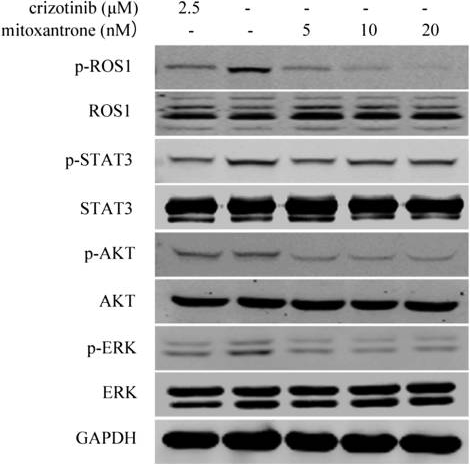
| Western blot | p-ROS1 / ROS1 / p-STAT3 / STAT3 / p-AKT / AKT / p-ERK / ERK |
|
30108778 |
| Growth inhibition assay | Cell number |

|
24349321 |
Informations sur lessai clinique
(données du https://clinicaltrials.gov, mis à jour le 2024-05-22)
| Numéro NCT | Recrutement | Conditions | Promoteur/Collaborateurs | Date de début | Phases |
|---|---|---|---|---|---|
| NCT06156761 | Not yet recruiting | Breast Cancer |
Cancer Institute and Hospital Chinese Academy of Medical Sciences|CSPC Ouyi Pharmaceutical Co. Ltd. |
November 28 2023 | Not Applicable |
| NCT05875428 | Recruiting | Diffuse Large B-Cell Lymphoma |
CSPC ZhongQi Pharmaceutical Technology Co. Ltd. |
July 10 2023 | Phase 2 |
| NCT05496894 | Withdrawn | Relapsing Multiple Sclerosis |
CSPC Zhongnuo Pharmaceutical (Shijiazhuang) Co. Ltd. |
August 2022 | Phase 2 |
Support technique
Tel: +1-832-582-8158 Ext:3
Si vous avez dautres questions, veuillez laisser un message.

Les produits sont destinés à la recherche uniquement. Ne pas utiliser chez lhomme. Nous ne vendons pas aux patients.
©Copyright 2013 Selleck Chemicals. Tous droits réservés.