
pour la recherche uniquement
Riluzole Sodium Channel Inhibiteur
Réf. Catalogue: S1614
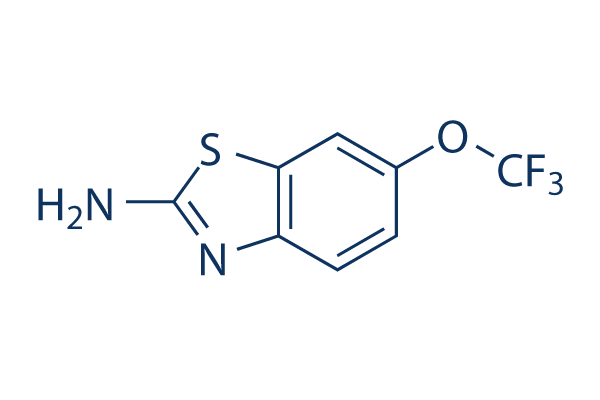
Structure chimique
Poids moléculaire: 234.2
Contrôle Qualité (Quality Control)
| Cibles apparentées | CFTR CRM1 CD markers AChR Calcium Channel Potassium Channel GABA Receptor TRP Channel ATPase GluR |
|---|---|
| Autre Sodium Channel Inhibiteurs | Camostat Mesilate A-803467 cariporide Tolperisone HCl Vinpocetine Veratramine Bulleyaconi cine A GS967 Ambroxol HCl Benzocaine |
Informations chimiques, stockage et stabilité (Chemical Information, Storage & Stability)
| Poids moléculaire | 234.2 | Formule | C8H5F3N2OS |
Stockage (À compter de la date de réception) | |
|---|---|---|---|---|---|
| N° CAS | 1744-22-5 | Télécharger le SDF | Stockage des solutions mères |
|
|
| Synonymes | RP-54274, PK 26124 | Smiles | C1=CC2=C(C=C1OC(F)(F)F)SC(=N2)N | ||
Solubilité (Solubility)
|
In vitro |
DMSO
: 47 mg/mL
(200.68 mM)
Ethanol : 47 mg/mL Water : Insoluble |
Calculateur de molarité
|
In vivo |
|||||
Calculateur de formulation in vivo (Solution claire)
Étape 1 : Saisir les informations ci-dessous (Recommandé : Un animal supplémentaire pour tenir compte des pertes pendant l'expérience)
Étape 2 : Saisir la formulation in vivo (Ceci est seulement le calculateur, pas la formulation. Veuillez nous contacter d'abord s'il n'y a pas de formulation in vivo dans la section Solubilité.)
Résultats du calcul :
Concentration de travail : mg/ml;
Méthode de préparation du liquide maître DMSO : mg médicament prédissous dans μL DMSO ( Concentration du liquide maître mg/mL, Veuillez nous contacter d'abord si la concentration dépasse la solubilité du DMSO du lot de médicament. )
Méthode de préparation de la formulation in vivo : Prendre μL DMSO liquide maître, puis ajouterμL PEG300, mélanger et clarifier, puis ajouterμL Tween 80, mélanger et clarifier, puis ajouter μL ddH2O, mélanger et clarifier.
Méthode de préparation de la formulation in vivo : Prendre μL DMSO liquide maître, puis ajouter μL Huile de maïs, mélanger et clarifier.
Note : 1. Veuillez vous assurer que le liquide est clair avant d'ajouter le solvant suivant.
2. Assurez-vous d'ajouter le(s) solvant(s) dans l'ordre. Vous devez vous assurer que la solution obtenue, lors de l'ajout précédent, est une solution claire avant de procéder à l'ajout du solvant suivant. Des méthodes physiques telles que le vortex, les ultrasons ou le bain-marie chaud peuvent être utilisées pour faciliter la dissolution.
Mécanisme d'action (Mechanism of Action)
| Targets/IC50/Ki |
Sodium channel
NMDA receptor
Glutamate release
|
|---|---|
| In vitro |
Riluzole inhibits the release of glutamic acid from cultured neurons, and from brain slices. These effects may be partly due to inactivation of voltage-dependent sodium channels on glutamatergic nerve terminals, as well as activation of a G-protein-dependent signal transduction process. Electrophysiologic experiments performed on isolated excitatory amino acid receptors expressed in the Xenopus oocyte have revealed that this compound inhibits currents evoked by N-methyl-D-aspartate (NMDA) (IC50 = 18 μM) and kainic acid (IC50 = 167 μM). It has been shown to stabilize inactivated sodium channels in frog sciatic nerve, in rat cerebellar granule cells, and on recombinant rat sodium channels expressed in Xenopus oocytes (Ki = 0.2 μM). This chemical also blocks some of the postsynaptic effects of glutamic acid by noncompetitive blockade of NMDA receptors. It protects cultured neurons from anoxic damage, from the toxic effects of glutamic-acid-uptake inhibitors, and from the toxic factor in the CSF of patients with amyotrophic lateral sclerosis.
|
| In vivo |
Riluzole can easily cross the blood-brain barrier. This compound has neuroprotective, anticonvulsant, and sedative properties in vivo. In a rodent model of transient global cerebral ischemia, a complete suppression of the ischemia-evoked surge in glutamic acid release has been observed by this chemical treatment (8 mg/kg i.p.).
|
Références |
|
Applications (Applications)
| Méthodes | Biomarqueurs | Images | PMID |
|---|---|---|---|
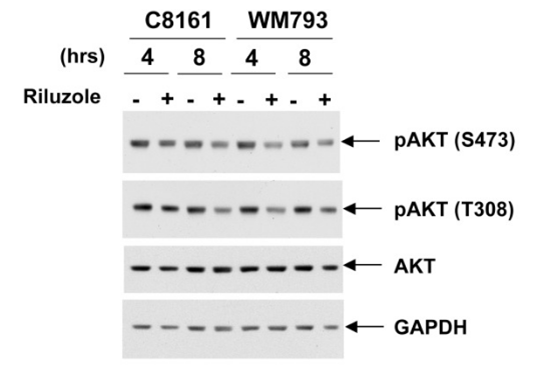
| Western blot | p-AKT / AKT p-Smad2 / Smad2 / p-Smad3 / Smad3 |
|
23077590 |
Informations sur l'essai clinique (Clinical Trial Information)
(données du https://clinicaltrials.gov, mis à jour le 2025-10-03)
| Numéro NCT | Recrutement | Conditions | Promoteur/Collaborateurs | Date de début | Phases |
|---|---|---|---|---|---|
| NCT07174492 | NOT_YET_RECRUITING | Amyotrophic Lateral Sclerosis (ALS) |
AB Science |
2026-01-01 | PHASE3 |
| NCT07447050 | RECRUITING | Breast Cancer; Sarcoma; Gastric (Stomach) Cancer; Lung Cancer; Head and Neck Cancer; Colorectal Cancer; Ovarian Cancer; Liver Cancer; Genitourinary Cancer; Gynecologic Cancer |
University of California, Irvine |
2025-12-23 | PHASE2 |
| NCT03127267 | RECRUITING | Amyotrophic Lateral Sclerosis |
AB Science |
2021-02-02 | PHASE3 |
| NCT06580002 | RECRUITING | Breast Cancer; Sarcoma; Gastric Cancer; Lung Cancer; Head and Neck Cancer; Colorectal Cancer; Ovarian Cancer; Liver Cancer; Genitourinary Cancer; Gynecologic Cancer; Urinary Bladder Cancer; Leukemia; Lymphoid Leukemia; Myeloma Multiple; Prostate Cancer; Pancreas Cancer; Non-hodgkin Lymphoma; Hodgkin Lymphoma; Brain Cancer; Melanoma; Mycosis Fungoides; Kidney Cancer |
University of California, Irvine |
2024-12-02 | PHASE2 |
| NCT07142291 | RECRUITING | Amyotrophic Lateral Sclerosis (ALS) |
PhenoNet, Inc. |
2025-11-25 | PHASE2 |
| NCT07414212 | RECRUITING | Amyotrophic Lateral Sclerosis |
Biogipuzkoa Health Research Institute |
2025-11-25 | PHASE1; PHASE2 |

Les produits sont destinés à la recherche uniquement. Ne pas utiliser chez l'homme. Nous ne vendons pas aux patients.
©Copyright 2013 Selleck Chemicals. Tous droits réservés.