
pour la recherche uniquement
Amlexanox Immunology & Inflammation related Modulateur
Réf. Catalogue: S3648
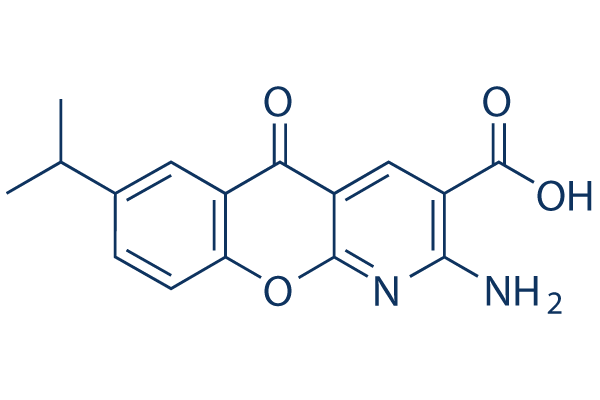
Structure chimique
Poids moléculaire: 298.29
Contrôle Qualité (Quality Control)
| Cibles apparentées | PD-1/PD-L1 CXCR STING AhR CD markers Interleukins Anti-infection Antioxidant COX Histamine Receptor |
|---|---|
| Autre Immunology & Inflammation related Inhibiteurs | Cl-amidine Bestatin (Ubenimex) Bindarit (AF 2838) Tempol Tranilast Sinomenine GI254023X (GI4023) Geniposidic acid CORM-3 Oxymatrine |
Culture cellulaire, traitement et concentration de travail
(Cell Culture, Treatment & Working Concentration)
| Lignées cellulaires | Type d'essai | Concentration | Temps d'incubation | Formulation | Description de l'activité | PMID |
|---|---|---|---|---|---|---|
| ARPE-19 cells | Function assay | 1 μM | Inhibition of TBK1 by Amlx (1 µM) reduces HG-induced mitophagic flux | |||
| HCT-116 | Function assay | 100 μM | 48 h | Amlexanox stimulates expression from a NMD reporter vector. | ||
| PC3 | Function assay | 20 nM, 100 nM, 1μM and 5 μM | leads to dosage-dependent downregulation of EMT-inducing transcriptional factors Zeb1 and N-cadherin, and upregulation of epithelial-specific protein E-cadherin | |||
| DU145 | Function assay | 20 nM, 100 nM, 1μM and 5 μM | leads to dosage-dependent downregulation of EMT-inducing transcriptional factors Zeb1 and N-cadherin, and upregulation of epithelial-specific protein E-cadherin | |||
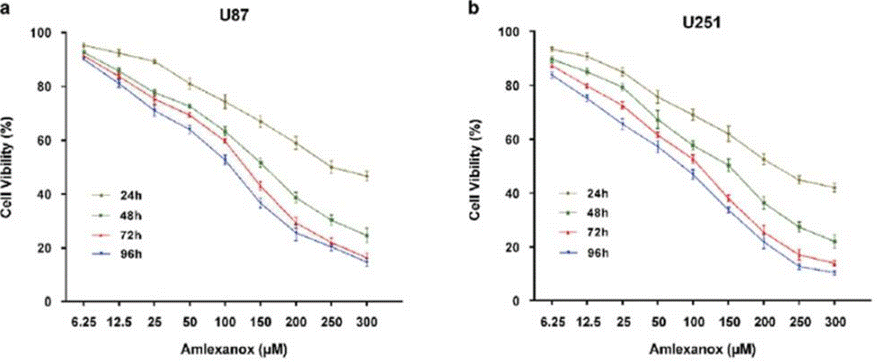
| U87 | Proliferation assay | 0-300 μM | 24, 48, 72 and 96 h | The IC50 values for 72 h of amlexanox treatment were approximately 140 μM in U87 cells. | ||
| U251 | Proliferation assay | 0-300 μM | 24, 48, 72 and 96 h | The IC50 values for 72 h of amlexanox treatment were approximately 120 μM in U251 cells. | ||
| NIH 3T3 cells | Function assay | 1 mM or 0.375 mM | 24 h | Cells exhibited a dramatic change in their morphology that included a larger and more flattened phenotype and often displayed long processes that are stable for at least 10 days | ||
| HUVEC | Function assay | 1 mM or 0.375 mM | 24 h | modify cell morphology | ||
| Swiss 3T3 | Function assay | 1 mM | 10-360 min | Amlexanox was able to stimulate the tyrosine phosphorylation of cortactin in a rapid and sustained manner. | ||
| Cliquez pour voir plus de données expérimentales sur la lignée cellulaire | ||||||
Informations chimiques, stockage et stabilité (Chemical Information, Storage & Stability)
| Poids moléculaire | 298.29 | Formule | C16H14N2O4 |
Stockage (À compter de la date de réception) | |
|---|---|---|---|---|---|
| N° CAS | 68302-57-8 | Télécharger le SDF | Stockage des solutions mères |
|
|
| Synonymes | CHX-3673, Amoxanox, AA-673 | Smiles | CC(C)C1=CC2=C(C=C1)OC3=NC(=C(C=C3C2=O)C(=O)O)N | ||
Solubilité (Solubility)
|
In vitro |
DMSO
: 59 mg/mL
(197.79 mM)
Ethanol : 2 mg/mL Water : Insoluble |
Calculateur de molarité
|
In vivo |
|||||
Calculateur de formulation in vivo (Solution claire)
Étape 1 : Saisir les informations ci-dessous (Recommandé : Un animal supplémentaire pour tenir compte des pertes pendant l'expérience)
Étape 2 : Saisir la formulation in vivo (Ceci est seulement le calculateur, pas la formulation. Veuillez nous contacter d'abord s'il n'y a pas de formulation in vivo dans la section Solubilité.)
Résultats du calcul :
Concentration de travail : mg/ml;
Méthode de préparation du liquide maître DMSO : mg médicament prédissous dans μL DMSO ( Concentration du liquide maître mg/mL, Veuillez nous contacter d'abord si la concentration dépasse la solubilité du DMSO du lot de médicament. )
Méthode de préparation de la formulation in vivo : Prendre μL DMSO liquide maître, puis ajouterμL PEG300, mélanger et clarifier, puis ajouterμL Tween 80, mélanger et clarifier, puis ajouter μL ddH2O, mélanger et clarifier.
Méthode de préparation de la formulation in vivo : Prendre μL DMSO liquide maître, puis ajouter μL Huile de maïs, mélanger et clarifier.
Note : 1. Veuillez vous assurer que le liquide est clair avant d'ajouter le solvant suivant.
2. Assurez-vous d'ajouter le(s) solvant(s) dans l'ordre. Vous devez vous assurer que la solution obtenue, lors de l'ajout précédent, est une solution claire avant de procéder à l'ajout du solvant suivant. Des méthodes physiques telles que le vortex, les ultrasons ou le bain-marie chaud peuvent être utilisées pour faciliter la dissolution.
Mécanisme d'action (Mechanism of Action)
| Targets/IC50/Ki |
TBK1
IKK-ε
|
|---|---|
| In vitro |
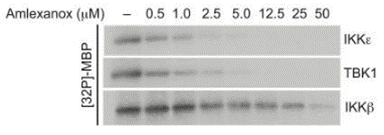
Dose-response relationship of amlexanox inhibition of IKK-ɛ and TBK1 activity as determined by MBP phosphorylation showing an IC50 of approximately 1-2 μM. This compound also blocks the activity of TBK1 at approximately the same concentrations but has no effect on IKK-α or IKK-β and at these concentrations do not block any other kinases from a broad panel representing most kinase families. Inhibition of IKK-ɛ or TBK1 by this chemical is competitive for its substrate ATP, indicating that it interacts with the enzymes in the ATP-binding site. It increases the phosphorylation of TBK1 at Ser172 in 3T3-L1 adipocytes and blocks polyinosinic:polycytidylic acid (poly I:C)-stimulated phosphorylation of interferon responsive factor-3 (IRF3), a presumed substrate of IKK-ɛ and TBK1.
|
| In vivo |
Treatment of obese mice with amlexanox elevates energy expenditure through increased thermogenesis, producing weight loss, improves insulin sensitivity and decreases steatosis.
|
Références |
Applications (Applications)
| Méthodes | Biomarqueurs | Images | PMID |
|---|---|---|---|
| Western blot | IKKε / TBK1 / IKKβ MMP2 / MMP9 IKBKE / MST1 / MST2 / p-MST / LAST1 / LAST2 / p-YAP1 / YAP1 / Axl / c-Myc / Cyr61 p-p65 / p-IκBα / S100A13 |
|
23396211 |
| Growth inhibition assay | Cell viability |
|
29048430 |
Informations sur l'essai clinique (Clinical Trial Information)
(données du https://clinicaltrials.gov, mis à jour le 2018-11-07)
| Numéro NCT | Recrutement | Conditions | Promoteur/Collaborateurs | Date de début | Phases |
|---|---|---|---|---|---|
| NCT01975935 | COMPLETED | Diabetes Mellitus Type 2; Non-alcoholic Fatty Liver Disease; Obesity |
University of Michigan |
2014-01 | PHASE2 |
| NCT01842282 | TERMINATED | Diabetes Mellitus Type 2; Non Alcoholic Fatty Liver Disease; Obesity |
University of Michigan |
2013-07-19 | PHASE2 |
| NCT01083875 | COMPLETED | Oral Mucositis |
Access Pharmaceuticals, Inc. |
2000-02 | PHASE2 |

Les produits sont destinés à la recherche uniquement. Ne pas utiliser chez l'homme. Nous ne vendons pas aux patients.
©Copyright 2013 Selleck Chemicals. Tous droits réservés.