
pour la recherche uniquement
R788 (Fostamatinib) Disodium Syk Inhibiteur
Réf. Catalogue: S2206
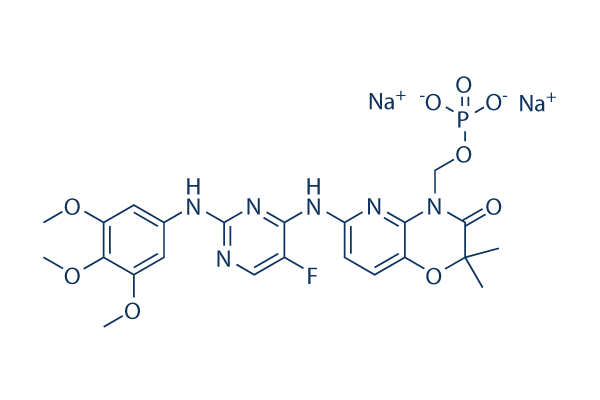
Structure chimique
Poids moléculaire: 624.42
Contrôle Qualité (Quality Control)
| Cibles apparentées | EGFR VEGFR JAK FGFR PDGFR Src HIF FLT3 HER2 FLT |
|---|---|
| Autre Syk Inhibiteurs | R406 R406 (free base) PRT062607 (P505-15) HCl Entospletinib (GS-9973) Piceatannol BAY 61-3606 dihydrochloride PRT-060318 2HCl TAK-659 Hydrochloride Lanraplenib (GS-SYK) RO9021 |
Culture cellulaire, traitement et concentration de travail
(Cell Culture, Treatment & Working Concentration)
| Lignées cellulaires | Type d'essai | Concentration | Temps d'incubation | Formulation | Description de l'activité | PMID |
|---|---|---|---|---|---|---|
| Ramos | Function assay | Inhibition of SYK in human Ramos cells, IC50 = 0.267 μM. | 23350847 | |||
| SJ-GBM2 | qHTS assay | qHTS of pediatric cancer cell lines to identify multiple opportunities for drug repurposing: Primary screen for SJ-GBM2 cells | 29435139 | |||
| A673 | qHTS assay | qHTS of pediatric cancer cell lines to identify multiple opportunities for drug repurposing: Primary screen for A673 cells | 29435139 | |||
| SK-N-MC | qHTS assay | qHTS of pediatric cancer cell lines to identify multiple opportunities for drug repurposing: Primary screen for SK-N-MC cells | 29435139 | |||
| NB-EBc1 | qHTS assay | qHTS of pediatric cancer cell lines to identify multiple opportunities for drug repurposing: Primary screen for NB-EBc1 cells | 29435139 | |||
| U-2 OS | qHTS assay | qHTS of pediatric cancer cell lines to identify multiple opportunities for drug repurposing: Primary screen for U-2 OS cells | 29435139 | |||
| Saos-2 | qHTS assay | qHTS of pediatric cancer cell lines to identify multiple opportunities for drug repurposing: Primary screen for Saos-2 cells | 29435139 | |||
| SK-N-SH | qHTS assay | qHTS of pediatric cancer cell lines to identify multiple opportunities for drug repurposing: Primary screen for SK-N-SH cells | 29435139 | |||
| NB1643 | qHTS assay | qHTS of pediatric cancer cell lines to identify multiple opportunities for drug repurposing: Primary screen for NB1643 cells | 29435139 | |||
| LAN-5 | qHTS assay | qHTS of pediatric cancer cell lines to identify multiple opportunities for drug repurposing: Primary screen for LAN-5 cells | 29435139 | |||
| Rh18 | qHTS assay | qHTS of pediatric cancer cell lines to identify multiple opportunities for drug repurposing: Primary screen for Rh18 cells | 29435139 | |||
| OHS-50 | qHTS assay | qHTS of pediatric cancer cell lines to identify multiple opportunities for drug repurposing: Primary screen for OHS-50 cells | 29435139 | |||
| RD | qHTS assay | qHTS of pediatric cancer cell lines to identify multiple opportunities for drug repurposing: Primary screen for RD cells | 29435139 | |||
| MG 63 (6-TG R) | qHTS assay | qHTS of pediatric cancer cell lines to identify multiple opportunities for drug repurposing: Primary screen for MG 63 (6-TG R) cells | 29435139 | |||
| Rh41 | qHTS assay | qHTS of pediatric cancer cell lines to identify multiple opportunities for drug repurposing: Primary screen for Rh41 cells | 29435139 | |||
| NB1643 | qHTS assay | qHTS of pediatric cancer cell lines to identify multiple opportunities for drug repurposing: Confirmatory screen for NB1643 cells | 29435139 | |||
| A673 | qHTS assay | qHTS of pediatric cancer cell lines to identify multiple opportunities for drug repurposing: Confirmatory screen for A673 cells) | 29435139 | |||
| SK-N-MC | qHTS assay | qHTS of pediatric cancer cell lines to identify multiple opportunities for drug repurposing: Confirmatory screen for SK-N-MC cells | 29435139 | |||
| LAN-5 | qHTS assay | qHTS of pediatric cancer cell lines to identify multiple opportunities for drug repurposing: Confirmatory screen for LAN-5 cells | 29435139 | |||
| DAOY | qHTS assay | qHTS of pediatric cancer cell lines to identify multiple opportunities for drug repurposing: Confirmatory screen for DAOY cells | 29435139 | |||
| BT-37 | qHTS assay | qHTS of pediatric cancer cell lines to identify multiple opportunities for drug repurposing: Confirmatory screen for BT-37 cells | 29435139 | |||
| TC32 | qHTS assay | qHTS of pediatric cancer cell lines to identify multiple opportunities for drug repurposing: Confirmatory screen for TC32 cells | 29435139 | |||
| MG 63 (6-TG R) | qHTS assay | qHTS of pediatric cancer cell lines to identify multiple opportunities for drug repurposing: Confirmatory screen for MG 63 (6-TG R) cells | 29435139 | |||
| U-2 OS | qHTS assay | qHTS of pediatric cancer cell lines to identify multiple opportunities for drug repurposing: Confirmatory screen for U-2 OS cells | 29435139 | |||
| Rh41 | qHTS assay | qHTS of pediatric cancer cell lines to identify multiple opportunities for drug repurposing: Confirmatory screen for Rh41 cells | 29435139 | |||
| RD | qHTS assay | qHTS of pediatric cancer cell lines to identify multiple opportunities for drug repurposing: Confirmatory screen for RD cells | 29435139 | |||
| Rh30 | qHTS assay | qHTS of pediatric cancer cell lines to identify multiple opportunities for drug repurposing: Confirmatory screen for Rh30 cells | 29435139 | |||
| Saos-2 | qHTS assay | qHTS of pediatric cancer cell lines to identify multiple opportunities for drug repurposing: Confirmatory screen for Saos-2 cells | 29435139 | |||
| OHS-50 | qHTS assay | qHTS of pediatric cancer cell lines to identify multiple opportunities for drug repurposing: Confirmatory screen for OHS-50 cells | 29435139 | |||
| SK-N-SH | qHTS assay | qHTS of pediatric cancer cell lines to identify multiple opportunities for drug repurposing: Confirmatory screen for SK-N-SH cells | 29435139 | |||
| Cliquez pour voir plus de données expérimentales sur la lignée cellulaire | ||||||
Informations chimiques, stockage et stabilité (Chemical Information, Storage & Stability)
| Poids moléculaire | 624.42 | Formule | C23H24FN6O9P.2Na |
Stockage (À compter de la date de réception) | |
|---|---|---|---|---|---|
| N° CAS | 1025687-58-4 | Télécharger le SDF | Stockage des solutions mères |
|
|
| Synonymes | Tamatinib Fosdium | Smiles | CC1(C(=O)N(C2=C(O1)C=CC(=N2)NC3=NC(=NC=C3F)NC4=CC(=C(C(=C4)OC)OC)OC)COP(=O)([O-])[O-])C.[Na+].[Na+] | ||
Solubilité (Solubility)
|
In vitro |
DMSO
: 12 mg/mL
(19.21 mM)
Water : Insoluble Ethanol : Insoluble |
Calculateur de molarité
|
In vivo |
|||||
Calculateur de formulation in vivo (Solution claire)
Étape 1 : Saisir les informations ci-dessous (Recommandé : Un animal supplémentaire pour tenir compte des pertes pendant l'expérience)
Étape 2 : Saisir la formulation in vivo (Ceci est seulement le calculateur, pas la formulation. Veuillez nous contacter d'abord s'il n'y a pas de formulation in vivo dans la section Solubilité.)
Résultats du calcul :
Concentration de travail : mg/ml;
Méthode de préparation du liquide maître DMSO : mg médicament prédissous dans μL DMSO ( Concentration du liquide maître mg/mL, Veuillez nous contacter d'abord si la concentration dépasse la solubilité du DMSO du lot de médicament. )
Méthode de préparation de la formulation in vivo : Prendre μL DMSO liquide maître, puis ajouterμL PEG300, mélanger et clarifier, puis ajouterμL Tween 80, mélanger et clarifier, puis ajouter μL ddH2O, mélanger et clarifier.
Méthode de préparation de la formulation in vivo : Prendre μL DMSO liquide maître, puis ajouter μL Huile de maïs, mélanger et clarifier.
Note : 1. Veuillez vous assurer que le liquide est clair avant d'ajouter le solvant suivant.
2. Assurez-vous d'ajouter le(s) solvant(s) dans l'ordre. Vous devez vous assurer que la solution obtenue, lors de l'ajout précédent, est une solution claire avant de procéder à l'ajout du solvant suivant. Des méthodes physiques telles que le vortex, les ultrasons ou le bain-marie chaud peuvent être utilisées pour faciliter la dissolution.
Mécanisme d'action (Mechanism of Action)
| Caractéristiques |
Clinically used oral formulation of R406.
|
|---|---|
| Targets/IC50/Ki |
Syk
(Cell-free assay) 41 nM
|
| In vitro |
R935788 is a methylene phosphate prodrug of R406, which can be rapidly converted to R406 in vivo. R406 (in vitro active form of R935788) selectively inhibits Syk-dependent signaling with EC50 values ranging from 33 nM to 171 nM, more potently than Syk-independent pathways in different cells. R406 inhibits cellular proliferation of a variety of diffuse large B-cell lymphoma (DLBCL) cell lines with EC50 values ranging from 0.8 μM to 8.1 μM. R406 treatment reduces basal phosphorylation of BLNK, Akt, glycogen synthase kinase-3 (GSK-3), forkhead box O (FOXO) and ERK not only in cells with high (TCL-002) but also in cells with low levels of phosphorylated Syk (TCL1-551). In addition, R406 completely inhibits the anti-IgM induced Bcr signal in TCL1 leukemias. Despite the higher levels of constitutively active Syk in TCL1 leukemias, R406 is not selectively cytotoxic to the leukemic cells.
|
| Essai kinase |
Essais de kinases par polarisation de fluorescence in vitro
|
|
Le R406 (forme active in vitro du R935788) est dilué en série dans du DMSO puis dilué à 1% de DMSO dans un tampon kinase (20 mM HEPES, pH 7,4, 5 mM MgCl2, 2 mM MnCl2, 1 mM DTT, 0,1 mg/mL de BGG acétylé). L'ATP et le substrat dans le tampon kinase sont ajoutés à température ambiante, ce qui entraîne une concentration finale de DMSO de 0,2%. Les réactions de kinase sont réalisées dans un volume final de 20 μL contenant 5 μM de substrat peptidique HS1 et 4 μM d'ATP et sont initiées par l'addition de 0,125 ng de Syk dans le tampon kinase. La réaction est laissée se dérouler pendant 40 minutes à température ambiante. La réaction est arrêtée par l'addition de 20 μL d'un mélange d'extinction PTK contenant de l'EDTA/anticorps anti-phosphotyrosine (1× final)/traceur phosphopeptidique fluorescent (0,5× final) dilué dans un tampon de dilution FP. La plaque est incubée pendant 30 minutes dans l'obscurité à température ambiante puis lue sur un lecteur de plaque à polarisation de fluorescence Polarion. Les données sont converties pour déterminer la quantité de phosphopeptide présent à l'aide d'une courbe d'étalonnage générée par compétition avec le compétiteur phosphopeptidique fourni dans le kit d'essai de la tyrosine kinase. Pour la détermination de l'IC50, le R406 est testé à onze concentrations en double et l'ajustement de la courbe est réalisé par analyse de régression non linéaire à l'aide du logiciel Prism GraphPad.
|
|
| In vivo |
Given that plasma half-life of R406 in mice is less than 2 hours, R935788 is administered in 3 divided doses at 3-hour intervals to provide continuous Syk inhibition during each day of treatment, mimicking the longer plasma half-life in humans (15 hours). Despite the relatively modest cytotoxic effect in vitro, R935788 significantly inhibits the proliferation and survival of leukemic cell in vivo, which is associated with the blocking of antigen-dependent B-cell receptor (Bcr) signaling rather than inhibition of constitutive Syk activity. R935788 treatment at 80 mg/kg/day for 18-21 days potently inhibits tumor growth of TCL1-002, TCL1-551 and TCL1-870 in mice with undetectable leukemic CD5+/B220+ cells at the last day of treatment, significantly prolongs the survival of the treated mice with median survival increased from 45/46 days to 170/172 days, and completely eradicates the malignant cells in a substantial proportion of mice after a 6-month follow-up period without affecting the production of normal B lymphocytes. R935788 treatment also induces an early and transient migration of both normal and malignant B cells from spleen and lymph nodes to peripheral blood, which is subsequently followed by selective growth inhibition of the malignant B-cell population. In addition, R935788 is also effective against spontaneously developing TCL1 leukemias in Eμ-TCL1 transgenic mice.
|
Références |
|
Applications (Applications)
| Méthodes | Biomarqueurs | Images | PMID |
|---|---|---|---|
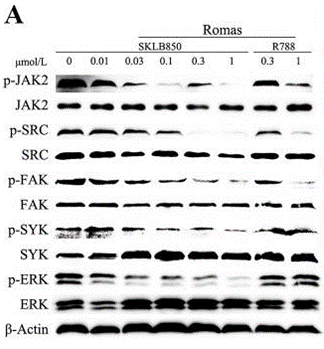
| Western blot | p-JAK2 / JAK2 / p-SRC / SRC / p-FAK / FAK / p-SYK / SYK / p-ERK / ERK p-SYK(525-526) / t-SYK / p-SYK(323) / p-BTK / t-BTK p-MEK / MEK / p-ERK / ERK / p-AKT / AKT |
|
29340070 |
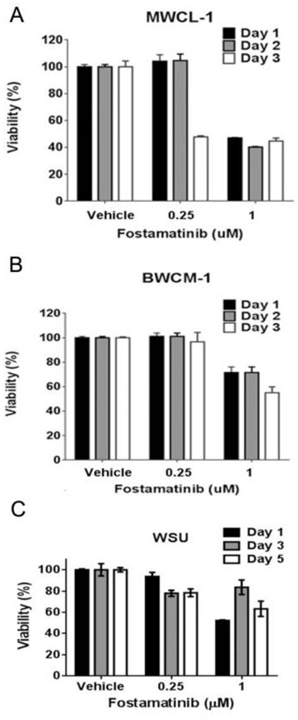
| Growth inhibition assay | Cell viability |
|
25748087 |
Informations sur l'essai clinique (Clinical Trial Information)
(données du https://clinicaltrials.gov, mis à jour le 2026-01-22)
| Numéro NCT | Recrutement | Conditions | Promoteur/Collaborateurs | Date de début | Phases |
|---|---|---|---|---|---|
| NCT06233110 | RECRUITING | Chronic Graft Versus Host Disease |
Stefanie Sarantopoulos, MD, PhD. |
2025-10-29 | PHASE1 |
| NCT06948097 | RECRUITING | Lung Transplantation |
National Heart, Lung, and Blood Institute (NHLBI) |
2026-09-09 | PHASE1 |
| NCT06639724 | RECRUITING | Pancreatic Ductal Adenocarcinoma (PDAC) |
University of California, San Diego |
2024-12-05 | PHASE1 |
| NCT06564207 | NOT_YET_RECRUITING | Acute Respiratory Distress Syndrome; ARDS |
Inova Health Care Services |
2026-08-30 | PHASE2 |
| NCT05904093 | RECRUITING | Sickle Cell Disease; Hb-SS Disease; Hemoglobin S; Disease Sickle Cell Anemia; Sickle Cell Disorders; Hemoglobin Beta Thalassemia Disease |
National Heart, Lung, and Blood Institute (NHLBI) |
2024-12-18 | PHASE1 |
| NCT05509582 | WITHDRAWN | Immune Mediated Anemia; Immune Mediated Thrombocytopenia; Chronic GVHD |
National Heart, Lung, and Blood Institute (NHLBI) |
2025-11-07 | PHASE2 |
Foire aux questions (Frequently Asked Questions)
Question 1:
What’s the difference between S2625 and S2206?
Réponse :
The differences between S2625 and S2206: 1. S2206 is more stable than S2625; 2. The water solubility of S2206 is better than S2625; 3. The absorption of S2206 is harder than S2625, so you need to test the suitable dosage if you use it in animal assays; 4. The potency of S2206 and S2625 is similar.

Les produits sont destinés à la recherche uniquement. Ne pas utiliser chez l'homme. Nous ne vendons pas aux patients.
©Copyright 2013 Selleck Chemicals. Tous droits réservés.