
pour la recherche uniquement
IPA-3 PAK Inhibiteur
Réf. CatalogueS7093
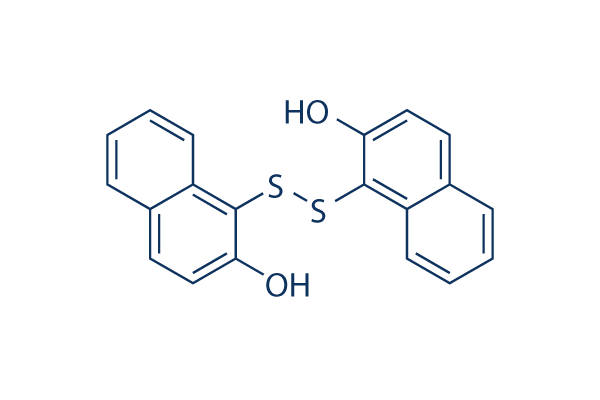
Structure chimique
Poids moléculaire: 350.45
Contrôle Qualité
- Cité dans Nature Medicine pour sa qualité supérieure
- COA
- NMR
- SDS
- Fiche technique
| Cibles apparentées | Akt Wnt/beta-catenin PKC HSP ROCK Microtubule Associated Integrin Bcr-Abl Actin FAK |
|---|---|
| Autre PAK Inhibiteurs | FRAX597 PF-3758309 FRAX486 FRAX1036 LCH-7749944 NVS-PAK1-1 Hydrastine GNE 2861 G-5555 |
Culture cellulaire, traitement et concentration de travail
| Lignées cellulaires | Type dessai | Concentration | Temps dincubation | Formulation | Description de lactivité | PMID |
|---|---|---|---|---|---|---|
| human NALM-6 cell | Growth inhibition assay | Inhibition of human NALM-6 cell growth in a cell viability assay, IC50=0.97694 μM | ||||
| human SW1710 cell | Growth inhibition assay | Inhibition of human SW1710 cell growth in a cell viability assay, IC50=1.17833 μM | ||||
| human YT cell | Growth inhibition assay | Inhibition of human YT cell growth in a cell viability assay, IC50=1.39036 μM | ||||
| human BL-70 cell | Growth inhibition assay | Inhibition of human BL-70 cell growth in a cell viability assay, IC50=2.03796 μM | ||||
| human SIG-M5 cell | Growth inhibition assay | Inhibition of human SIG-M5 cell growth in a cell viability assay, IC50=2.10219 μM | ||||
| human MCF7 cell | Growth inhibition assay | Inhibition of human MCF7 cell growth in a cell viability assay, IC50=2.1807 μM | ||||
| human GB-1 cell | Growth inhibition assay | Inhibition of human GB-1 cell growth in a cell viability assay, IC50=2.63494 μM | ||||
| human KU812 cell | Growth inhibition assay | Inhibition of human KU812 cell growth in a cell viability assay, IC50=2.7595 μM | ||||
| human QIMR-WIL cell | Growth inhibition assay | Inhibition of human QIMR-WIL cell growth in a cell viability assay, IC50=2.90891 μM | ||||
| human BL-41 cell | Growth inhibition assay | Inhibition of human BL-41 cell growth in a cell viability assay, IC50=3.09844 μM | ||||
| human CMK cell | Growth inhibition assay | Inhibition of human CMK cell growth in a cell viability assay, IC50=3.14599 μM | ||||
| human U-698-M cell | Growth inhibition assay | Inhibition of human U-698-M cell growth in a cell viability assay, IC50=3.23856 μM | ||||
| human Daoy cell | Growth inhibition assay | Inhibition of human Daoy cell growth in a cell viability assay, IC50=3.24662 μM | ||||
| human 786-0 cell | Growth inhibition assay | Inhibition of human 786-0 cell growth in a cell viability assay, IC50=3.31805 μM | ||||
| human REH cell | Growth inhibition assay | Inhibition of human REH cell growth in a cell viability assay, IC50=3.36655 μM | ||||
| human MHH-PREB-1 cell | Growth inhibition assay | Inhibition of human MHH-PREB-1 cell growth in a cell viability assay, IC50=3.46687 μM | ||||
| human KE-37 cell growth | Growth inhibition assay | Inhibition of human KE-37 cell growth in a cell viability assay, IC50=3.50231 μM | ||||
| human CAL-51 cell | Growth inhibition assay | Inhibition of human CAL-51 cell growth in a cell viability assay, IC50=3.54519 μM | ||||
| human CA46 cell | Growth inhibition assay | Inhibition of human CA46 cell growth in a cell viability assay, IC50=3.6618 μM | ||||
| human HEL cell | Growth inhibition assay | Inhibition of human HEL cell growth in a cell viability assay, IC50=3.72768 μM | ||||
| human NB6 cell | Growth inhibition assay | Inhibition of human NB6 cell growth in a cell viability assay, IC50=3.83751 μM | ||||
| human 8305C cell | Growth inhibition assay | Inhibition of human 8305C cell growth in a cell viability assay, IC50=4.16758 μM | ||||
| human EW-13 cell | Growth inhibition assay | Inhibition of human EW-13 cell growth in a cell viability assay, IC50=4.20148 μM | ||||
| human NB13 cell | Growth inhibition assay | Inhibition of human NB13 cell growth in a cell viability assay, IC50=4.2256 μM | ||||
| human EB2 cell | Growth inhibition assay | Inhibition of human EB2 cell growth in a cell viability assay, IC50=4.49142 μM | ||||
| human HOS cell | Growth inhibition assay | Inhibition of human HOS cell growth in a cell viability assay | ||||
| human HLE cell | Growth inhibition assay | Inhibition of human HLE cell growth in a cell viability assay, IC50=4.52149 μM | ||||
| human ST486 cell | Growth inhibition assay | Inhibition of human ST486 cell growth in a cell viability assay, IC50=4.8654 μM | ||||
| human NCI-H2009 cell | Growth inhibition assay | Inhibition of human NCI-H2009 cell growth in a cell viability assay, IC50=5.04354 μM | ||||
| human NH-12 cell | Growth inhibition assay | Inhibition of human NH-12 cell growth in a cell viability assay, IC50=5.1176 μM | ||||
| human BFTC-905 cell | Growth inhibition assay | Inhibition of human BFTC-905 cell growth in a cell viability assay, IC50=5.14768 μM | ||||
| human RKO cell | Growth inhibition assay | Inhibition of human RKO cell growth in a cell viability assay, IC50=5.28471 μM | ||||
| human PF-382 | Growth inhibition assay | Inhibition of human PF-382 cell growth in a cell viability assay, IC50=5.35226 μM | ||||
| human SR cell | Growth inhibition assay | Inhibition of human SR cell growth in a cell viability assay, IC50=5.37256 μM | ||||
| human WSU-NHL cell | Growth inhibition assay | Inhibition of human WSU-NHL cell growth in a cell viability assay, IC50=5.52067 μM | ||||
| human CAL-12T cell | Growth inhibition assay | Inhibition of human CAL-12T cell growth in a cell viability assay, IC50=5.6414 μM | ||||
| human Daudi cell | Growth inhibition assay | Inhibition of human Daudi cell growth in a cell viability assay, IC50=5.68477 μM | ||||
| human MC-CAR cell | Growth inhibition assay | Inhibition of human MC-CAR cell growth in a cell viability assay, IC50=5.70644 μM | ||||
| human RPMI-8402 cell | Growth inhibition assay | Inhibition of human RPMI-8402 cell growth in a cell viability assay, IC50=5.76876 μM | ||||
| human CCRF-CEM cell | Growth inhibition assay | Inhibition of human CCRF-CEM cell growth in a cell viability assay, IC50=5.97667 μM | ||||
| human CHP-126 cell | Growth inhibition assay | Inhibition of human CHP-126 cell growth in a cell viability assay, IC50=6.74268 μM | ||||
| human NB69 cell | Growth inhibition assay | Inhibition of human NB69 cell growth in a cell viability assay, IC50=6.76352 μM | ||||
| human KS-1 cell | Growth inhibition assay | Inhibition of human KS-1 cell growth in a cell viability assay, IC50=6.88549 μM | ||||
| human J82 cell | Growth inhibition assay | Inhibition of human J82 cell growth in a cell viability assay, IC50=7.04965 μM | ||||
| human SW872 cell | Growth inhibition assay | Inhibition of human SW872 cell growth in a cell viability assay, IC50=7.83558 μM | ||||
| human HC-1 cell | Growth inhibition assay | Inhibition of human HC-1 cell growth in a cell viability assay, IC50=8.06805 μM | ||||
| human DU-145 cell | Growth inhibition assay | Inhibition of human DU-145 cell growth in a cell viability assay, IC50=8.21464 μM | ||||
| human HL-60 cell | Growth inhibition assay | Inhibition of human HL-60 cell growth in a cell viability assay, IC50=8.84605 μM | ||||
| human MV-4-11 cell | Growth inhibition assay | Inhibition of human MV-4-11 cell growth in a cell viability assay, IC50=9.1649 μM | ||||
| human SK-N-DZ cell | Growth inhibition assay | Inhibition of human SK-N-DZ cell growth in a cell viability assay, IC50=9.20423 μM | ||||
| human HT-1197 cell | Growth inhibition assay | Inhibition of human HT-1197 cell growth in a cell viability assay, IC50=10.3073 μM | ||||
| human NOS-1 cell | Growth inhibition assay | Inhibition of human NOS-1 cell growth in a cell viability assay, IC50=11.7152 μM | ||||
| human HT-1080 cell | Growth inhibition assay | Inhibition of human HT-1080 cell growth in a cell viability assay, IC50=18.6283 μM | ||||
| human SK-LU-1 cell | Growth inhibition assay | Inhibition of human SK-LU-1 cell growth in a cell viability assay, IC50=18.8731 μM | ||||
| human SW48 cell | Growth inhibition assay | Inhibition of human SW48 cell growth in a cell viability assay, IC50=21.8897 μM | ||||
| human A2780 cell | Growth inhibition assay | Inhibition of human A2780 cell growth in a cell viability assay, IC50=28.371 μM | ||||
| Cliquez pour voir plus de données expérimentales sur la lignée cellulaire | ||||||
Informations chimiques, stockage et stabilité
| Poids moléculaire | 350.45 | Formule | C20H14O2S2 |
Stockage (À compter de la date de réception) | |
|---|---|---|---|---|---|
| N° CAS | 42521-82-4 | Télécharger le SDF | Stockage des solutions mères |
|
|
| Synonymes | N/A | Smiles | C1=CC=C2C(=C1)C=CC(=C2SSC3=C(C=CC4=CC=CC=C43)O)O | ||
Solubilité
|
In vitro |
DMSO
: 70 mg/mL
(199.74 mM)
Ethanol : 7 mg/mL Water : Insoluble |
Calculateur de molarité
|
In vivo |
|||||
Calculateur de formulation in vivo (Solution claire)
Étape 1 : Saisir les informations ci-dessous (Recommandé : Un animal supplémentaire pour tenir compte des pertes pendant lexpérience)
Étape 2 : Saisir la formulation in vivo (Ceci est seulement le calculateur, pas la formulation. Veuillez nous contacter dabord sil ny a pas de formulation in vivo dans la section Solubilité.)
Résultats du calcul :
Concentration de travail : mg/ml;
Méthode de préparation du liquide maître DMSO : mg médicament prédissous dans μL DMSO ( Concentration du liquide maître mg/mL, Veuillez nous contacter dabord si la concentration dépasse la solubilité du DMSO du lot de médicament. )
Méthode de préparation de la formulation in vivo : Prendre μL DMSO liquide maître, puis ajouterμL PEG300, mélanger et clarifier, puis ajouterμL Tween 80, mélanger et clarifier, puis ajouter μL ddH2O, mélanger et clarifier.
Méthode de préparation de la formulation in vivo : Prendre μL DMSO liquide maître, puis ajouter μL Huile de maïs, mélanger et clarifier.
Note : 1. Veuillez vous assurer que le liquide est clair avant dajouter le solvant suivant.
2. Assurez-vous dajouter le(s) solvant(s) dans lordre. Vous devez vous assurer que la solution obtenue, lors de lajout précédent, est une solution claire avant de procéder à lajout du solvant suivant. Des méthodes physiques telles que le vortex, les ultrasons ou le bain-marie chaud peuvent être utilisées pour faciliter la dissolution.
Mécanisme daction
| Caractéristiques |
IPA-3 binds covalently to the Pak1 regulatory domain and prevents binding to the upstream activator Cdc42.
|
|---|---|
| Targets/IC50/Ki |
PAK1
(Cell-free assay) 2.5 μM
|
| In vitro |
IPA-3 est un inhibiteur allostérique non compétitif de l'ATP de la p21-activated kinase 1 (Pak1). Le PIR3.5 est le composé de contrôle de ce composé. Il empêche l'autophosphorylation de Pak1 stimulée par Cdc42 sur Thr423. Ce composé empêche également l'autophosphorylation de Pak1 dépendante de la sphingosine. Il ne cible pas les résidus cystéine exposés sur Pak1. La liaison disulfure de cet inhibiteur est essentielle pour l'inhibition de Pak1 et la réduction in vitro par l'agent réducteur dithiothreitol (DTT) abolit l'inhibition de Pak1 par ce produit chimique. Il inhibe l'activation de Pak1 par divers activateurs, mais n'inhibe pas le Pak1 préactivé. Ce composé inhibe l'activation de Pak stimulée par le PDGF dans les fibroblastes embryonnaires de souris. Il inhibe l'activation de Pak1 en partie en se liant de manière covalente au domaine régulateur de Pak1. Ce produit chimique se lie à Pak1 de manière covalente d'une manière dépendante du temps et de la température. Il empêche la liaison de l'activateur de Pak1, Cdc42. Cet inhibiteur se lie directement au domaine autorégulateur de Pak1. Il inhibe de manière réversible le ruffling membranaire induit par le PMA dans les cellules.
|
Références |
|
Applications
| Méthodes | Biomarqueurs | Images | PMID |
|---|---|---|---|
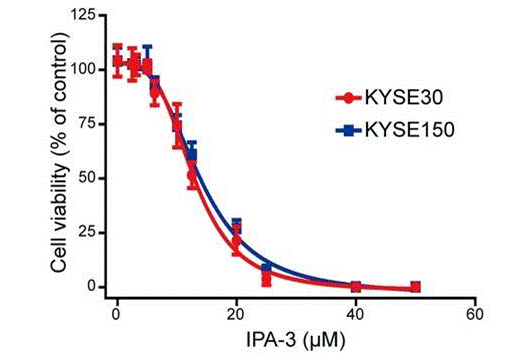
| Growth inhibition assay | Cell viability |
|
30971268 |
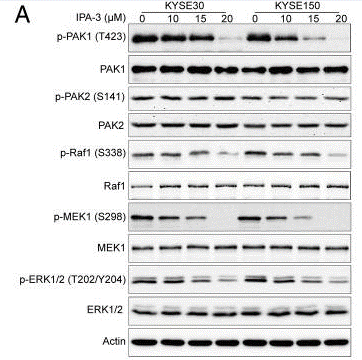
| Western blot | p-PAK1 / PAK1 / p-PAK2 / PAK2 / p-Raf1 / Raf1 / p-MEK1 / MEK1 / p-ERK / ERK |
|
30971268 |
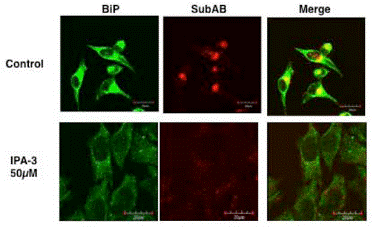
| Immunofluorescence | BiP NF-κB Paxillin |
|
24844382 |
Support technique
Tel: +1-832-582-8158 Ext:3
Si vous avez dautres questions, veuillez laisser un message.
Foire aux questions
Question 1:
If this compound is cell membrane permeable, would it be suitable for PAK1 inhibition on a pancreatic beta cell line?
Réponse :
Based on the reference, this compound is able to penetrate the cell membrane, and it is likely to inhibit PAK1 on a pancreatic beta cell line although there is no reference confirming it: Figure 3: http://www.ncbi.nlm.nih.gov/pmc/articles/PMC3963893/; http://www.ncbi.nlm.nih.gov/pmc/articles/PMC4353635/

Les produits sont destinés à la recherche uniquement. Ne pas utiliser chez lhomme. Nous ne vendons pas aux patients.
©Copyright 2013 Selleck Chemicals. Tous droits réservés.