
pour la recherche uniquement
ONX-0914 (PR-957) Proteasome inhibiteur
Réf. CatalogueS7172
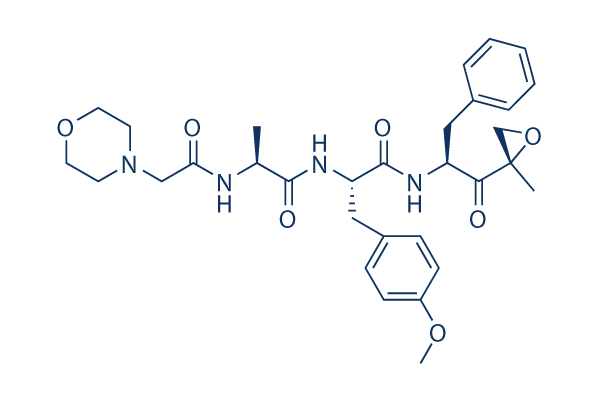
Structure chimique
Poids moléculaire: 580.67
Contrôle Qualité
| Cibles apparentées | HDAC Caspase Secretase MMP HCV Protease Cysteine Protease DPP Tyrosinase HIV Protease Serine Protease |
|---|---|
| Autre Proteasome Inhibiteurs | MG132 Celastrol Epoxomicin (BU-4061T) Oprozomib Delanzomib VR23 Marizomib (Salinosporamide A) PI-1840 KSQ-4279 (USP1-IN-1) Isoginkgetin |
Culture cellulaire, traitement et concentration de travail
| Lignées cellulaires | Type dessai | Concentration | Temps dincubation | Formulation | Description de lactivité | PMID |
|---|---|---|---|---|---|---|
| Raji | Function assay | Inhibition of proteasome subunit beta-5i in human Raji cells using BODIPY-NC005 by fluorescent densitometry, IC50=0.0057μM | 25006746 | |||
| EBC1 | Antitumor assay | 15 mg/kg | 5 days | Antitumor activity against human EBC1 cells xenografted in CD-1 nude mouse assessed as tumor regression at 15 mg/kg, po qd administered for 5 days on and 2 days off up to 32 days | 25006746 | |
| SJ-GBM2 | qHTS assay | qHTS of pediatric cancer cell lines to identify multiple opportunities for drug repurposing: Primary screen for SJ-GBM2 cells | 25006746 | |||
| SK-N-SH | qHTS assay | qHTS of pediatric cancer cell lines to identify multiple opportunities for drug repurposing: Primary screen for SK-N-SH cells | 25006746 | |||
| RPMI8226 | Function assay | Inhibition of proteasome subunit beta-1i in human RPMI8226 cells using BODIPY-NC001 by fluorescent densitometry, IC50=0.34μM | 25006746 | |||
| Raji | Function assay | Inhibition of proteasome subunit beta-1i in human Raji cells using BODIPY- epoxomicin by fluorescent densitometry, IC50=0.46μM | 25006746 | |||
| Raji | Function assay | Inhibition of proteasome subunit beta-2i in human Raji cells using BODIPY- epoxomicin by fluorescent densitometry, IC50=0.59μM | 25006746 | |||
| RPMI8226 | Function assay | Inhibition of proteasome subunit beta-2i in human RPMI8226 cells using BODIPY-epoxomicin by fluorescent densitometry, IC50=0.59μM | 25006746 | |||
| Raji | Function assay | Inhibition of 20s proteasome subunit beta-2c in human Raji cells using BODIPY- epoxomicin by fluorescent densitometry, IC50=1.1μM | 25006746 | |||
| RPMI8226 | Function assay | Inhibition of 20s proteasome subunit beta-2c in human RPMI8226 cells using BODIPY-epoxomicin by fluorescent densitometry, IC50=1.1μM | 25006746 | |||
| SK-N-MC | qHTS assay | qHTS of pediatric cancer cell lines to identify multiple opportunities for drug repurposing: Primary screen for SK-N-MC cells | 29339252 | |||
| RD | qHTS assay | qHTS of pediatric cancer cell lines to identify multiple opportunities for drug repurposing: Primary screen for RD cells | 29339252 | |||
| MG 63 (6-TG R) | qHTS assay | qHTS of pediatric cancer cell lines to identify multiple opportunities for drug repurposing: Primary screen for MG 63 (6-TG R) cells | 29339252 | |||
| NCI-H727 | Cytotoxicity assay | 48 hrs | Cytotoxicity against human NCI-H727 cells assessed as reduction in cell viability after 48 hrs by Hoechst 33342 staining based HCS assay, EC50=0.3μM | 29339252 | ||
| PC3 | Cytotoxicity assay | 48 hrs | Cytotoxicity against human PC3 cells assessed as reduction in cell viability after 48 hrs by Hoechst 33342 staining based HCS assay, EC50=0.33μM | 29339252 | ||
| HuH7 | Cytotoxicity assay | 48 hrs | Cytotoxicity against human HuH7 cells assessed as reduction in cell viability after 48 hrs by Hoechst 33342 staining based HCS assay, EC50=0.39μM | 29339252 | ||
| Caco2 | Cytotoxicity assay | 48 hrs | Cytotoxicity against human Caco2 cells assessed as reduction in cell viability after 48 hrs by Hoechst 33342 staining based HCS assay, EC50=1.3μM | 29339252 | ||
| DAOY | qHTS assay | qHTS of pediatric cancer cell lines to identify multiple opportunities for drug repurposing: Primary screen for DAOY cells | 30380863 | |||
| A673 | qHTS assay | qHTS of pediatric cancer cell lines to identify multiple opportunities for drug repurposing: Primary screen for A673 cells | 30380863 | |||
| Rh41 | qHTS assay | qHTS of pediatric cancer cell lines to identify multiple opportunities for drug repurposing: Primary screen for Rh41 cells | 30380863 | |||
| A20 | Function assay | Inhibition of LMP2 in mouse A20 cells by ELISA, IC50=0.328μM | 30380863 | |||
| A20 | Function assay | Inhibition of 20S proteosome beta 5 in mouse A20 cells by ELISA, IC50=0.401μM | 30380863 | |||
| MOLT4 | Function assay | Inhibition of 20S proteosome beta 5 in human MOLT4 cells by ELISA, IC50=0.422μM | 30380863 | |||
| A20 | Function assay | Inhibition of MECL1 in mouse A20 cells by ELISA, IC50=0.699μM | 30380863 | |||
| MOLT4 | Function assay | Inhibition of MECL1 in human MOLT4 cells by ELISA, IC50=0.902μM | 30380863 | |||
| A20 | Function assay | Inhibition of 20S proteosome beta 2 in mouse A20 cells by ELISA, IC50=0.913μM | 30380863 | |||
| MOLT4 | Function assay | Inhibition of 20S proteosome beta 2 in human MOLT4 cells by ELISA, IC50=0.927μM | 30380863 | |||
| PBMC | Function assay | 100 nM | 3 to 72 hrs | Inhibition of 20S proteasome beta 5i in human PBMC cells assessed as induction of PSMB5 expression at 100 nM after 3 to 72 hrs by RT-PCR analysis | 31283222 | |
| PBMC | Function assay | 100 nM | 3 to 72 hrs | Inhibition of 20S proteasome beta 5i in human PBMC cells assessed as induction of PSMB6 expression at 100 nM after 3 to 72 hrs by RT-PCR analysis | 31283222 | |
| PBMC | Function assay | 100 nM | 3 to 72 hrs | Inhibition of 20S proteasome beta 5i in human PBMC cells assessed as induction of PSMB7 expression at 100 nM after 3 to 72 hrs by RT-PCR method | 31283222 | |
| Cliquez pour voir plus de données expérimentales sur la lignée cellulaire | ||||||
Informations chimiques, stockage et stabilité
| Poids moléculaire | 580.67 | Formule | C31H40N4O7 |
Stockage (À compter de la date de réception) | |
|---|---|---|---|---|---|
| N° CAS | 960374-59-8 | Télécharger le SDF | Stockage des solutions mères |
|
|
| Synonymes | N/A | Smiles | CC(C(=O)NC(CC1=CC=C(C=C1)OC)C(=O)NC(CC2=CC=CC=C2)C(=O)C3(CO3)C)NC(=O)CN4CCOCC4 | ||
Solubilité
|
In vitro |
DMSO
: 100 mg/mL
(172.21 mM)
Water : 100 mg/mL Ethanol : 100 mg/mL |
Calculateur de molarité
|
In vivo |
|||||
Calculateur de formulation in vivo (Solution claire)
Étape 1 : Saisir les informations ci-dessous (Recommandé : Un animal supplémentaire pour tenir compte des pertes pendant lexpérience)
Étape 2 : Saisir la formulation in vivo (Ceci est seulement le calculateur, pas la formulation. Veuillez nous contacter dabord sil ny a pas de formulation in vivo dans la section Solubilité.)
Résultats du calcul :
Concentration de travail : mg/ml;
Méthode de préparation du liquide maître DMSO : mg médicament prédissous dans μL DMSO ( Concentration du liquide maître mg/mL, Veuillez nous contacter dabord si la concentration dépasse la solubilité du DMSO du lot de médicament. )
Méthode de préparation de la formulation in vivo : Prendre μL DMSO liquide maître, puis ajouterμL PEG300, mélanger et clarifier, puis ajouterμL Tween 80, mélanger et clarifier, puis ajouter μL ddH2O, mélanger et clarifier.
Méthode de préparation de la formulation in vivo : Prendre μL DMSO liquide maître, puis ajouter μL Huile de maïs, mélanger et clarifier.
Note : 1. Veuillez vous assurer que le liquide est clair avant dajouter le solvant suivant.
2. Assurez-vous dajouter le(s) solvant(s) dans lordre. Vous devez vous assurer que la solution obtenue, lors de lajout précédent, est une solution claire avant de procéder à lajout du solvant suivant. Des méthodes physiques telles que le vortex, les ultrasons ou le bain-marie chaud peuvent être utilisées pour faciliter la dissolution.
Mécanisme daction
| Caractéristiques |
The first highly selective, small molecule inhibitor of the immunoproteasome. Potential use in cancer and autoimmune diseases (e.g. rheumatoid arthritis, inflammatory bowel disease, and lupus).
|
|---|---|
| Targets/IC50/Ki |
LMP7
(Cell-free assay) ~10 nM
|
| In vitro |
ONX-0914 (PR-957) est 20 à 40 fois plus sélectif pour LMP7 que pour les sites les plus sensibles suivants, β5 ou LMP2. Il bloque la présentation d'antigènes restreints par le MHC-I spécifiques de LMP7 in vitro et in vivo avec une réactivité croisée minimale pour le Proteasome constitutif. L'inhibition sélective de LMP7 par ce composé bloque la production d'interleukine-23 (IL-23) par les monocytes activés et d'interféron-gamma et d'IL-2 par les lymphocytes T. L'inhibition de LMP7 bloque la production d'IL-23 d'environ 90 % et celle du facteur de nécrose tumorale-α (TNF-α) et d'IL-6 d'environ 50 %.
|
| In vivo |
Dans des modèles murins de polyarthrite rhumatoïde et de lupus, le traitement par ONX-0914 (PR-957) inverse les signes de la maladie et entraîne une réduction de l'infiltration cellulaire, de la production de cytokines et des taux d'autoanticorps à des doses bien tolérées. La dose maximale tolérée (DMT) de ce composé chez la souris est de 30 mg/kg de poids corporel. La libération d'IFN-g est inhibée d'environ 60 % aux concentrations sélectives de LMP7 et d'environ 90 % aux concentrations plus élevées. La production d'IL-2 est également inhibée d'environ 50 %.
|
Références |
Support technique
Tel: +1-832-582-8158 Ext:3
Si vous avez dautres questions, veuillez laisser un message.

Les produits sont destinés à la recherche uniquement. Ne pas utiliser chez lhomme. Nous ne vendons pas aux patients.
©Copyright 2013 Selleck Chemicals. Tous droits réservés.