
pour la recherche uniquement
Probenecid TRP Channel Agoniste
Réf. Catalogue: S4022
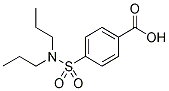
Structure chimique
Poids moléculaire: 285.36
Contrôle Qualité (Quality Control)
| Cibles apparentées | CFTR CRM1 CD markers AChR Calcium Channel Sodium Channel Potassium Channel GABA Receptor ATPase GluR |
|---|---|
| Autre TRP Channel Inhibiteurs | 2-APB (2-Aminoethyl Diphenylborinate) SKF96365 AMG-517 Capsazepine GSK2193874 HC-030031 GSK1016790A EIPA (L593754) ML-SI3 SB705498 |
Informations chimiques, stockage et stabilité (Chemical Information, Storage & Stability)
| Poids moléculaire | 285.36 | Formule | C13H19NO4S |
Stockage (À compter de la date de réception) | |
|---|---|---|---|---|---|
| N° CAS | 57-66-9 | Télécharger le SDF | Stockage des solutions mères |
|
|
| Synonymes | Benemid | Smiles | CCCN(CCC)S(=O)(=O)C1=CC=C(C=C1)C(=O)O | ||
Solubilité (Solubility)
|
In vitro |
DMSO
: 57 mg/mL
(199.74 mM)
Ethanol : 19 mg/mL Water : Insoluble |
Calculateur de molarité
|
In vivo |
|||||
Calculateur de formulation in vivo (Solution claire)
Étape 1 : Saisir les informations ci-dessous (Recommandé : Un animal supplémentaire pour tenir compte des pertes pendant l'expérience)
Étape 2 : Saisir la formulation in vivo (Ceci est seulement le calculateur, pas la formulation. Veuillez nous contacter d'abord s'il n'y a pas de formulation in vivo dans la section Solubilité.)
Résultats du calcul :
Concentration de travail : mg/ml;
Méthode de préparation du liquide maître DMSO : mg médicament prédissous dans μL DMSO ( Concentration du liquide maître mg/mL, Veuillez nous contacter d'abord si la concentration dépasse la solubilité du DMSO du lot de médicament. )
Méthode de préparation de la formulation in vivo : Prendre μL DMSO liquide maître, puis ajouterμL PEG300, mélanger et clarifier, puis ajouterμL Tween 80, mélanger et clarifier, puis ajouter μL ddH2O, mélanger et clarifier.
Méthode de préparation de la formulation in vivo : Prendre μL DMSO liquide maître, puis ajouter μL Huile de maïs, mélanger et clarifier.
Note : 1. Veuillez vous assurer que le liquide est clair avant d'ajouter le solvant suivant.
2. Assurez-vous d'ajouter le(s) solvant(s) dans l'ordre. Vous devez vous assurer que la solution obtenue, lors de l'ajout précédent, est une solution claire avant de procéder à l'ajout du solvant suivant. Des méthodes physiques telles que le vortex, les ultrasons ou le bain-marie chaud peuvent être utilisées pour faciliter la dissolution.
Mécanisme d'action (Mechanism of Action)
| Targets/IC50/Ki |
organic anion transport
TRPV2
TAS2R16
|
|---|---|
| In vitro |
Probenecid is able to prevent the efflux of calcium-sensitive fluorescent dyes during studies of cellular calcium mobilization. This compound (2.5 mM) is found to block the export of Fura-2 from 1321N1 astrocytoma cells, and does not change the basal calcium concentration or the muscarinic calcium response. It is a potent transient receptor potential vanilloid 2 (TRPV2) agonist. This chemical selectively induces increase in intracellular Ca2+ influx in HEK293T cells transiently expressing exogenous TRPV2. It is able to interact with organic anion transporters (OAT). 0.1 mM of this compound efficiently inhibits ATP-dependent active vesicular N-ethylmaleimide glutathione (NEM-GS) uptake by Human Multidrug Resistance Proteins 1 (MRP1) and MRP2. In isolated Sf9 cell membranes, it stimulates ATPase activity of MRP2 with approximate KACT of 250 μM, but inhibits ATPase activity of MRP1. This chemical is an inhibitor of the hTAS2R16, hTAS2R38, and hTAS2R43 bitter taste receptors. 1 mM of it attenuates saccharin-induced calcium flux responses of hTAS2R16 to near baseline levels. It dose-dependently inhibits hTAS2R16 (in the presence of 3 mM salicin) and hTAS2R38 (in the presence of 300 μM PTC). This activity is independent of its activity as a transport inhibitor, but is concerning with its interaction with the receptor. |
| In vivo |
Probenecid is an inhibitor of organic transport in vivo. This compound is able to decrease the renal clearance of antibiotic, such as penicillin, which enhances serum levels of antibiotic. It enhances the renal excretion of urate by acting as a competitive inhibitor of OAT, which prevents OAT-mediated reuptake of uric acid from the urine to the serum. This chemical is found to block acid metabolites from exiting the central nervous system, and is a competitive inhibitor of monoamine transport in the kidney, liver, and the eye. |
Références |
|
Informations sur l'essai clinique (Clinical Trial Information)
(données du https://clinicaltrials.gov, mis à jour le 2026-03-17)
| Numéro NCT | Recrutement | Conditions | Promoteur/Collaborateurs | Date de début | Phases |
|---|---|---|---|---|---|
| NCT07118618 | RECRUITING | Alcohol Use Disorder (AUD); Alcohol Consumption; Craving |
Brown University |
2026-03-14 | PHASE2 |
| NCT07318870 | NOT_YET_RECRUITING | Focal Epilepsy |
Fondation Ophtalmologique Adolphe de Rothschild |
2026-01 | PHASE2 |
| NCT07764302 | NOT_YET_RECRUITING | Osteoarticular Infections (OAIs) |
Assistance Publique - Hôpitaux de Paris |
2026-12 | PHASE3 |
| NCT05903859 | RECRUITING | Infertility, Male |
University of Miami |
2024-01-18 | PHASE3 |
| NCT04939623 | RECRUITING | Chronic Pain; Drug Dependence of Morphine Type; Symptom, Withdrawal |
University of Calgary |
2023-10-31 | PHASE2 |
| NCT07796191 | NOT_YET_RECRUITING | Healthy Adult Participants |
Jiangsu vcare pharmaceutical technology co., LTD |
2026-09-20 | PHASE1 |

Les produits sont destinés à la recherche uniquement. Ne pas utiliser chez l'homme. Nous ne vendons pas aux patients.
©Copyright 2013 Selleck Chemicals. Tous droits réservés.