
pour la recherche uniquement
Prucalopride 5-HT Receptor Agoniste
Réf. Catalogue: S2875
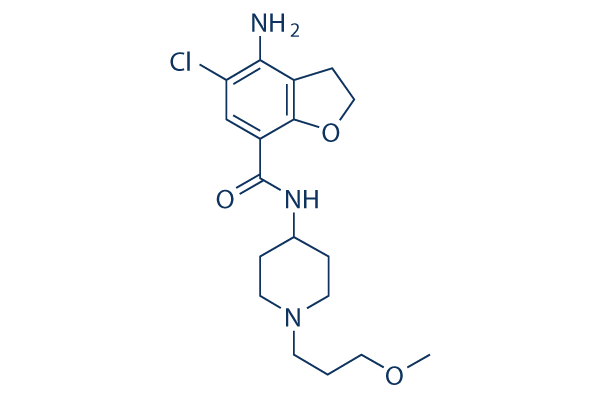
Structure chimique
Poids moléculaire: 367.87
Contrôle Qualité (Quality Control)
| Cibles apparentées | Adrenergic Receptor AChR COX Calcium Channel Histamine Receptor Dopamine Receptor GABA Receptor TRP Channel Cholinesterase (ChE) GluR |
|---|---|
| Autre 5-HT Receptor Inhibiteurs | Serotonin Hydrochloride (5-HT HCl) WAY-100635 Maleate Puerarin SB269970 HCl Ketanserin BRL-15572 Dihydrochloride RS-127445 Nuciferine Flopropione BRL-54443 |
Informations chimiques, stockage et stabilité (Chemical Information, Storage & Stability)
| Poids moléculaire | 367.87 | Formule | C18H26ClN3O3 |
Stockage (À compter de la date de réception) | |
|---|---|---|---|---|---|
| N° CAS | 179474-81-8 | Télécharger le SDF | Stockage des solutions mères |
|
|
| Synonymes | R-93877 | Smiles | COCCCN1CCC(CC1)NC(=O)C2=CC(=C(C3=C2OCC3)N)Cl | ||
Solubilité (Solubility)
|
In vitro |
DMSO
: 74 mg/mL
(201.15 mM)
Ethanol : 74 mg/mL Water : Insoluble |
Calculateur de molarité
|
In vivo |
|||||
Calculateur de formulation in vivo (Solution claire)
Étape 1 : Saisir les informations ci-dessous (Recommandé : Un animal supplémentaire pour tenir compte des pertes pendant l'expérience)
Étape 2 : Saisir la formulation in vivo (Ceci est seulement le calculateur, pas la formulation. Veuillez nous contacter d'abord s'il n'y a pas de formulation in vivo dans la section Solubilité.)
Résultats du calcul :
Concentration de travail : mg/ml;
Méthode de préparation du liquide maître DMSO : mg médicament prédissous dans μL DMSO ( Concentration du liquide maître mg/mL, Veuillez nous contacter d'abord si la concentration dépasse la solubilité du DMSO du lot de médicament. )
Méthode de préparation de la formulation in vivo : Prendre μL DMSO liquide maître, puis ajouterμL PEG300, mélanger et clarifier, puis ajouterμL Tween 80, mélanger et clarifier, puis ajouter μL ddH2O, mélanger et clarifier.
Méthode de préparation de la formulation in vivo : Prendre μL DMSO liquide maître, puis ajouter μL Huile de maïs, mélanger et clarifier.
Note : 1. Veuillez vous assurer que le liquide est clair avant d'ajouter le solvant suivant.
2. Assurez-vous d'ajouter le(s) solvant(s) dans l'ordre. Vous devez vous assurer que la solution obtenue, lors de l'ajout précédent, est une solution claire avant de procéder à l'ajout du solvant suivant. Des méthodes physiques telles que le vortex, les ultrasons ou le bain-marie chaud peuvent être utilisées pour faciliter la dissolution.
Mécanisme d'action (Mechanism of Action)
| Targets/IC50/Ki |
5-HT4A
2.5 nM(Ki)
5-HT4B
8 nM(Ki)
|
|---|---|
| In vitro |
Prucalopride induces contractions in a concentration-dependent manner with pEC50 of 7.5. This compound (1 mM) significantly amplifies the rebound contraction of the guinea-pig proximal colon after electrical field stimulation. It induces relaxation of the rat oesophagus preparation of rat oesophagus tunica muscularis mucosae with pEC50 of 7.8, yielding a monophasic concentration–response curve.
|
| In vivo |
Complete bowel movements per week is 30.9% of those receiving 2 mg of Prucalopride and 28.4% of those receiving 4 mg of this compound, as compared with 12.0% in the placebo group. 47.3% of patients receiving 2 mg of this compound and 46.6% of those receiving 4 mg of it has an increase in the number of spontaneous, complete bowel movements of one or more per week, on average, as compared with 25.8% in the placebo group. This compound (2 mg or 4 mg) significantly improves all other secondary efficacy end points, including patients' satisfaction with their bowel function and treatment and their perception of the severity of their constipation symptoms. It (4 mg daily) accelerates overall gastric emptying and small bowel transit in patients with constipation without a rectal evacuation disorder. This chemical (4 mg daily) tends to accelerate overall colonic transit with significantly faster overall colonic transit and ascending colon emptying. Higher proportions of patients on this compound 2 mg (19.5%), 4 mg (23.6%) has three or more spontaneous complete bowel movements(SCBM)/week compared with placebo (9.6%). It also significantly improves secondary efficacy and quality of life endpoints, including the proportion of patients with an increase of one or more SCBM/week, evacuation completeness, perceived disease severity and treatment effectiveness and quality of life. This compound alters colonic contractile motility patterns in a dose-dependent fashion by stimulating high-amplitude clustered contractions in the proximal colon and by inhibiting contractile activity in the distal colon of fasted dogs. It also causes a dose-dependent decrease in the time to the first giant migrating contraction (GMC); at higher doses of this chemical, the first GMC generally occurres within the first half-hour after treatment.
|
Références |
|
Informations sur l'essai clinique (Clinical Trial Information)
(données du https://clinicaltrials.gov, mis à jour le 2025-08-11)
| Numéro NCT | Recrutement | Conditions | Promoteur/Collaborateurs | Date de début | Phases |
|---|---|---|---|---|---|
| NCT06883175 | RECRUITING | Dysphagia; Achalasia, Esophageal; Ineffective Esophageal Motility |
Northwestern University |
2024-09-01 | |
| NCT05455359 | RECRUITING | Esophageal Motility Disorders; Gastric Motor Dysfunction; Aspiration Pneumonia; Gastro Esophageal Reflux |
Boston Children's Hospital |
2025-02-13 | PHASE4 |
| NCT06474286 | NOT_YET_RECRUITING | Schizophrenia |
University of Pittsburgh |
2026-07-31 | |
| NCT07127237 | NOT_YET_RECRUITING | Bowel Preparation |
Hospital de Clínicas Dr. Manuel Quintela |
2025-09 | EARLY_PHASE1 |
| NCT06816407 | RECRUITING | Post-Op Complication |
Future University in Egypt |
2025-03-02 | PHASE3 |
| NCT05220228 | COMPLETED | Depression in Remission |
University of Oxford |
2022-01-04 |

Les produits sont destinés à la recherche uniquement. Ne pas utiliser chez l'homme. Nous ne vendons pas aux patients.
©Copyright 2013 Selleck Chemicals. Tous droits réservés.