
pour la recherche uniquement
SB269970 HCl 5-HT Receptor Antagoniste
Réf. Catalogue: S2849
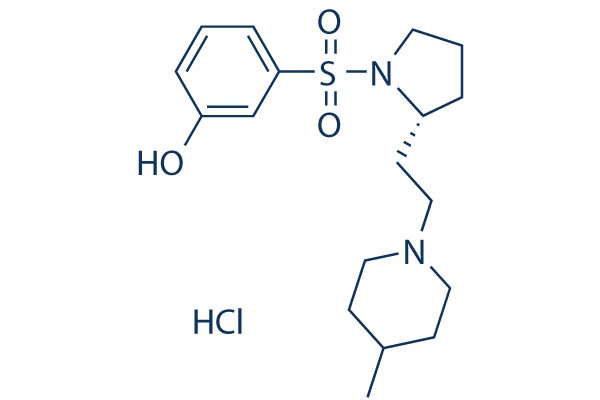
Structure chimique
Poids moléculaire: 388.95
Contrôle Qualité (Quality Control)
- Cité dans Nature Medicine pour sa qualité supérieure
- COA
- NMR
- SDS
- Fiche technique
Informations chimiques, stockage et stabilité (Chemical Information, Storage & Stability)
| Poids moléculaire | 388.95 | Formule | C18H28N2O3S.HCl |
Stockage (À compter de la date de réception) | |
|---|---|---|---|---|---|
| N° CAS | 261901-57-9 | Télécharger le SDF | Stockage des solutions mères |
|
|
| Synonymes | N/A | Smiles | CC1CCN(CC1)CCC2CCCN2S(=O)(=O)C3=CC=CC(=C3)O.Cl | ||
Solubilité (Solubility)
|
In vitro |
DMSO
: 11 mg/mL
(28.28 mM)
Water : Insoluble Ethanol : Insoluble |
Calculateur de molarité
|
In vivo |
|||||
Calculateur de formulation in vivo (Solution claire)
Étape 1 : Saisir les informations ci-dessous (Recommandé : Un animal supplémentaire pour tenir compte des pertes pendant l'expérience)
Étape 2 : Saisir la formulation in vivo (Ceci est seulement le calculateur, pas la formulation. Veuillez nous contacter d'abord s'il n'y a pas de formulation in vivo dans la section Solubilité.)
Résultats du calcul :
Concentration de travail : mg/ml;
Méthode de préparation du liquide maître DMSO : mg médicament prédissous dans μL DMSO ( Concentration du liquide maître mg/mL, Veuillez nous contacter d'abord si la concentration dépasse la solubilité du DMSO du lot de médicament. )
Méthode de préparation de la formulation in vivo : Prendre μL DMSO liquide maître, puis ajouterμL PEG300, mélanger et clarifier, puis ajouterμL Tween 80, mélanger et clarifier, puis ajouter μL ddH2O, mélanger et clarifier.
Méthode de préparation de la formulation in vivo : Prendre μL DMSO liquide maître, puis ajouter μL Huile de maïs, mélanger et clarifier.
Note : 1. Veuillez vous assurer que le liquide est clair avant d'ajouter le solvant suivant.
2. Assurez-vous d'ajouter le(s) solvant(s) dans l'ordre. Vous devez vous assurer que la solution obtenue, lors de l'ajout précédent, est une solution claire avant de procéder à l'ajout du solvant suivant. Des méthodes physiques telles que le vortex, les ultrasons ou le bain-marie chaud peuvent être utilisées pour faciliter la dissolution.
Mécanisme d'action (Mechanism of Action)
| Caractéristiques |
A hydrochloride salt form of SB-269970 which is a potent 5-HT 7 receptor antagonist.
|
|---|---|
| Targets/IC50/Ki |
5-HT7
8.3(pKi)
|
| In vitro |
SB-269970 inhibits 5-CT-stimulated adenylyl cyclase activity in guinea-pig hippocampal membranes. SB-269970 (0.03 μM, 0.1 μM, 0.3 μM and 1 μM) produces a concentration-related rightward-shift of the 5-CT concentration-response curve with no significant alteration in the maximal response to 5-CT. SB-269970 (1 μM) has any effect on 5-HT efflux when superfused alone.
|
| In vivo |
SB-269970 (10 mg/kg and 30 mg/kg) significantly reduces the effects of amphetamine by 25 and 27%, respectively, and blocks the effects of ketamine by 38% (10 mg/kg) and 30% (30 mg/kg). SB-269970 significantly reduces amphetamine-induced hyperactivity in wild-type mice and is without effects in 5-HT7 knockout mice. Systemic administration of SB-269970 (30 mg/kg) significantly reverses amphetamine disruption of PPI and did not enhance PPI by itself compared to control. SB-269970 significantly reverses the deficits induced by MK-801, but not by scopolamine. SB-269970 normalizes MK-801-induced glutamate but not dopamine release in the cortex. SB-269970 (in one medium dose of 0.5 or 1 mg/kg) exerts a specific antianxiety-like effect in the Vogel drinking test in rats, in the elevated plus-maze test in rats and in the four-plate test in mice. Moreover, SB-269970 (in one medium dose of 5 or 10 mg/kg) reveals antidepressant-like activity in the forced swimming and the tail suspension tests in mice. SB-269970 at doses of 0.3, 1 and 3 μg exhibits an anticonflict effect which is weaker than that of diazepam (40 μg), whereas SB-269970 at doses of 3 and 10 μg had marked anti-immobility action comparable to that of imipramine (0.1 μg).
|
Références |
|

Les produits sont destinés à la recherche uniquement. Ne pas utiliser chez l'homme. Nous ne vendons pas aux patients.
©Copyright 2013 Selleck Chemicals. Tous droits réservés.