
pour la recherche uniquement
Regorafenib (BAY-734506) Monohydrate VEGFR inhibiteur
Réf. CatalogueS5077
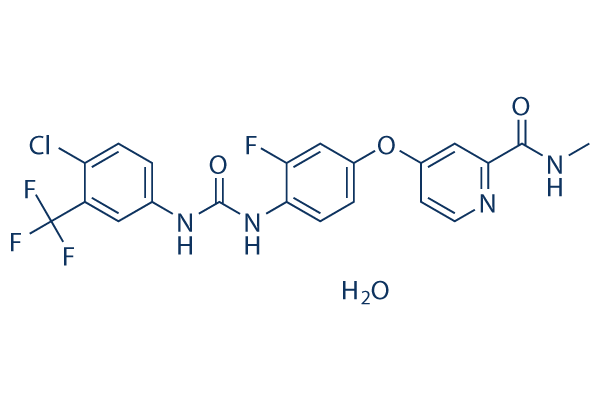
Structure chimique
Poids moléculaire: 500.83
Contrôle Qualité
| Cibles apparentées | EGFR PDGFR FGFR c-Met Src MEK CSF-1R FLT3 HER2 c-Kit |
|---|---|
| Autre VEGFR Inhibiteurs | SAR131675 SU 5402 Cediranib (AZD2171) Vatalanib (PTK787) 2HCl Anlotinib (AL3818) Dihydrochloride Linifanib (ABT-869) Apatinib (YN968D1) Apatinib (YN968D1) mesylate Ki8751 ZM 323881 HCl |
Culture cellulaire, traitement et concentration de travail
| Lignées cellulaires | Type dessai | Concentration | Temps dincubation | Formulation | Description de lactivité | PMID |
|---|---|---|---|---|---|---|
| GISTT1 | Cytotoxicity assay | 72 hrs | Cytotoxicity against human GISTT1 cells assessed as cell growth inhibition after 72 hrs by CellTiterGlo assay, GI50=0.13μM | 28991465 | ||
| GISTT1 | Cytotoxicity assay | 72 hrs | Cytotoxicity against human GISTT1 cells harboring KIT T670I mutant assessed as cell growth inhibition after 72 hrs by CellTiterGlo assay, GI50=0.38μM | 28991465 | ||
| GISTT1 | Cytotoxicity assay | 72 hrs | Cytotoxicity against human GISTT1 cells harboring KIT D816E mutant assessed as cell growth inhibition after 72 hrs by CellTiterGlo assay, GI50=1.35μM | 28991465 | ||
| GIST430 | Cytotoxicity assay | 72 hrs | Cytotoxicity against human GIST430 cells harboring KIT V654A mutant assessed as cell growth inhibition after 72 hrs by CellTiterGlo assay, GI50=3μM | 28991465 | ||
| DAOY | qHTS assay | qHTS of pediatric cancer cell lines to identify multiple opportunities for drug repurposing: Primary screen for DAOY cells | 29435139 | |||
| SJ-GBM2 | qHTS assay | qHTS of pediatric cancer cell lines to identify multiple opportunities for drug repurposing: Primary screen for SJ-GBM2 cells | 29435139 | |||
| A673 | qHTS assay | qHTS of pediatric cancer cell lines to identify multiple opportunities for drug repurposing: Primary screen for A673 cells | 29435139 | |||
| SK-N-MC | qHTS assay | qHTS of pediatric cancer cell lines to identify multiple opportunities for drug repurposing: Primary screen for SK-N-MC cells | 29435139 | |||
| BT-37 | qHTS assay | qHTS of pediatric cancer cell lines to identify multiple opportunities for drug repurposing: Primary screen for BT-37 cells | 29435139 | |||
| NB-EBc1 | qHTS assay | qHTS of pediatric cancer cell lines to identify multiple opportunities for drug repurposing: Primary screen for NB-EBc1 cells | 29435139 | |||
| U-2 OS | qHTS assay | qHTS of pediatric cancer cell lines to identify multiple opportunities for drug repurposing: Primary screen for U-2 OS cells | 29435139 | |||
| Saos-2 | qHTS assay | qHTS of pediatric cancer cell lines to identify multiple opportunities for drug repurposing: Primary screen for Saos-2 cells | 29435139 | |||
| NB1643 | qHTS assay | qHTS of pediatric cancer cell lines to identify multiple opportunities for drug repurposing: Primary screen for NB1643 cells | 29435139 | |||
| LAN-5 | qHTS assay | qHTS of pediatric cancer cell lines to identify multiple opportunities for drug repurposing: Primary screen for LAN-5 cells | 29435139 | |||
| BT-12 | qHTS assay | qHTS of pediatric cancer cell lines to identify multiple opportunities for drug repurposing: Primary screen for BT-12 cells | 29435139 | |||
| Rh18 | qHTS assay | qHTS of pediatric cancer cell lines to identify multiple opportunities for drug repurposing: Primary screen for Rh18 cells | 29435139 | |||
| OHS-50 | qHTS assay | qHTS of pediatric cancer cell lines to identify multiple opportunities for drug repurposing: Primary screen for OHS-50 cells | 29435139 | |||
| RD | qHTS assay | qHTS of pediatric cancer cell lines to identify multiple opportunities for drug repurposing: Primary screen for RD cells | 29435139 | |||
| MG 63 (6-TG R) | qHTS assay | qHTS of pediatric cancer cell lines to identify multiple opportunities for drug repurposing: Primary screen for MG 63 (6-TG R) cells | 29435139 | |||
| BA/F3 | Function assay | 72 hrs | Inhibition of Kit exon 11 deletion (557 to 558 residues) mutant (unknown origin) transfected in mouse BA/F3 cells assessed as inhibition of cell growth incubated for 72 hrs by MTS assay, GI50=0.021μM | 30204441 | ||
| BA/F3 | Function assay | 72 hrs | Inhibition of TEL-fused PDGFRbeta (unknown origin) transfected in mouse BA/F3 cells assessed as inhibition of cell growth incubated for 72 hrs by MTS assay, GI50=0.029μM | 30204441 | ||
| BA/F3 | Function assay | 72 hrs | Inhibition of Kit exon 11 deletion (557 to 558 residues) and D816H mutant and T670I mutant (unknown origin) transfected in mouse BA/F3 cells assessed as inhibition of cell growth incubated for 72 hrs by MTS assay, GI50=0.033μM | 30204441 | ||
| BA/F3 | Function assay | 72 hrs | Inhibition of Kit exon 11 deletion (557 to 558 residues) and A829P mutant and Y823D mutant (unknown origin) transfected in mouse BA/F3 cells assessed as inhibition of cell growth incubated for 72 hrs by MTS assay, GI50=0.047μM | 30204441 | ||
| BA/F3 | Function assay | 72 hrs | Inhibition of Kit exon 11 deletion (557 to 558 residues) and N822K mutant and Y823D mutant (unknown origin) transfected in mouse BA/F3 cells assessed as inhibition of cell growth incubated for 72 hrs by MTS assay, GI50=0.049μM | 30204441 | ||
| BA/F3 | Function assay | 72 hrs | Inhibition of TEL-fused PDGFRalpha (unknown origin) transfected in mouse BA/F3 cells assessed as inhibition of cell growth incubated for 72 hrs by MTS assay, GI50=0.051μM | 30204441 | ||
| BA/F3 | Function assay | 72 hrs | Inhibition of Kit exon 11 deletion (557 to 558 residues) and D820A mutant and D820A mutant (unknown origin) transfected in mouse BA/F3 cells assessed as inhibition of cell growth incubated for 72 hrs by MTS assay, GI50=0.063μM | 30204441 | ||
| BA/F3 | Function assay | 72 hrs | Inhibition of Kit exon 11 deletion (557 to 558 residues) and Y823D mutant (unknown origin) transfected in mouse BA/F3 cells assessed as inhibition of cell growth incubated for 72 hrs by MTS assay, GI50=0.094μM | 30204441 | ||
| BA/F3 | Function assay | 72 hrs | Inhibition of Kit V560D mutant (unknown origin) transfected in mouse BA/F3 cells assessed as inhibition of cell growth incubated for 72 hrs by MTS assay, GI50=0.108μM | 30204441 | ||
| BA/F3 | Function assay | 72 hrs | Inhibition of KDR (unknown origin) transfected in mouse BA/F3 cells assessed as inhibition of cell growth incubated for 72 hrs by MTS assay, GI50=0.114μM | 30204441 | ||
| BA/F3 | Function assay | 72 hrs | Inhibition of Kit exon 9 AY502 to 503 insertion mutant (unknown origin) transfected in mouse BA/F3 cells assessed as inhibition of cell growth incubated for 72 hrs by MTS assay, GI50=0.114μM | 30204441 | ||
| BA/F3 | Function assay | 72 hrs | Inhibition of Kit exon 11 deletion (557 to 558 residues) and V654A mutant (unknown origin) transfected in mouse BA/F3 cells assessed as inhibition of cell growth incubated for 72 hrs by MTS assay, GI50=0.231μM | 30204441 | ||
| BA/F3 | Function assay | 72 hrs | Inhibition of Kit exon 11 deletion (557 to 558 residues) and D816H mutant (unknown origin) transfected in mouse BA/F3 cells assessed as inhibition of cell growth incubated for 72 hrs by MTS assay, GI50=0.29μM | 30204441 | ||
| BA/F3 | Function assay | 72 hrs | Inhibition of PDGFRalpha V561D/D842V mutant (unknown origin) transfected in mouse BA/F3 cells assessed as inhibition of cell growth incubated for 72 hrs by MTS assay, GI50=0.522μM | 30204441 | ||
| BA/F3 | Function assay | 72 hrs | Inhibition of Kit V560D/V654A mutant (unknown origin) transfected in mouse BA/F3 cells assessed as inhibition of cell growth incubated for 72 hrs by MTS assay, GI50=0.549μM | 30204441 | ||
| BA/F3 | Function assay | 72 hrs | Inhibition of Kit exon 9 AY502 to 503 insertion and D816 mutant (unknown origin) transfected in mouse BA/F3 cells assessed as inhibition of cell growth incubated for 72 hrs by MTS assay, GI50=0.833μM | 30204441 | ||
| BA/F3 | Function assay | 72 hrs | Inhibition of Kit V560D/D816H mutant (unknown origin) transfected in mouse BA/F3 cells assessed as inhibition of cell growth incubated for 72 hrs by MTS assay, GI50=0.834μM | 30204441 | ||
| BA/F3 | Function assay | 72 hrs | Inhibition of Kit exon 11 deletion (560 to 578 residues) mutant (unknown origin) transfected in mouse BA/F3 cells assessed as inhibition of cell growth incubated for 72 hrs by MTS assay, GI50=0.943μM | 30204441 | ||
| BA/F3 | Function assay | 72 hrs | Inhibition of Kit exon 9 AY502 to 503 insertion and V654 mutant (unknown origin) transfected in mouse BA/F3 cells assessed as inhibition of cell growth incubated for 72 hrs by MTS assay, GI50=1.27μM | 30204441 | ||
| BA/F3 | Function assay | 72 hrs | Inhibition of Kit D816V mutant (unknown origin) transfected in mouse BA/F3 cells assessed as inhibition of cell growth incubated for 72 hrs by MTS assay, GI50=2.371μM | 30204441 | ||
| BA/F3 | Cytotoxicity assay | 72 hrs | Cytotoxicity in mouse parental BA/F3 cells incubated for 72 hrs by MTS assay, GI50=9.953μM | 30204441 | ||
| Sf9 | Function assay | Inhibition of human N-terminal GST tagged VEGFR-2 expressed in baculovirus infected Sf9 cells using poly (Glu,Tyr) 4:1 as substrate in presence of ATP by Kinase-Glo luminescence assay, IC50=0.005μM | 31284081 | |||
| Sf9 | Function assay | 4 hrs | Inhibition of wild type recombinant GST-tagged FLT3 (Y567 to S993 residues) (unknown origin) expressed in baculovirus infected Sf9 insect cells using Her2 peptide as substrate measured after 4 hrs in presence of ATP by Kinase-Glo Plus reagent-based lumine, IC50=0.082μM | 31721578 | ||
| Sf9 | Function assay | 150 mins | Inhibition of recombinant N-terminal 6x-His-tagged c-KIT (547 to 935 residues)/(694 to 753 residues deletion) (unknown origin) expressed in baculovirus infected Sf9 insect cells using poly (Glu,Tyr) 4:1 as substrate measured after 150 mins in presence of , IC50=0.116μM | 31721578 | ||
| GISTT1 | Antiproliferative assay | 72 hrs | Antiproliferative activity against human GISTT1 cells harboring heterozygous deletion mutation at C-kit exon 11 assessed as cell growth inhibition after 72 hrs by CellTiter 96 AQueous One Solution Cell Proliferation assay, GI50=0.119μM | 31721578 | ||
| GIST882 | Antiproliferative assay | 144 hrs | Antiproliferative activity against human GIST882 cells harboring c-KIT exon 13 homozygous primary K642E mutant assessed as cell growth inhibition after 144 hrs by methylene blue staining based assay, GI50=0.285μM | 31721578 | ||
| GIST48 | Antiproliferative assay | 120 hrs | Antiproliferative activity against human GIST48 cells harboring c-KIT exon 11 homozygous primary missense V560D mutant and exon 17 heterozygous secondary D820A mutant assessed as cell growth inhibition after 120 hrs by methylene blue staining based assay, GI50=0.785μM | 31721578 | ||
| Caco-2 | Toxicity assay | 48 hrs | Toxicity against Caco-2 cells determined at 48 hours by intracellular ATP concentration using the CellTiter-Glo Luminescent Cell Viability Assay, CC50=0.97μM | ChEMBL | ||
| Caco-2 | Function assay | 48 hrs | Determination of IC50 values for inhibition of SARS-CoV-2 induced cytotoxicity of Caco-2 cells after 48 hours by high content imaging, IC50=1.67μM | ChEMBL | ||
| VERO-E6 | Toxicity assay | 48 hrs | Toxicity CC50 against VERO-E6 cells determined at 48 hours by high content imaging (same conditions as 2_LEY without exposure to 0.01 MOI SARS CoV-2 virus), CC50=8.31μM | ChEMBL | ||
| VERO-E6 | Function assay | 48 hrs | Determination of IC50 values for inhibition of SARS-CoV-2 induced cytotoxicity of VERO-E6 cells after 48 hours exposure to 0.01 MOI SARS CoV-2 virus by high content imaging, IC50=24.95μM | ChEMBL | ||
| Cliquez pour voir plus de données expérimentales sur la lignée cellulaire | ||||||
Informations chimiques, stockage et stabilité
| Poids moléculaire | 500.83 | Formule | C21H15ClF4N4O3.H2O |
Stockage (À compter de la date de réception) | |
|---|---|---|---|---|---|
| N° CAS | 1019206-88-2 | -- | Stockage des solutions mères |
|
|
| Synonymes | Fluoro-sorafenib, Resihance, Stivarga, regorafaenib monohydrate | Smiles | CNC(=O)C1=NC=CC(=C1)OC2=CC(=C(C=C2)NC(=O)NC3=CC(=C(C=C3)Cl)C(F)(F)F)F.O | ||
Solubilité
|
In vitro |
DMSO
: 100 mg/mL
(199.66 mM)
Water : Insoluble Ethanol : Insoluble |
Calculateur de molarité
|
In vivo |
|||||
Calculateur de formulation in vivo (Solution claire)
Étape 1 : Saisir les informations ci-dessous (Recommandé : Un animal supplémentaire pour tenir compte des pertes pendant lexpérience)
Étape 2 : Saisir la formulation in vivo (Ceci est seulement le calculateur, pas la formulation. Veuillez nous contacter dabord sil ny a pas de formulation in vivo dans la section Solubilité.)
Résultats du calcul :
Concentration de travail : mg/ml;
Méthode de préparation du liquide maître DMSO : mg médicament prédissous dans μL DMSO ( Concentration du liquide maître mg/mL, Veuillez nous contacter dabord si la concentration dépasse la solubilité du DMSO du lot de médicament. )
Méthode de préparation de la formulation in vivo : Prendre μL DMSO liquide maître, puis ajouterμL PEG300, mélanger et clarifier, puis ajouterμL Tween 80, mélanger et clarifier, puis ajouter μL ddH2O, mélanger et clarifier.
Méthode de préparation de la formulation in vivo : Prendre μL DMSO liquide maître, puis ajouter μL Huile de maïs, mélanger et clarifier.
Note : 1. Veuillez vous assurer que le liquide est clair avant dajouter le solvant suivant.
2. Assurez-vous dajouter le(s) solvant(s) dans lordre. Vous devez vous assurer que la solution obtenue, lors de lajout précédent, est une solution claire avant de procéder à lajout du solvant suivant. Des méthodes physiques telles que le vortex, les ultrasons ou le bain-marie chaud peuvent être utilisées pour faciliter la dissolution.
Mécanisme daction
| Targets/IC50/Ki |
PDGFRβ
(Cell-free) RET
(Cell-free) 1.5 nM
Raf-1
(Cell-free) 2.5 nM
murine VEGFR2
(Cell-free) 4.2 nM
KIT
(Cell-free) 7 nM
VEGFR1
(Cell-free) 13 nM
B-Raf (V600E)
(Cell-free) 19 nM
PDGFRβ
(Cell-free) 22 nM
B-Raf
(Cell-free) 28 nM
murine VEGFR3
(Cell-free) 46 nM
|
|---|---|
| In vitro |
Le Regorafenib prévient fortement l'autophosphorylation de VEGFR2 dans les cellules NIH-3T3/VEGFR2 avec un IC50 de 3 nM. Dans les HAoSMCs, le Regorafenib supprime l'autophosphorylation de PDGFR-β après stimulation avec PDGF-BB, avec un IC50 de 90 nM. Le Regorafenib inhibe également la signalisation FGFR dans les cellules de cancer du sein (BC) MCF-7 stimulées avec FGF10. Le Regorafenib a très puissamment inhibé les récepteurs mutants KITK642E et RETC634W, avec des IC50 d'environ 20 nM et 10 nM, respectivement. Le Regorafenib inhibe la prolifération des HUVECs stimulées par VEGF165, avec un IC50 d'environ 3 nM. Le Regorafenib prévient la prolifération des HUVECs stimulées par FGF2 et des HAoSMCs stimulées par PDGF-BB avec des IC50 de 127 nM et 146 nM, respectivement. Le Regorafenib cible à la fois la prolifération des cellules tumorales et la vascularisation tumorale par inhibition des récepteurs des tyrosine kinases (VEGFR, KIT, RET, FGFR et PDGFR) et des sérine/thréonine kinases (Raf et p38MAPK). Le Regorafenib supprime la croissance des cellules humaines Hep3B, PLC/PRF/5 et HepG2 de manière dépendante de la concentration et du temps.
|
| Essai kinase |
Tests de kinases
|
|
Des tests in vitro utilisant les domaines kinase recombinants VEGFR2 (murine aa785-aa1367), VEGFR3 (murine aa818-aa1363), PDGFRβ (aa561-aa1106), Raf-1 (aa305-aa648) et BRafV600E (aa409-aa765) sont effectués. Le profilage initial d'inhibition de kinase in vitro est réalisé à une concentration fixe de 1 μM de Regorafenib. Les valeurs d'IC50 (concentration inhibitrice de 50%) sont déterminées à partir des kinases répondantes sélectionnées, par exemple, VEGFR1 et RET. L'inhibition de la kinase TIE2 est mesurée par un dosage de fluorescence résolue dans le temps homogène (HTRF) utilisant une protéine de fusion recombinante de glutathion-S-transférase, le domaine intracellulaire de TIE2 et le peptide biotine-Ahx-EPKDDAYPLYSDFG comme substrat.
|
|
| In vivo |
Le Regorafenib révèle un TGI puissant dépendant de la dose dans divers modèles xénogreffes humains précliniques chez la souris, avec des réductions de tumeurs dans les modèles de carcinome mammaire MDA-MB-231 et rénal 786-O. Le Regorafenib prévient non seulement la croissance des tumeurs mammaires primaires syngéniques 4T1 poussant orthotopiquement dans le coussin adipeux, mais supprime également la formation de métastases tumorales dans le poumon.
|
Références |
|
Informations sur lessai clinique
(données du https://clinicaltrials.gov, mis à jour le 2024-05-22)
| Numéro NCT | Recrutement | Conditions | Promoteur/Collaborateurs | Date de début | Phases |
|---|---|---|---|---|---|
| NCT03386825 | Completed | Colorectal Neoplasms |
Bayer |
January 31 2018 | -- |
| NCT01959269 | Completed | Colorectal Neoplasm |
Bayer |
October 31 2013 | -- |
Support technique
Tel: +1-832-582-8158 Ext:3
Si vous avez dautres questions, veuillez laisser un message.

Les produits sont destinés à la recherche uniquement. Ne pas utiliser chez lhomme. Nous ne vendons pas aux patients.
©Copyright 2013 Selleck Chemicals. Tous droits réservés.