
pour la recherche uniquement
BMS-536924 IGF-1R inhibiteur
Réf. CatalogueS1012
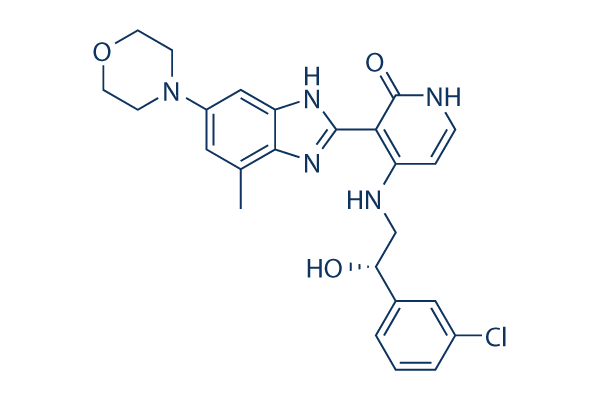
Structure chimique
Poids moléculaire: 479.96
Contrôle Qualité
| Cibles apparentées | EGFR VEGFR PDGFR FGFR c-Met Src MEK CSF-1R FLT3 HER2 |
|---|---|
| Autre IGF-1R Inhibiteurs | Linsitinib (OSI-906) NVP-AEW541 BMS-754807 Picropodophyllin (AXL1717) GSK1904529A AG-1024 NVP-ADW742 NT157 PQ 401 MSDC-0160 |
Informations chimiques, stockage et stabilité
| Poids moléculaire | 479.96 | Formule | C25H26ClN5O3 |
Stockage (À compter de la date de réception) | |
|---|---|---|---|---|---|
| N° CAS | 468740-43-4 | Télécharger le SDF | Stockage des solutions mères |
|
|
| Synonymes | CS-0117 | Smiles | CC1=CC(=CC2=C1N=C(N2)C3=C(C=CNC3=O)NCC(C4=CC(=CC=C4)Cl)O)N5CCOCC5 | ||
Solubilité
|
In vitro |
DMSO
: 96 mg/mL
(200.01 mM)
Water : Insoluble Ethanol : Insoluble |
Calculateur de molarité
|
In vivo |
|||||
Calculateur de formulation in vivo (Solution claire)
Étape 1 : Saisir les informations ci-dessous (Recommandé : Un animal supplémentaire pour tenir compte des pertes pendant lexpérience)
Étape 2 : Saisir la formulation in vivo (Ceci est seulement le calculateur, pas la formulation. Veuillez nous contacter dabord sil ny a pas de formulation in vivo dans la section Solubilité.)
Résultats du calcul :
Concentration de travail : mg/ml;
Méthode de préparation du liquide maître DMSO : mg médicament prédissous dans μL DMSO ( Concentration du liquide maître mg/mL, Veuillez nous contacter dabord si la concentration dépasse la solubilité du DMSO du lot de médicament. )
Méthode de préparation de la formulation in vivo : Prendre μL DMSO liquide maître, puis ajouterμL PEG300, mélanger et clarifier, puis ajouterμL Tween 80, mélanger et clarifier, puis ajouter μL ddH2O, mélanger et clarifier.
Méthode de préparation de la formulation in vivo : Prendre μL DMSO liquide maître, puis ajouter μL Huile de maïs, mélanger et clarifier.
Note : 1. Veuillez vous assurer que le liquide est clair avant dajouter le solvant suivant.
2. Assurez-vous dajouter le(s) solvant(s) dans lordre. Vous devez vous assurer que la solution obtenue, lors de lajout précédent, est une solution claire avant de procéder à lajout du solvant suivant. Des méthodes physiques telles que le vortex, les ultrasons ou le bain-marie chaud peuvent être utilisées pour faciliter la dissolution.
Mécanisme daction
| Targets/IC50/Ki |
Insulin Receptor
73 nM
IGF-1R
100 nM
FAK
150 nM
MEK
182 nM
LCK
341 nM
VEGFR2
1.4 μM
EGF
1.6 μM
Met
4.87 μM
|
|---|---|
| In vitro |
BMS-536924 inhibe également FAK et Lck avec des CI50 de 150 nM et 341 nM, respectivement. Ce composé inhibe la prolifération cellulaire et perturbe la phosphorylation d'Akt et de MAPK. Il inhibe la signalisation IGF-1R stimulée par IGF-I dans les cellules MCF10A et bloque l'activité constitutive d'IGF-1R dans les CD8-IGF-1R-MCF10A. La préincubation des cellules MCF10A avec 1 μM de cette substance chimique bloque complètement la capacité d'IGF-I à stimuler la phosphorylation d'IGF-1R. La stimulation d'IGF-I entraîne une augmentation de la phosphorylation d'ERK1/2, de GSK3β et d'Akt. Ce composé inhibe cette phosphorylation induite par le ligand. Le traitement des cellules CD8-IGF-1R-MCF10A avec cet inhibiteur entraîne une inhibition dose-dépendante de la phosphorylation avec une inhibition partielle à 0,01 μM et 0,1 μM, mais une inhibition complète du récepteur à une concentration de 1 μM. L'inhibition maximale d'IGF-1R phosphorylé est observée dès 10 minutes après l'incubation. Il conserve sa capacité à inhiber la phosphorylation d'IGF-1R pendant 48 heures. L'ajout de cet agent inhibe la phosphorylation d'Akt de manière dépendante du temps, à partir de 1 heure. À 48 heures, l'activation d'Akt est complètement bloquée. Le traitement avec ce composé montre une activité antiproliférative dans un panel de lignées cellulaires cancéreuses, y compris les cellules TC32, HT1080/S, SK-LMS-1, H513 et CTR. pIGF-1R/pIR est activé lors de la stimulation par IGF-I/insuline et l'activation est inhibée par cette substance chimique à des puissances similaires dans les lignées cellulaires Rh41 et Rh36. L'expression de la mort cellulaire programmée 4 (PDCD4), le clivage de la poly(ADP-ribose) polymérase (PARP) et de la caspase-3 sont régulés à la hausse dans les cellules Rh41 traitées avec cet inhibiteur.
|
| Essai kinase |
Activité de la voie IGF-I
|
|
1 × 10⁶ cellules pBabe-MCF10A sont ensemencées dans des boîtes de 60 mm. Après 24 heures, le milieu est remplacé par un milieu sans sérum et incubé pendant la nuit à 37 °C pendant 24 heures. Les cellules sont ensuite préincubées avec ou sans 1 uM BMS-536924 pendant 1 heure dans un milieu sans sérum, puis stimulées avec de l'IGF-I (50 ng/mL) pendant 10 minutes. Les monocouches cellulaires sont lavées deux fois avec du PBS et récoltées pour analyse par immunobuvardage.
|
|
| In vivo |
L'administration orale de BMS-536924 à 100-300 mpk inhibe fortement le modèle tumoral IGR-1R Sal. Une efficacité est également observée dans le modèle de carcinome colorectal humain non modifié Colo205. L'administration orale de ce composé une fois par jour (100-300 mpk) ou deux fois par jour (50, 100 mpk) démontre une activité antitumorale dans ce modèle tumoral. Le test d'hyperglycémie provoquée par voie orale (OGTT) montre que 100 mpk (b.i.d.) provoque une élévation significative des niveaux de glucose après un défi au glucose. Les paramètres pharmacocinétiques de cette substance chimique, administrée par voie orale dans du poly(éthylène glycol) 400 et de l'eau (80:20 v/v), sont déterminés chez la souris, le rat, le chien et le singe. Une bonne biodisponibilité est évidente chez toutes les espèces. Une pharmacocinétique non linéaire significative est observée chez les rongeurs à des doses p.o. croissantes. Ce composé réduit le volume des xénogreffes tumorales des cellules CD8-IGF-1R-MCF10A après deux semaines de traitement (100 mg/kg) à 76 %. L'administration orale de 70 mg/kg de cette substance chimique inhibe significativement la croissance tumorale (cellules TGBC-1TKB) inoculées chez des souris nues. Elle régule positivement l'apoptose dans les tumeurs xénogreffées. Le traitement n'a pas d'effets indésirables sur le poids corporel des souris ou les niveaux de glucose au moment du décès, suggérant une toxicité tolérable.
|
Références |
|
Support technique
Tel: +1-832-582-8158 Ext:3
Si vous avez dautres questions, veuillez laisser un message.
Foire aux questions
Question 1:
What are the differences between it and S1034?
Réponse :
The most remarkable difference between these two IGF-IR inhibitors is that S1012 is an ATP-competitive inhibitor. You will get more information about the differences between IR inhibitors in this reference: http://www.sciencedirect.com/science/article/pii/S1359644605035129.

Les produits sont destinés à la recherche uniquement. Ne pas utiliser chez lhomme. Nous ne vendons pas aux patients.
©Copyright 2013 Selleck Chemicals. Tous droits réservés.