
pour la recherche uniquement
MLN2238 (Ixazomib) Proteasome inhibiteur
Réf. CatalogueS2180
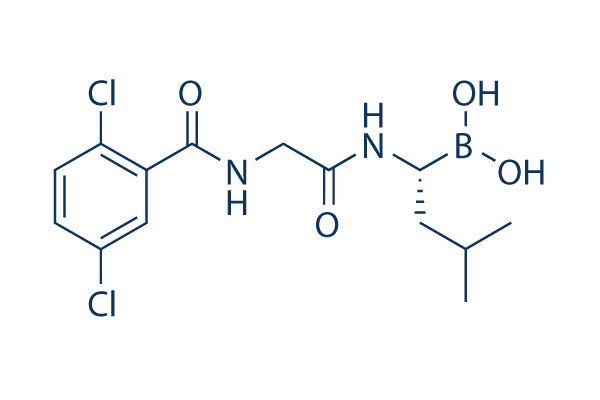
Structure chimique
Poids moléculaire: 361.03
Contrôle Qualité
| Cibles apparentées | HDAC Caspase Secretase MMP HCV Protease Cysteine Protease DPP Tyrosinase HIV Protease Serine Protease |
|---|---|
| Autre Proteasome Inhibiteurs | MG132 Celastrol Epoxomicin (BU-4061T) ONX-0914 (PR-957) Oprozomib Delanzomib VR23 Marizomib (Salinosporamide A) PI-1840 KSQ-4279 (USP1-IN-1) |
Culture cellulaire, traitement et concentration de travail
| Lignées cellulaires | Type dessai | Concentration | Temps dincubation | Formulation | Description de lactivité | PMID |
|---|---|---|---|---|---|---|
| HEK293 | Function assay | 1 hr | Inhibition of NFkappaB in HEK293 cells incubated for 1 hr prior to TNF-alpha challenge measured after 3 hrs by luciferase reporter gene assay relative to control, IC50 = 0.0062 μM. | ChEMBL | ||
| Calu6 | Function assay | 1 hr | Inhibition of 26S proteasome beta5 subunit in human Calu6 cells using Suc-LLVY-aminoluciferin as substrate after 1hr by luminescence assay, IC50 = 0.009 μM. | ChEMBL | ||
| Calu6 | Cytotoxicity assay | 72 hrs | Cytotoxicity against human Calu6 cells after 72 hrs by luminescence assay, LC50 = 0.014 μM. | ChEMBL | ||
| U266B1 | Cytotoxicity assay | 72 hrs | Cytotoxicity against human U266B1 cells assessed as reduction in cell viability after 72 hrs by CellTiter 96 aqueous one solution assay, IC50 = 0.05215 μM. | 29934218 | ||
| RPMI8226 | Cytotoxicity assay | 72 hrs | Cytotoxicity against human RPMI8226 cells assessed as reduction in cell viability after 72 hrs by CellTiter 96 aqueous one solution assay, IC50 = 0.05532 μM. | 29934218 | ||
| ARH77 | Cytotoxicity assay | 72 hrs | Cytotoxicity against human ARH77 cells assessed as reduction in cell viability after 72 hrs by CellTiter 96 aqueous one solution assay, IC50 = 0.0655 μM. | 29934218 | ||
| TC32 | qHTS assay | qHTS of pediatric cancer cell lines to identify multiple opportunities for drug repurposing: Primary screen for TC32 cells | 29435139 | |||
| U-2 OS | qHTS assay | qHTS of pediatric cancer cell lines to identify multiple opportunities for drug repurposing: Primary screen for U-2 OS cells | 29435139 | |||
| A673 | qHTS assay | qHTS of pediatric cancer cell lines to identify multiple opportunities for drug repurposing: Primary screen for A673 cells | 29435139 | |||
| DAOY | qHTS assay | qHTS of pediatric cancer cell lines to identify multiple opportunities for drug repurposing: Primary screen for DAOY cells | 29435139 | |||
| Saos-2 | qHTS assay | qHTS of pediatric cancer cell lines to identify multiple opportunities for drug repurposing: Primary screen for Saos-2 cells | 29435139 | |||
| BT-37 | qHTS assay | qHTS of pediatric cancer cell lines to identify multiple opportunities for drug repurposing: Primary screen for BT-37 cells | 29435139 | |||
| RD | qHTS assay | qHTS of pediatric cancer cell lines to identify multiple opportunities for drug repurposing: Primary screen for RD cells | 29435139 | |||
| SK-N-SH | qHTS assay | qHTS of pediatric cancer cell lines to identify multiple opportunities for drug repurposing: Primary screen for SK-N-SH cells | 29435139 | |||
| BT-12 | qHTS assay | qHTS of pediatric cancer cell lines to identify multiple opportunities for drug repurposing: Primary screen for BT-12 cells | 29435139 | |||
| NB1643 | qHTS assay | qHTS of pediatric cancer cell lines to identify multiple opportunities for drug repurposing: Primary screen for NB1643 cells | 29435139 | |||
| MG 63 (6-TG R) | qHTS assay | qHTS of pediatric cancer cell lines to identify multiple opportunities for drug repurposing: Primary screen for MG 63 (6-TG R) cells | 29435139 | |||
| OHS-50 | qHTS assay | qHTS of pediatric cancer cell lines to identify multiple opportunities for drug repurposing: Primary screen for OHS-50 cells | 29435139 | |||
| BT-12 | qHTS assay | qHTS of pediatric cancer cell lines to identify multiple opportunities for drug repurposing: Confirmatory screen for BT-12 cells | 29435139 | |||
| DAOY | qHTS assay | qHTS of pediatric cancer cell lines to identify multiple opportunities for drug repurposing: Confirmatory screen for DAOY cells | 29435139 | |||
| fibroblast cells | qHTS assay | qHTS of pediatric cancer cell lines to identify multiple opportunities for drug repurposing: Primary screen for control Hh wild type fibroblast cells | 29435139 | |||
| SK-N-SH | qHTS assay | qHTS of pediatric cancer cell lines to identify multiple opportunities for drug repurposing: Confirmatory screen for SK-N-SH cells | 29435139 | |||
| Rh41 | qHTS assay | qHTS of pediatric cancer cell lines to identify multiple opportunities for drug repurposing: Primary screen for Rh41 cells | 29435139 | |||
| A673 | qHTS assay | qHTS of pediatric cancer cell lines to identify multiple opportunities for drug repurposing: Confirmatory screen for A673 cells) | 29435139 | |||
| Rh30 | qHTS assay | qHTS of pediatric cancer cell lines to identify multiple opportunities for drug repurposing: Primary screen for Rh30 cells | 29435139 | |||
| U-2 OS | qHTS assay | qHTS of pediatric cancer cell lines to identify multiple opportunities for drug repurposing: Confirmatory screen for U-2 OS cells | 29435139 | |||
| Rh41 | qHTS assay | qHTS of pediatric cancer cell lines to identify multiple opportunities for drug repurposing: Confirmatory screen for Rh41 cells | 29435139 | |||
| RD | qHTS assay | qHTS of pediatric cancer cell lines to identify multiple opportunities for drug repurposing: Confirmatory screen for RD cells | 29435139 | |||
| SJ-GBM2 | qHTS assay | qHTS of pediatric cancer cell lines to identify multiple opportunities for drug repurposing: Primary screen for SJ-GBM2 cells | 29435139 | |||
| SK-N-MC | qHTS assay | qHTS of pediatric cancer cell lines to identify multiple opportunities for drug repurposing: Primary screen for SK-N-MC cells | 29435139 | |||
| NB-EBc1 | qHTS assay | qHTS of pediatric cancer cell lines to identify multiple opportunities for drug repurposing: Primary screen for NB-EBc1 cells | 29435139 | |||
| LAN-5 | qHTS assay | qHTS of pediatric cancer cell lines to identify multiple opportunities for drug repurposing: Primary screen for LAN-5 cells | 29435139 | |||
| Rh18 | qHTS assay | qHTS of pediatric cancer cell lines to identify multiple opportunities for drug repurposing: Primary screen for Rh18 cells | 29435139 | |||
| SJ-GBM2 | qHTS assay | qHTS of pediatric cancer cell lines to identify multiple opportunities for drug repurposing: Confirmatory screen for SJ-GBM2 cells | 29435139 | |||
| Rh18 | qHTS assay | qHTS of pediatric cancer cell lines to identify multiple opportunities for drug repurposing: Confirmatory screen for Rh18 cells | 29435139 | |||
| Cliquez pour voir plus de données expérimentales sur la lignée cellulaire | ||||||
Informations chimiques, stockage et stabilité
| Poids moléculaire | 361.03 | Formule | C14H19BCl2N2O4 |
Stockage (À compter de la date de réception) | |
|---|---|---|---|---|---|
| N° CAS | 1072833-77-2 | Télécharger le SDF | Stockage des solutions mères |
|
|
| Synonymes | N/A | Smiles | B(C(CC(C)C)NC(=O)CNC(=O)C1=C(C=CC(=C1)Cl)Cl)(O)O | ||
Solubilité
|
In vitro |
DMSO
: 72 mg/mL
(199.42 mM)
Ethanol : 72 mg/mL Water : Insoluble |
Calculateur de molarité
|
In vivo |
|||||
Calculateur de formulation in vivo (Solution claire)
Étape 1 : Saisir les informations ci-dessous (Recommandé : Un animal supplémentaire pour tenir compte des pertes pendant lexpérience)
Étape 2 : Saisir la formulation in vivo (Ceci est seulement le calculateur, pas la formulation. Veuillez nous contacter dabord sil ny a pas de formulation in vivo dans la section Solubilité.)
Résultats du calcul :
Concentration de travail : mg/ml;
Méthode de préparation du liquide maître DMSO : mg médicament prédissous dans μL DMSO ( Concentration du liquide maître mg/mL, Veuillez nous contacter dabord si la concentration dépasse la solubilité du DMSO du lot de médicament. )
Méthode de préparation de la formulation in vivo : Prendre μL DMSO liquide maître, puis ajouterμL PEG300, mélanger et clarifier, puis ajouterμL Tween 80, mélanger et clarifier, puis ajouter μL ddH2O, mélanger et clarifier.
Méthode de préparation de la formulation in vivo : Prendre μL DMSO liquide maître, puis ajouter μL Huile de maïs, mélanger et clarifier.
Note : 1. Veuillez vous assurer que le liquide est clair avant dajouter le solvant suivant.
2. Assurez-vous dajouter le(s) solvant(s) dans lordre. Vous devez vous assurer que la solution obtenue, lors de lajout précédent, est une solution claire avant de procéder à lajout du solvant suivant. Des méthodes physiques telles que le vortex, les ultrasons ou le bain-marie chaud peuvent être utilisées pour faciliter la dissolution.
Mécanisme daction
| Caractéristiques |
A first-in-class proteasome inhibitor that has improved pharmacokinetics (PK), pharmacodynamics(PD), and antitumor activity in preclinical studies.
|
|---|---|
| Targets/IC50/Ki |
20S proteasome
(Cell-free assay) 0.93 nM(Ki)
20S proteasome
(Cell-free assay) 3.4 nM
|
| In vitro |
À des concentrations plus élevées, ce composé inhibe également les sites protéolytiques de type caspase (β1) et de type trypsine (β2) avec une IC50 de 31 nM et 3,5 uM, respectivement. Il inhibe les cellules Calu-6 avec une IC50 de 9,7 nM. MLN2238 est un inhibiteur sélectif, puissant et réversible du Proteasome dans les cellules tumorales. Ce composé montre une inhibition réversible du Proteasome dépendante du temps. Ce composé et le Bortezomib montrent tous deux une inhibition réversible du Proteasome dépendante du temps ; cependant, la demi-vie de dissociation du Proteasome pour celui-ci est déterminée à être environ 6 fois plus rapide que celle du Bortezomib (18 et 110 minutes, respectivement). Il se dissocie plus rapidement du Proteasome que le Bortezomib, ce qui est cohérent avec une récupération plus rapide de l'activité du Proteasome observée dans l'essai Proteasome-Glo. Il a un effet pharmacodynamique tumoral global plus important que le Bortezomib, évalué par l'inhibition du 20S. Ce composé est la forme biologiquement active du MLN9708.
|
| Essai kinase |
Dosage de Kinase
|
|
Les cellules Calu-6 sont cultivées dans du MEM contenant 10 % de sérum bovin fœtal et 1 % de pénicilline/streptomycine et ensemencées 1 jour avant le début de l'expérience à 1 × 10⁴ cellules par puits dans une plaque à 384 puits. L'activité du Proteasome est évaluée en surveillant l'hydrolyse du substrat de type chymotrypsine Suc-LLVY-aminoluciférine en présence de luciférase à l'aide des réactifs du test Proteasome-Glo conformément aux instructions du fabricant. La luminescence est mesurée à l'aide d'un instrument LEADseeker.
|
|
| In vivo |
MLN2238 induit une réponse pharmacodynamique plus importante que le Bortezomib dans les tumeurs xénogreffées. Ce composé montre une inhibition maximale et soutenue du Proteasome tumoral plus importante par rapport au Bortezomib dans les modèles de xénogreffes. Ces résultats confirment que l'exposition améliorée de la tumeur observée avec cet agent se traduit par une réponse pharmacodynamique tumorale améliorée, à la fois au niveau et en aval du Proteasome. Il montre une activité antitumorale dans le modèle de xénogreffe CWR22. Ce produit chimique montre des réponses pharmacodynamiques tumorales plus importantes dans les xénogreffes WSU-DLCL2 par rapport au Bortezomib. De même, le traitement au Bortezomib n'a entraîné qu'une légère augmentation des niveaux de GADD34 dans les tumeurs xénogreffées WSU-DLCL2, alors qu'il induit fortement son expression. Ce composé présente un profil pharmacodynamique et une activité antitumorale améliorés par rapport au Bortezomib dans les modèles OCI-Ly10 et PHTX22L.
|
Références |
|
Applications
| Méthodes | Biomarqueurs | Images | PMID |
|---|---|---|---|
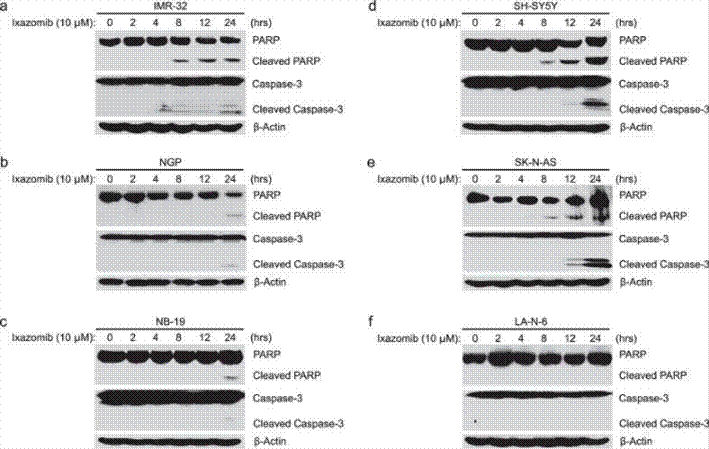
| Western blot | PARP / Cleaved PARP / Caspase-3 / Cleaved Caspase-3 Mcl-1 / Bcl-2 p53 / p21 / NOXA / PUMA / pRb / E2F / Cyclin D1 / CDK6 |
|
27687684 |
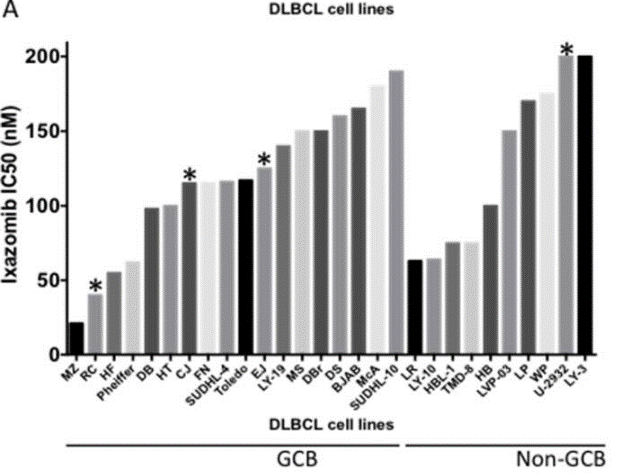
| Growth inhibition assay | IC50 |
|
29416618 |
Informations sur lessai clinique
(données du https://clinicaltrials.gov, mis à jour le 2024-05-22)
| Numéro NCT | Recrutement | Conditions | Promoteur/Collaborateurs | Date de début | Phases |
|---|---|---|---|---|---|
| NCT00963820 | Completed | Multiple Myeloma |
Millennium Pharmaceuticals Inc.|Takeda |
October 2009 | Phase 1 |
Support technique
Tel: +1-832-582-8158 Ext:3
Si vous avez dautres questions, veuillez laisser un message.

Les produits sont destinés à la recherche uniquement. Ne pas utiliser chez lhomme. Nous ne vendons pas aux patients.
©Copyright 2013 Selleck Chemicals. Tous droits réservés.