
pour la recherche uniquement
Olanzapine 5-HT Receptor Antagoniste
Réf. Catalogue: S2493
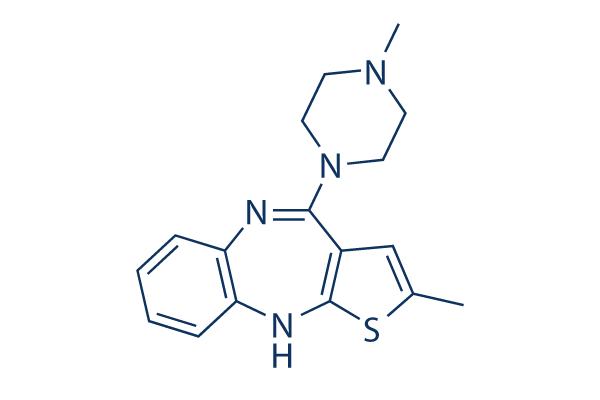
Structure chimique
Poids moléculaire: 312.43975
Contrôle Qualité (Quality Control)
| Cibles apparentées | Adrenergic Receptor AChR COX Calcium Channel Histamine Receptor Dopamine Receptor GABA Receptor TRP Channel Cholinesterase (ChE) GluR |
|---|---|
| Autre 5-HT Receptor Inhibiteurs | Serotonin Hydrochloride (5-HT HCl) WAY-100635 Maleate Puerarin SB269970 HCl Ketanserin BRL-15572 Dihydrochloride RS-127445 Nuciferine Flopropione BRL-54443 |
Informations chimiques, stockage et stabilité (Chemical Information, Storage & Stability)
| Poids moléculaire | 312.43975 | Formule | C17H20N4S |
Stockage (À compter de la date de réception) | |
|---|---|---|---|---|---|
| N° CAS | 132539-06-1 | Télécharger le SDF | Stockage des solutions mères |
|
|
| Synonymes | LY170053,Zyprexa, Zalasta, Zolafren, Olzapin, Oferta, Zypadhera | Smiles | CC1=CC2=C(S1)NC3=CC=CC=C3N=C2N4CCN(CC4)C | ||
Solubilité (Solubility)
|
In vitro |
DMSO
: 62 mg/mL
(198.43 mM)
Ethanol : 15 mg/mL Water : Insoluble |
Calculateur de molarité
|
In vivo |
|||||
Calculateur de formulation in vivo (Solution claire)
Étape 1 : Saisir les informations ci-dessous (Recommandé : Un animal supplémentaire pour tenir compte des pertes pendant l'expérience)
Étape 2 : Saisir la formulation in vivo (Ceci est seulement le calculateur, pas la formulation. Veuillez nous contacter d'abord s'il n'y a pas de formulation in vivo dans la section Solubilité.)
Résultats du calcul :
Concentration de travail : mg/ml;
Méthode de préparation du liquide maître DMSO : mg médicament prédissous dans μL DMSO ( Concentration du liquide maître mg/mL, Veuillez nous contacter d'abord si la concentration dépasse la solubilité du DMSO du lot de médicament. )
Méthode de préparation de la formulation in vivo : Prendre μL DMSO liquide maître, puis ajouterμL PEG300, mélanger et clarifier, puis ajouterμL Tween 80, mélanger et clarifier, puis ajouter μL ddH2O, mélanger et clarifier.
Méthode de préparation de la formulation in vivo : Prendre μL DMSO liquide maître, puis ajouter μL Huile de maïs, mélanger et clarifier.
Note : 1. Veuillez vous assurer que le liquide est clair avant d'ajouter le solvant suivant.
2. Assurez-vous d'ajouter le(s) solvant(s) dans l'ordre. Vous devez vous assurer que la solution obtenue, lors de l'ajout précédent, est une solution claire avant de procéder à l'ajout du solvant suivant. Des méthodes physiques telles que le vortex, les ultrasons ou le bain-marie chaud peuvent être utilisées pour faciliter la dissolution.
Mécanisme d'action (Mechanism of Action)
| Targets/IC50/Ki |
5-HT2
D2 receptor
|
|---|---|
| In vitro |
Olanzapine interacts with key receptors of interest in schizophrenia, having a nanomolar affinity for dopaminergic, serotonergic, alpha 1-adrenergic, and muscarinic receptors. This compound has a receptor profile that is similar to that of clozapine: it is relatively nonselective at dopamine receptor subtypes and it shows selectivity for mesolimbic and mesocortical over striatal dopamine tracts (electrophysiology; Fos). |
| In vivo |
Olanzapine is a potent antagonist at DA receptors (DOPAC levels; pergolide-stimulated increases in plasma corticosterone) and 5-HT receptors (quipazine-stimulated increases in corticosterone), but is weaker at alpha-adrenergic and muscarinic receptors. This compound combined with fluoxetine produces robust, sustained increases of extracellular levels of dopamine ([DA](ex)) and norepinephrine ([NE](ex)) up to 361% and 272% of the baseline in rat prefrontal cortex, respectively, which are significantly greater than either drug alone. It at 0.5 mg/kg, 3 mg/kg and 10 mg/kg (s.c.) dose-dependently increases the extracellular dopamine (DA) and norepinephrine (NE) levels in rat prefrontal cortex, nucleus accumbens and striatum. This chemical also increases extracellular levels of a DA metabolite, DOPAC, and tissue concentrations of a released DA metabolite, 3-methoxytyramine. It results in an 8-11% reduction in mean fresh brain weights as well as left cerebrum fresh weights and volumes in macaque monkeys. This agent results in substantial increases in adiposity: increased total body fat reflecting marked increases in subcutaneous and visceral adipose stores. It results in marked hepatic insulin resistance. |
Références |
|
Informations sur l'essai clinique (Clinical Trial Information)
(données du https://clinicaltrials.gov, mis à jour le 2026-05-26)
| Numéro NCT | Recrutement | Conditions | Promoteur/Collaborateurs | Date de début | Phases |
|---|---|---|---|---|---|
| NCT07152184 | NOT_YET_RECRUITING | Patient With Schizophrenia Spectrum Disorder; NLM Classification WM 203, Psychology:Schizophrenic Psychology; Schizophrenia Spectrum and Other Psychotic Disorders |
University Hospital, Strasbourg, France |
2026-10-01 | PHASE2 |
| NCT06995508 | RECRUITING | Cancer-Associated Anorexia; Head and Neck Squamous Cell Carcinoma; Neck Squamous Cell Carcinoma of Unknown Primary |
Roswell Park Cancer Institute |
2025-12-24 | PHASE2 |
| NCT07722806 | NOT_YET_RECRUITING | Cancer, Advanced Solid Tumors; Malnutrition |
Kantonsspital Winterthur KSW |
2026-08 | PHASE2 |
| NCT07581405 | NOT_YET_RECRUITING | Gastric Adenocarcinoma; Gastric Cancer |
University of Illinois at Chicago |
2026-09 | PHASE2 |
| NCT07442890 | NOT_YET_RECRUITING | Lung Cancer |
Henan Cancer Hospital |
2026-04-30 | |
| NCT07208305 | RECRUITING | Nausea; Vomiting |
Affiliated Hospital of Qinghai University |
2026-02-03 | PHASE3 |

Les produits sont destinés à la recherche uniquement. Ne pas utiliser chez l'homme. Nous ne vendons pas aux patients.
©Copyright 2013 Selleck Chemicals. Tous droits réservés.