
pour la recherche uniquement
TWS119 GSK-3 inhibiteur
Réf. CatalogueS1590
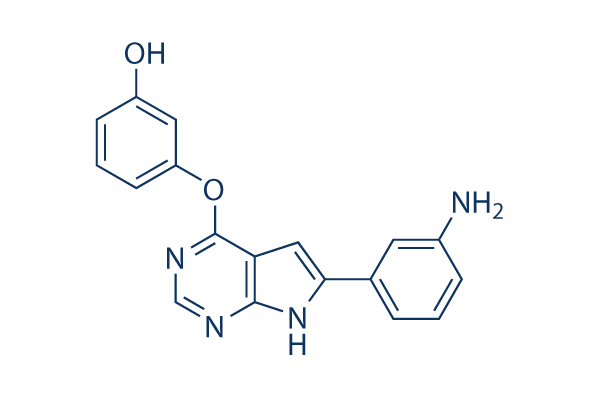
Structure chimique
Poids moléculaire: 318.33
Contrôle Qualité
| Cibles apparentées | PI3K Akt mTOR ATM/ATR DNA-PK AMPK PDPK1 PTEN PP2A PDK |
|---|---|
| Autre GSK-3 Inhibiteurs | CHIR-99021 (Laduviglusib) Laduviglusib (CHIR-99021) Hydrochloride SB216763 CHIR-98014 GSK-3 Inhibitor IX (BIO) LY2090314 Tideglusib SB415286 AR-A014418 IM-12 |
Culture cellulaire, traitement et concentration de travail
| Lignées cellulaires | Type dessai | Concentration | Temps dincubation | Formulation | Description de lactivité | PMID |
|---|---|---|---|---|---|---|
| RAW 264.7 | Cytotoxicity Assay | 0-10000ng/ml | 24 h | induces cell death in a dose dependent manner | 24330853 | |
| D3 | Function assay | Binding affinity to GSK-3 beta in mouse D3 cells, IC50=0.03μM. | 16408003 | |||
| D3 | Function assay | Inhibition of GSK-3 beta in mouse D3 cells, Kd=0.126μM. | 16408003 | |||
| D3 | Function assay | Inhibition of GSK-3 beta in mouse D3 cells assessed as induction of neuron specific marker neurofilament-M by immunofluorescence method, EC50=1μM. | 16408003 | |||
| D3 | Function assay | Inhibition of GSK-3 beta in mouse D3 cells assessed as induction of neuron specific marker microtubule-associated protein 2 by immunofluorescence method, EC50=1μM. | 16408003 | |||
| D3 | Function assay | Inhibition of GSK-3 beta in mouse D3 cells assessed as induction of neuron specific marker beta3-tubulin by immunofluorescence method, EC50=1μM. | 16408003 | |||
| DAOY | qHTS assay | qHTS of pediatric cancer cell lines to identify multiple opportunities for drug repurposing: Primary screen for DAOY cells | 29435139 | |||
| SJ-GBM2 | qHTS assay | qHTS of pediatric cancer cell lines to identify multiple opportunities for drug repurposing: Primary screen for SJ-GBM2 cells | 29435139 | |||
| A673 | qHTS assay | qHTS of pediatric cancer cell lines to identify multiple opportunities for drug repurposing: Primary screen for A673 cells | 29435139 | |||
| SK-N-MC | qHTS assay | qHTS of pediatric cancer cell lines to identify multiple opportunities for drug repurposing: Primary screen for SK-N-MC cells | 29435139 | |||
| NB-EBc1 | qHTS assay | qHTS of pediatric cancer cell lines to identify multiple opportunities for drug repurposing: Primary screen for NB-EBc1 cells | 29435139 | |||
| Saos-2 | qHTS assay | qHTS of pediatric cancer cell lines to identify multiple opportunities for drug repurposing: Primary screen for Saos-2 cells | 29435139 | |||
| SK-N-SH | qHTS assay | qHTS of pediatric cancer cell lines to identify multiple opportunities for drug repurposing: Primary screen for SK-N-SH cells | 29435139 | |||
| NB1643 | qHTS assay | qHTS of pediatric cancer cell lines to identify multiple opportunities for drug repurposing: Primary screen for NB1643 cells | 29435139 | |||
| LAN-5 | qHTS assay | qHTS of pediatric cancer cell lines to identify multiple opportunities for drug repurposing: Primary screen for LAN-5 cells | 29435139 | |||
| Rh18 | qHTS assay | qHTS of pediatric cancer cell lines to identify multiple opportunities for drug repurposing: Primary screen for Rh18 cells | 29435139 | |||
| RD | qHTS assay | qHTS of pediatric cancer cell lines to identify multiple opportunities for drug repurposing: Primary screen for RD cells | 29435139 | |||
| Rh41 | qHTS assay | qHTS of pediatric cancer cell lines to identify multiple opportunities for drug repurposing: Primary screen for Rh41 cells | 29435139 | |||
| Cliquez pour voir plus de données expérimentales sur la lignée cellulaire | ||||||
Informations chimiques, stockage et stabilité
| Poids moléculaire | 318.33 | Formule | C18H14N4O2 |
Stockage (À compter de la date de réception) | |
|---|---|---|---|---|---|
| N° CAS | 601514-19-6 | Télécharger le SDF | Stockage des solutions mères |
|
|
| Synonymes | N/A | Smiles | C1=CC(=CC(=C1)N)C2=CC3=C(N2)N=CN=C3OC4=CC=CC(=C4)O | ||
Solubilité
|
In vitro |
DMSO
: 64 mg/mL
(201.04 mM)
Water : Insoluble Ethanol : Insoluble |
Calculateur de molarité
|
In vivo |
|||||
Calculateur de formulation in vivo (Solution claire)
Étape 1 : Saisir les informations ci-dessous (Recommandé : Un animal supplémentaire pour tenir compte des pertes pendant lexpérience)
Étape 2 : Saisir la formulation in vivo (Ceci est seulement le calculateur, pas la formulation. Veuillez nous contacter dabord sil ny a pas de formulation in vivo dans la section Solubilité.)
Résultats du calcul :
Concentration de travail : mg/ml;
Méthode de préparation du liquide maître DMSO : mg médicament prédissous dans μL DMSO ( Concentration du liquide maître mg/mL, Veuillez nous contacter dabord si la concentration dépasse la solubilité du DMSO du lot de médicament. )
Méthode de préparation de la formulation in vivo : Prendre μL DMSO liquide maître, puis ajouterμL PEG300, mélanger et clarifier, puis ajouterμL Tween 80, mélanger et clarifier, puis ajouter μL ddH2O, mélanger et clarifier.
Méthode de préparation de la formulation in vivo : Prendre μL DMSO liquide maître, puis ajouter μL Huile de maïs, mélanger et clarifier.
Note : 1. Veuillez vous assurer que le liquide est clair avant dajouter le solvant suivant.
2. Assurez-vous dajouter le(s) solvant(s) dans lordre. Vous devez vous assurer que la solution obtenue, lors de lajout précédent, est une solution claire avant de procéder à lajout du solvant suivant. Des méthodes physiques telles que le vortex, les ultrasons ou le bain-marie chaud peuvent être utilisées pour faciliter la dissolution.
Mécanisme daction
| Targets/IC50/Ki |
GSK-3β
(Cell-free assay) 30 nM
|
|---|---|
| In vitro |
Le traitement d'une monocouche de cellules P19 avec 1 μM de TWS119 provoque la différenciation de 30 à 40 % des cellules spécifiquement en lignées neuronales, sur la base du comptage des cellules TuJ1 positives avec une morphologie neuronale correcte (jusqu'à 60 % de différenciation neuronale a eu lieu via le protocole standard de formation d'EB avec traitement concomitant avec ce composé). Ce composé se lie étroitement à la GSK-3β (K D = 126 nM), ce qui est quantifié par résonance plasmonique de surface (SPR) et démontre en outre une IC50 de 30 nM. Il s'avère qu'il induit puissamment la différenciation neuronale dans les cellules de carcinome embryonnaire de souris et les cellules ES. Le traitement avec ce produit chimique des cellules stellaires hépatiques (HSC) entraîne une phosphorylation réduite de la β-caténine, induit la translocation nucléaire de la β-caténine, élève la production de glutamine synthétase, empêche la synthèse de l'actine musculaire lisse et de Wnt5a, mais favorise l'expression de la protéine acide fibrillaire gliale, de Wnt10b et du facteur de transcription homéodomaine apparié 2c. Cet agent déclenche une accumulation rapide de β-caténine (augmentation moyenne de 6,8 fois par densitométrie), augmente l'interaction de la protéine nucléaire avec l'oligonucléotide contenant les séquences d'ADN auxquelles Tcf et Lef se lient et régule fortement à la hausse l'expression de Tcf7, Lef1 et d'autres gènes cibles de Wnt, y compris Jun, Ezd7 (codant Frizzled-7), Nlk (codant la kinase de type Nemo). Il induit une diminution dose-dépendante de la destruction spécifique des lymphocytes T et de la libération d'IFN-γ associée à la préservation de la capacité à produire de l'IL-2. Une étude récente indique que la signalisation Wnt est induite dans les lymphocytes T humains activés polyclonalement par un traitement avec ce composé. Ces lymphocytes T conservent un phénotype natif CD45RA(+)CD62L(+) par rapport aux lymphocytes T activés témoins qui progressent vers un phénotype effecteur CD45RO(+)CD62L(-) et cela se produit de manière dose-dépendante de ce produit chimique. La signalisation Wnt induite par ce produit chimique réduit l'expansion des lymphocytes T en raison d'un blocage de la division cellulaire et altère l'acquisition de la fonction effectrice des lymphocytes T, mesurée par la dégranulation et la production d'IFN-γ en réponse à l'activation des lymphocytes T. Le blocage de la division des lymphocytes T peut être attribué à une expression réduite de l'IL-2Rα dans les lymphocytes T traités avec cet agent, ce qui diminue leur capacité à utiliser l'IL-2 autocrine pour l'expansion.
|
| In vivo |
Une population cellulaire qui a exprimé de faibles niveaux de CD44 et des niveaux élevés de CD62L à la surface cellulaire lorsque 30 mg/kg de TWS119 sont administrés.
|
Références |
|
Applications
| Méthodes | Biomarqueurs | Images | PMID |
|---|---|---|---|
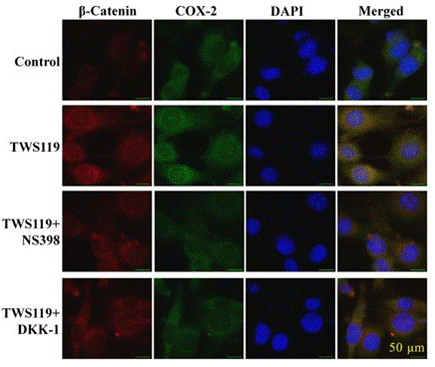
| Immunofluorescence | β-catenin / COX-2 |
|
30618773 |
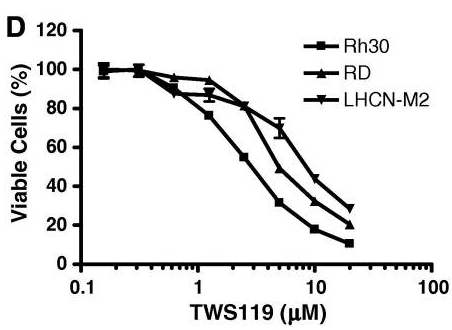
| Growth inhibition assay | Cell viability |
|
19995556 |
Support technique
Tel: +1-832-582-8158 Ext:3
Si vous avez dautres questions, veuillez laisser un message.

Les produits sont destinés à la recherche uniquement. Ne pas utiliser chez lhomme. Nous ne vendons pas aux patients.
©Copyright 2013 Selleck Chemicals. Tous droits réservés.