
pour la recherche uniquement
Adavosertib (AZD1775, MK-1775) Wee1 inhibiteur
Réf. CatalogueS1525
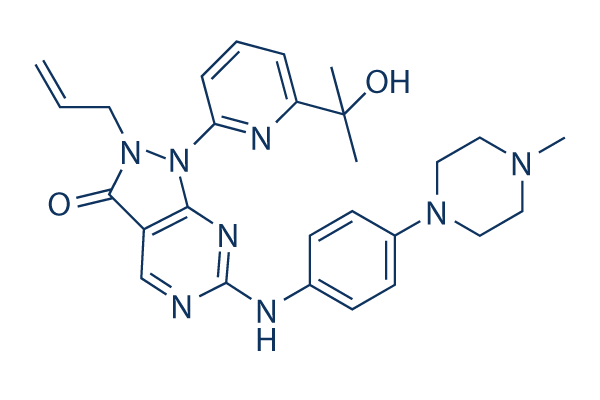
Structure chimique
Poids moléculaire: 500.6
Contrôle Qualité
| Cibles apparentées | CDK HSP PD-1/PD-L1 ROCK DNA/RNA Synthesis Microtubule Associated Ras KRas Aurora Kinase Casein Kinase |
|---|---|
| Autre Wee1 Inhibiteurs | PD0166285 Zedoresertib (Debio-0123, WEE1-IN-5) Azenosertib (Zn-C3) Potrasertib |
Culture cellulaire, traitement et concentration de travail
| Lignées cellulaires | Type dessai | Concentration | Temps dincubation | Formulation | Description de lactivité | PMID |
|---|---|---|---|---|---|---|
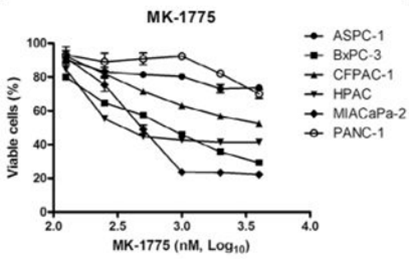
| ASPC-1 | Growth Inhibition Assay | IC50=13.2 ± 1.1 μM | 25458954 | |||
| BxPC-3 | Growth Inhibition Assay | IC50=0.8 ± 0.03 μM | 25458954 | |||
| CFPAC-1 | Growth Inhibition Assay | IC50=3.3 ± 0.2 μM | 25458954 | |||
| HPAC | Growth Inhibition Assay | IC50=0.5 ± 0.01 μM | 25458954 | |||
| MIAPaCa-2 | Growth Inhibition Assay | IC50=0.5 ± 0.05 μM | 25458954 | |||
| PANC-1 | Growth Inhibition Assay | IC50=10.6 ± 1.1 μM | 25458954 | |||
| SK-N-BE (2) | Growth Inhibition Assay | IC50=2.4 ± 0.3 μM | 25308916 | |||
| SK-N-BE (2), PAN→MK | Growth Inhibition Assay | IC50=26.6 ± 9.6 μM | 25308916 | |||
| SK-N-BE (2), MK→PAN | Growth Inhibition Assay | IC50=2.4 ± 0.3 μM | 25308916 | |||
| SK-N-AS | Growth Inhibition Assay | IC50=0.50 ± 0.02 μM | 25308916 | |||
| SK-N-DZ | Growth Inhibition Assay | IC50=0.36 ± 0.01 μM | 25308916 | |||
| SK-N-AS | Apoptosis Assay | 500 nM | 48 h | induces cell apoptosis | 25308916 | |
| SK-N-DZ | Apoptosis Assay | 500 nM | 48 h | induces cell apoptosis | 25308916 | |
| THP-1 | Growth Inhibition Assay | 125/250/500 nM | 48 h | increases cell death in a concentration-dependent manner | 25084614 | |
| MV4-11 | Growth Inhibition Assay | 125/250/500 nM | 48 h | increases cell death in a concentration-dependent manner | 25084614 | |
| U937 | Growth Inhibition Assay | 125/250/500 nM | 48 h | increases cell death in a concentration-dependent manner | 25084614 | |
| HL-60 | Growth Inhibition Assay | 125/250/500 nM | 48 h | increases cell death in a concentration-dependent manner | 25084614 | |
| OCI-AML3 | Growth Inhibition Assay | 125/250/500 nM | 48 h | increases cell death in a concentration-dependent manner | 25084614 | |
| MOLM-13 | Growth Inhibition Assay | 125/250/500 nM | 48 h | increases cell death in a concentration-dependent manner | 25084614 | |
| CMK | Cell Viability Assay | 10-10000 nM | 72 h | reduces cell vialibity in a concentration-dependent manner | 24962331 | |
| CMY | Cell Viability Assay | 10-10000 nM | 72 h | reduces cell vialibity in a concentration-dependent manner | 24962331 | |
| Dayo | Growth Inhibition Assay | IC50=150 nM | 24661910 | |||
| UW228 | Growth Inhibition Assay | IC50=232 nM | 24661910 | |||
| IST-MES1 | Cell Viability Assay | 150/250 nM | 72 h | enhances the cisplatin cytotoxic effect in a concentration-dependent manner | 24365782 | |
| IST-MES2 | Cell Viability Assay | 150/250 nM | 72 h | enhances the cisplatin cytotoxic effect in a concentration-dependent manner | 24365782 | |
| REN | Cell Viability Assay | 150/250 nM | 72 h | enhances the cisplatin cytotoxic effect in a concentration-dependent manner | 24365782 | |
| NCI-H2452 | Cell Viability Assay | 150/250 nM | 72 h | enhances the cisplatin cytotoxic effect in a concentration-dependent manner | 24365782 | |
| MSTO-211H | Cell Viability Assay | 150/250 nM | 72 h | enhances the cisplatin cytotoxic effect in a concentration-dependent manner | 24365782 | |
| NCI-H2052 | Cell Viability Assay | 150/250 nM | 72 h | enhances the cisplatin cytotoxic effect in a concentration-dependent manner | 24365782 | |
| WEE1 | Growth Inhibition Assay | IC50=5.2 nM | 23699655 | |||
| CDC2 | Growth Inhibition Assay | IC50>1000 nM | 23699655 | |||
| CDK7 | Growth Inhibition Assay | IC50>1000 nM | 23699655 | |||
| MYT1 | Growth Inhibition Assay | IC50=530 nM | 23699655 | |||
| T98G | Apoptosis Assay | 100/250 nM | 6 h | enhances radiation-induced cell killing | 21992793 | |
| A549 | Apoptosis Assay | 200 nM | 1 h | radiosensitizes NSCLC cells in a p53-dependent manner | 21799033 | |
| H460 | Apoptosis Assay | 200 nM | 1 h | radiosensitizes NSCLC cells in a p53-dependent manner | 21799033 | |
| H1299 | Apoptosis Assay | 200 nM | 1 h | radiosensitizes NSCLC cells in a p53-dependent manner | 21799033 | |
| Calu-6 | Apoptosis Assay | 200 nM | 1 h | radiosensitizes NSCLC cells in a p53-dependent manner | 21799033 | |
| WiDr | Kinase Assays | 10-10000 nM | 8 h | inhibits phosphorylation of CDC2 at Tyr15 with an EC50 value of 85 nmol/L pretreated with gemcitabine | 19887545 | |
| Function assay | Expi293F | Binding affinity to recombinant human full-length N-terminal His8-tagged Wee1 (1 to 646 residues) expressed in human Expi293F cells assessed as dessociation constant by quantitative real-time PCR method, Kd = 0.0032 μM. | 28792760 | |||
| Function assay | Expi293F | Binding affinity to recombinant human full-length N-terminal His8-tagged Wee2 (1 to 567 residues) expressed in human Expi293F cells assessed as dessociation constant by quantitative real-time PCR method, Kd = 0.0039 μM. | 28792760 | |||
| Antiproliferative assay | MDA-MB-231 | 72 hrs | Antiproliferative activity against human MDA-MB-231 cells measured after 72 hrs by CellTiter-Blue assay, IC50 = 0.26 μM. | 28792760 | ||
| Antiproliferative assay | HEK293T | 72 hrs | Antiproliferative activity against HEK293T cells measured after 72 hrs by CellTiter-Blue assay, IC50 = 0.29 μM. | 28792760 | ||
| Antiproliferative assay | MM1S | 72 hrs | Antiproliferative activity against human MM1S cells measured after 72 hrs by CellTiter-Blue assay, IC50 = 0.31 μM. | 28792760 | ||
| Function assay | HEK293 | 1 hr | Inhibition of human full length PKMYT1 expressed in HEK293 cells using EFS (247 to 259 residues) as substrate after 1 hr by fluorescence polarization immunoasay, Ki = 0.47 μM. | 29941193 | ||
| Function assay | HEK293 | 1 hr | Inhibition of human full length PKMYT1 expressed in HEK293 cells using EFS (247 to 259 residues) as substrate after 1 hr by fluorescence polarization immunoasay, IC50 = 4.94 μM. | 29941193 | ||
| Function assay | MDA-MB-231 | 0.1 to 10 uM | 6 hrs | Inhibition of Wee1 in human MDA-MB-231 cells assessed as decrease in CDK1 phosphorylation at Tyr 15 at 0.1 to 10 uM after 6 hrs by Western blot method | 28792760 | |
| Function assay | HEK293T | 0.1 to 10 uM | 6 hrs | Inhibition of Wee1 in HEK293T cells assessed as decrease in CDK1 phosphorylation at Tyr15 at 0.1 to 10 uM after 6 hrs by Western blot method | 28792760 | |
| Function assay | HEK293T | 0.1 to 10 uM | 6 hrs | Inhibition of PLK1 in HEK293T cells assessed as decrease in TCTP phosphorylation at 0.1 to 10 uM after 6 hrs by Western blot method | 28792760 | |
| Function assay | MDA-MB-23 | 0.1 to 10 uM | 6 hrs | Inhibition of PLK1 in human MDA-MB-23 cells assessed as decrease in TCTP phosphorylation at 0.1 to 10 uM after 6 hrs by Western blot method | 28792760 | |
| qHTS assay | TC32 | qHTS of pediatric cancer cell lines to identify multiple opportunities for drug repurposing: Primary screen for TC32 cells | 29435139 | |||
| qHTS assay | U-2 OS | qHTS of pediatric cancer cell lines to identify multiple opportunities for drug repurposing: Primary screen for U-2 OS cells | 29435139 | |||
| qHTS assay | A673 | qHTS of pediatric cancer cell lines to identify multiple opportunities for drug repurposing: Primary screen for A673 cells | 29435139 | |||
| qHTS assay | DAOY | qHTS of pediatric cancer cell lines to identify multiple opportunities for drug repurposing: Primary screen for DAOY cells | 29435139 | |||
| qHTS assay | Saos-2 | qHTS of pediatric cancer cell lines to identify multiple opportunities for drug repurposing: Primary screen for Saos-2 cells | 29435139 | |||
| qHTS assay | BT-37 | qHTS of pediatric cancer cell lines to identify multiple opportunities for drug repurposing: Primary screen for BT-37 cells | 29435139 | |||
| qHTS assay | RD | qHTS of pediatric cancer cell lines to identify multiple opportunities for drug repurposing: Primary screen for RD cells | 29435139 | |||
| qHTS assay | SK-N-SH | qHTS of pediatric cancer cell lines to identify multiple opportunities for drug repurposing: Primary screen for SK-N-SH cells | 29435139 | |||
| qHTS assay | BT-12 | qHTS of pediatric cancer cell lines to identify multiple opportunities for drug repurposing: Primary screen for BT-12 cells | 29435139 | |||
| qHTS assay | NB1643 | qHTS of pediatric cancer cell lines to identify multiple opportunities for drug repurposing: Primary screen for NB1643 cells | 29435139 | |||
| qHTS assay | OHS-50 | qHTS of pediatric cancer cell lines to identify multiple opportunities for drug repurposing: Primary screen for OHS-50 cells | 29435139 | |||
| qHTS assay | BT-12 | qHTS of pediatric cancer cell lines to identify multiple opportunities for drug repurposing: Confirmatory screen for BT-12 cells | 29435139 | |||
| qHTS assay | DAOY | qHTS of pediatric cancer cell lines to identify multiple opportunities for drug repurposing: Confirmatory screen for DAOY cells | 29435139 | |||
| qHTS assay | SK-N-SH | qHTS of pediatric cancer cell lines to identify multiple opportunities for drug repurposing: Confirmatory screen for SK-N-SH cells | 29435139 | |||
| qHTS assay | Rh41 | qHTS of pediatric cancer cell lines to identify multiple opportunities for drug repurposing: Primary screen for Rh41 cells | 29435139 | |||
| qHTS assay | A673 | qHTS of pediatric cancer cell lines to identify multiple opportunities for drug repurposing: Confirmatory screen for A673 cells) | 29435139 | |||
| qHTS assay | MG 63 (6-TG R) | qHTS of pediatric cancer cell lines to identify multiple opportunities for drug repurposing: Confirmatory screen for MG 63 (6-TG R) cells | 29435139 | |||
| qHTS assay | U-2 OS | qHTS of pediatric cancer cell lines to identify multiple opportunities for drug repurposing: Confirmatory screen for U-2 OS cells | 29435139 | |||
| qHTS assay | OHS-50 | qHTS of pediatric cancer cell lines to identify multiple opportunities for drug repurposing: Confirmatory screen for OHS-50 cells | 29435139 | |||
| qHTS assay | Rh41 | qHTS of pediatric cancer cell lines to identify multiple opportunities for drug repurposing: Confirmatory screen for Rh41 cells | 29435139 | |||
| qHTS assay | RD | qHTS of pediatric cancer cell lines to identify multiple opportunities for drug repurposing: Confirmatory screen for RD cells | 29435139 | |||
| qHTS assay | SJ-GBM2 | qHTS of pediatric cancer cell lines to identify multiple opportunities for drug repurposing: Primary screen for SJ-GBM2 cells | 29435139 | |||
| qHTS assay | SK-N-MC | qHTS of pediatric cancer cell lines to identify multiple opportunities for drug repurposing: Primary screen for SK-N-MC cells | 29435139 | |||
| qHTS assay | NB-EBc1 | qHTS of pediatric cancer cell lines to identify multiple opportunities for drug repurposing: Primary screen for NB-EBc1 cells | 29435139 | |||
| qHTS assay | LAN-5 | qHTS of pediatric cancer cell lines to identify multiple opportunities for drug repurposing: Primary screen for LAN-5 cells | 29435139 | |||
| qHTS assay | Rh18 | qHTS of pediatric cancer cell lines to identify multiple opportunities for drug repurposing: Primary screen for Rh18 cells | 29435139 | |||
| qHTS assay | SJ-GBM2 | qHTS of pediatric cancer cell lines to identify multiple opportunities for drug repurposing: Confirmatory screen for SJ-GBM2 cells | 29435139 | |||
| qHTS assay | Saos-2 | qHTS of pediatric cancer cell lines to identify multiple opportunities for drug repurposing: Confirmatory screen for Saos-2 cells | 29435139 | |||
| Cliquez pour voir plus de données expérimentales sur la lignée cellulaire | ||||||
Informations chimiques, stockage et stabilité
| Poids moléculaire | 500.6 | Formule | C27H32N8O2 |
Stockage (À compter de la date de réception) | |
|---|---|---|---|---|---|
| N° CAS | 955365-80-7 | Télécharger le SDF | Stockage des solutions mères |
|
|
| Synonymes | AZD1775 | Smiles | CC(C)(C1=NC(=CC=C1)N2C3=NC(=NC=C3C(=O)N2CC=C)NC4=CC=C(C=C4)N5CCN(CC5)C)O | ||
Solubilité
|
In vitro |
DMSO
: 100 mg/mL
(199.76 mM)
Water : Insoluble Ethanol : Insoluble |
Calculateur de molarité
|
In vivo |
|||||
Calculateur de formulation in vivo (Solution claire)
Étape 1 : Saisir les informations ci-dessous (Recommandé : Un animal supplémentaire pour tenir compte des pertes pendant lexpérience)
Étape 2 : Saisir la formulation in vivo (Ceci est seulement le calculateur, pas la formulation. Veuillez nous contacter dabord sil ny a pas de formulation in vivo dans la section Solubilité.)
Résultats du calcul :
Concentration de travail : mg/ml;
Méthode de préparation du liquide maître DMSO : mg médicament prédissous dans μL DMSO ( Concentration du liquide maître mg/mL, Veuillez nous contacter dabord si la concentration dépasse la solubilité du DMSO du lot de médicament. )
Méthode de préparation de la formulation in vivo : Prendre μL DMSO liquide maître, puis ajouterμL PEG300, mélanger et clarifier, puis ajouterμL Tween 80, mélanger et clarifier, puis ajouter μL ddH2O, mélanger et clarifier.
Méthode de préparation de la formulation in vivo : Prendre μL DMSO liquide maître, puis ajouter μL Huile de maïs, mélanger et clarifier.
Note : 1. Veuillez vous assurer que le liquide est clair avant dajouter le solvant suivant.
2. Assurez-vous dajouter le(s) solvant(s) dans lordre. Vous devez vous assurer que la solution obtenue, lors de lajout précédent, est une solution claire avant de procéder à lajout du solvant suivant. Des méthodes physiques telles que le vortex, les ultrasons ou le bain-marie chaud peuvent être utilisées pour faciliter la dissolution.
Mécanisme daction
| Caractéristiques |
The first reported Wee1 inhibitor.
|
|---|---|
| Targets/IC50/Ki |
Wee1
(Cell-free assay) 5.2 nM
|
| In vitro |
Adavosertib (MK-1775) inhibe la kinase Wee1 de manière ATP-compétitive. Comparé à Wee1, il présente une puissance 2 à 3 fois moindre contre Yes avec une IC50 de 14 nM, une puissance 10 fois moindre contre sept autres kinases avec >80% d'inhibition à 1 µM, et une sélectivité >100 fois supérieure à celle de la Myt 1 humaine, une autre kinase qui inhibe la kinase cycline-dépendante 1 (CDC2) par phosphorylation à un site alternatif (Thr14). En abrogeant le point de contrôle des dommages à l'ADN via le blocage de l'activité de Wee1 dans les cellules WiDr portant la p53 mutée, ce composé inhibe la phosphorylation basale de CDC2 au Tyr15 (CDC2Y15) avec une EC50 de 49 nM, et supprime la phosphorylation induite de CDC2 et l'arrêt du Cell Cycle de manière dose-dépendante, avec une EC50 de 82 nM et 81 nM, 180 nM et 163 nM, ainsi que 159 nM et 160 nM, respectivement. Son traitement seul à 30-100 nM n'a pas d'effet antiprolifératif significatif dans les cellules WiDr et H1299, tandis qu'à 300 nM, suffisant pour inhiber Wee1 de >80%, il présente des effets antiprolifératifs modérés mais significatifs de 34,1% dans les cellules WiDr et de 28,4% dans les cellules H1299. |
| Essai kinase |
Tests de kinase in vitro
|
|
La Wee1 humaine recombinante est utilisée. La réaction de la kinase est réalisée avec 10 μM d'ATP, 1,0 μCi de [γ-33P]ATP, et 2,5 μg de poly(Lys, Tyr) comme substrat en présence de concentrations croissantes d'Adavosertib (MK-1775) à 30°C pendant 30 minutes. La radioactivité incorporée dans le substrat est piégée sur des plaques MultiScreen-PH et est comptée sur un compteur à scintillation liquide.
|
|
| In vivo |
Le traitement par Adavosertib (MK-1775) seul à ~20 mg/kg présente des effets antitumoraux minimaux contre les xénogreffes WiDr chez le rat avec un T/C de 69% au jour 3. Son efficacité antitumorale dans les modèles de xénogreffes de rats nus HeLa-luc et TOV21G-shp53 est également modérée. |
Références |
Applications
| Méthodes | Biomarqueurs | Images | PMID |
|---|---|---|---|
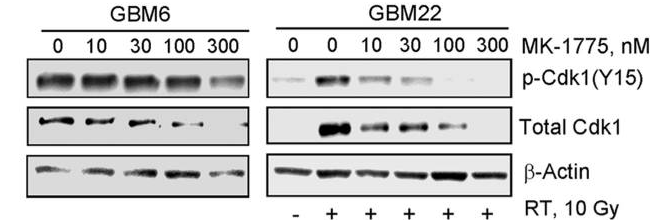
| Western blot | p-Cdk1(Y15) / Cdk1 p-KAP1(S824) / p-Chk2(T68) / p-Chk1(S345) PARP / CF-PARP / pH3(S10) / p-CDC25c(S216) / p-CDK2(Y15) WEE1 |
|
25609063 |
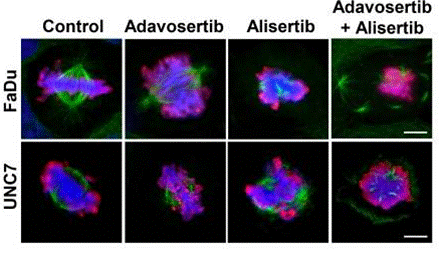
| Immunofluorescence | tubulin / p-HH3(S10) γH2AX Cleaved caspase-3 / pH3 |
|
30755439 |
| Growth inhibition assay | Cell viability IC50 |
|
25458954 |
Informations sur lessai clinique
(données du https://clinicaltrials.gov, mis à jour le 2024-05-22)
| Numéro NCT | Recrutement | Conditions | Promoteur/Collaborateurs | Date de début | Phases |
|---|---|---|---|---|---|
| NCT03253679 | Completed | Advanced Malignant Solid Neoplasm|Refractory Malignant Solid Neoplasm |
National Cancer Institute (NCI) |
January 16 2019 | Phase 2 |
| NCT03668340 | Active not recruiting | Uterine Cancer |
Dana-Farber Cancer Institute|AstraZeneca |
October 22 2018 | Phase 2 |
| NCT03028766 | Completed | Hypopharynx Squamous Cell Carcinoma|Oral Cavity Squamous Cell Carcinoma|Larynx Cancer |
University of Birmingham|AstraZeneca|Cancer Research UK |
June 22 2017 | Phase 1 |
Support technique
Tel: +1-832-582-8158 Ext:3
Si vous avez dautres questions, veuillez laisser un message.
Foire aux questions
Question 1:
How to prepare its methylcellulose solution? and how to prepare methylcellulose itself? Once make the solution, how should i keep it?
Réponse :
It is a suspension or emulsion in 0.5% methylcellulose, and it is ok to treat mice orally. It is recommended to dissolve methylcellulose in saline. It will take some time to dissolve methylcellulose, and you can vortex it for a while. The methylcellulose solution of this compound can be stored at 4°C for a week.

Les produits sont destinés à la recherche uniquement. Ne pas utiliser chez lhomme. Nous ne vendons pas aux patients.
©Copyright 2013 Selleck Chemicals. Tous droits réservés.