
pour la recherche uniquement
AG-1478 EGFR Inhibiteur
Réf. Catalogue: S2728
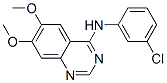
Structure chimique
Poids moléculaire: 315.75
Contrôle Qualité (Quality Control)
- Cité dans Nature Medicine pour sa qualité supérieure
- COA
- NMR
- HPLC
- SDS
- Fiche technique
| Cibles apparentées | VEGFR FGFR PDGFR c-Met Src MEK CSF-1R FLT3 HER2 c-Kit |
|---|---|
| Autre EGFR Inhibiteurs | Lazertinib (YH25448) Icotinib Hydrochloride Sunvozertinib AG-490 Canertinib (CI-1033) Genistein Rociletinib (CO-1686) Poziotinib (NOV120101, HM781-36B) WZ4002 PD153035 HCl |
Culture cellulaire, traitement et concentration de travail
(Cell Culture, Treatment & Working Concentration)
| Lignées cellulaires | Type d'essai | Concentration | Temps d'incubation | Formulation | Description de l'activité | PMID |
|---|---|---|---|---|---|---|
| U87MG | Growth inhibitory assay | ~100 μM | DMSO | IC50=34.6 μM | 8752145 | |
| U87MG.ΔEGFR | Growth inhibitory assay | ~100 μM | DMSO | IC50=8.7 μM | 8752145 | |
| U87MG.wtEGFR. | Growth inhibitory assay | ~100 μM | DMSO | IC50=48.4 μM | 8752145 | |
| U87MG | Kinase assay | ~100 μM | DMSO | inhibits EGFR tyrosine kinase activity | 8752145 | |
| U87MG.ΔEGFR | Kinase assay | ~100 μM | DMSO | inhibits EGFR tyrosine kinase activity | 8752145 | |
| U87MG.wtEGFR. | Kinase assay | ~100 μM | DMSO | inhibits EGFR tyrosine kinase activity | 8752145 | |
| HPV 16-immortalized human keratinocytes | Growth inhibitory assay | ~50 μM | DMSO | inhibits cell growth | 9288782 | |
| HPV 16-immortalized human keratinocytes | Function assay | ~50 μM | DMSO | induces arrest in the Cell Cycle | 9288782 | |
| HPV 16-immortalized human keratinocytes | Apoptosis assay | ~50 μM | DMSO | induces apoptosis. | 9288782 | |
| A431 | Kinase assay | ~10 μM | DMSO | inhibits the basal and TGF-α-stimulated tyrosine phosphorylation of the EGFR | 10702262 | |
| MDA-468 | Kinase assay | ~10 μM | DMSO | inhibits the basal and TGF-α-stimulated tyrosine phosphorylation of the EGFR | 10702262 | |
| A431 | Function assay | ~10 μM | DMSO | induces cell cycle arrest | 10702262 | |
| MDA-MB-231 | Kinase assay | ~5 μM | DMSO | inhibits EGF stimulated phosphorylation of FKHR | 11030146 | |
| CNE2 | Growth inhibitory assay | 100 μM | DMSO | inhibits cell proliferation by 98.4% | 11410322 | |
| CNE2 | Kinase assay | ~100 μM | DMSO | inhibits EGFR tyrosine phosphorylation | 11410322 | |
| CNE2 | Function assay | ~100 μM | DMSO | Inhibits MAPK and AKT activation | 11410322 | |
| CNE2 | Function assay | ~50 μM | DMSO | affects cell cycle distribution | 11410322 | |
| HSC-2 | Kinase assay | 8 μM | DMSO | inhibits phosphorylation of EGFR and Akt | 17689285 | |
| HSC-2 | Apoptosis assay | 8 μM | DMSO | inhibits Fas-mediated apoptosis | 17689285 | |
| HEp-2 | Growth inhibitory assay | ~10 μM | DMSO | enhances oridonin-induced growth-inhibitory | 20202741 | |
| SubG1 | Apoptosis assay | ~10 μM | DMSO | enhances oridonin-induced apoptosis | 20202741 | |
| HEp-2 | Function assay | ~10 μM | DMSO | enhances Oridonin-induced Bax activation, Bcl-2 degradation and SIRT1 inactivation | 20202741 | |
| H508 | Growth inhibitory assay | ~1 μM | DMSO | mitigates CPF-mediated H508 cell growth | 26514924 | |
| A431 | Antiproliferative assay | Tested for antiproliferative activity against human A431 cells, IC50=20μM | 15109642 | |||
| HeLa | Function assay | 30 mins | Inhibition of EGFR autophosphorylation in human HeLa cells preincubated for 30 mins prior to EGF stimulation by Western blotting | 21718029 | ||
| BT-37 | qHTS assay | qHTS of pediatric cancer cell lines to identify multiple opportunities for drug repurposing: Primary screen for BT-37 cells | 29435139 | |||
| SK-N-SH | qHTS assay | qHTS of pediatric cancer cell lines to identify multiple opportunities for drug repurposing: Primary screen for SK-N-SH cells | 29435139 | |||
| NB1643 | qHTS assay | qHTS of pediatric cancer cell lines to identify multiple opportunities for drug repurposing: Primary screen for NB1643 cells | 29435139 | |||
| OHS-50 | qHTS assay | qHTS of pediatric cancer cell lines to identify multiple opportunities for drug repurposing: Primary screen for OHS-50 cells | 29435139 | |||
| HEK293 | Function assay | 1 hr | Inhibition of human full length PKMYT1 expressed in HEK293 cells using EFS (247 to 259 residues) as substrate after 1 hr by fluorescence polarization immunoasay, Ki=1.87μM | 29941193 | ||
| HEK293 | Function assay | 1 hr | Inhibition of human full length PKMYT1 expressed in HEK293 cells using EFS (247 to 259 residues) as substrate after 1 hr by fluorescence polarization immunoasay, IC50=19.6μM | 29941193 | ||
| Cliquez pour voir plus de données expérimentales sur la lignée cellulaire | ||||||
Informations chimiques, stockage et stabilité (Chemical Information, Storage & Stability)
| Poids moléculaire | 315.75 | Formule | C16H14ClN3O2 |
Stockage (À compter de la date de réception) | |
|---|---|---|---|---|---|
| N° CAS | 153436-53-4,175178-82-2 | Télécharger le SDF | Stockage des solutions mères |
|
|
| Synonymes | Tyrphostin AG-1478, NSC 693255 | Smiles | COC1=C(C=C2C(=C1)C(=NC=N2)NC3=CC(=CC=C3)Cl)OC | ||
Solubilité (Solubility)
|
In vitro |
DMSO
: 25 mg/mL
(79.17 mM)
Ethanol : 13 mg/mL Water : Insoluble |
Calculateur de molarité
|
In vivo |
|||||
Calculateur de formulation in vivo (Solution claire)
Étape 1 : Saisir les informations ci-dessous (Recommandé : Un animal supplémentaire pour tenir compte des pertes pendant l'expérience)
Étape 2 : Saisir la formulation in vivo (Ceci est seulement le calculateur, pas la formulation. Veuillez nous contacter d'abord s'il n'y a pas de formulation in vivo dans la section Solubilité.)
Résultats du calcul :
Concentration de travail : mg/ml;
Méthode de préparation du liquide maître DMSO : mg médicament prédissous dans μL DMSO ( Concentration du liquide maître mg/mL, Veuillez nous contacter d'abord si la concentration dépasse la solubilité du DMSO du lot de médicament. )
Méthode de préparation de la formulation in vivo : Prendre μL DMSO liquide maître, puis ajouterμL PEG300, mélanger et clarifier, puis ajouterμL Tween 80, mélanger et clarifier, puis ajouter μL ddH2O, mélanger et clarifier.
Méthode de préparation de la formulation in vivo : Prendre μL DMSO liquide maître, puis ajouter μL Huile de maïs, mélanger et clarifier.
Note : 1. Veuillez vous assurer que le liquide est clair avant d'ajouter le solvant suivant.
2. Assurez-vous d'ajouter le(s) solvant(s) dans l'ordre. Vous devez vous assurer que la solution obtenue, lors de l'ajout précédent, est une solution claire avant de procéder à l'ajout du solvant suivant. Des méthodes physiques telles que le vortex, les ultrasons ou le bain-marie chaud peuvent être utilisées pour faciliter la dissolution.
Mécanisme d'action (Mechanism of Action)
| Targets/IC50/Ki |
EGFR
(Cell-free assay) 3 nM
|
|---|---|
| In vitro |
AG-1478 is high selective over ErbB2 and PDGFR with IC50 of >100 μM. This compound preferentially inhibits U87MG cells expressing truncated EGFR with IC50 of 8.7 μM, compared to those expressing endogenous wt EGFR or overexpressing exogenous wt EGFR with IC50 of 34.6 μM and 48.4 μM, respectively, and inhibits the DNA synthesis with IC50 of 4.6 μM, 19.67 μM, and 35.2 μM, respectively. This chemical also preferentially inhibits the tyrosine kinase activity and autophosphorylation of the ΔEGFR compared to endogenous or overexpressed exogenous wt EGFR. It (0.25 μM) abolishes the MAPK activation induced by Ang II, a Ca2+ ionophore as well as EGF but not by a phorbol ester or platelet-derived growth factor-BB in the VSMC. This compound inhibits EGF-induced mitogenesis of the BaF/ERX and LIM1215 cells with IC50 of 0.07 μM and 0.2 μM, respectively. It is able to inhibit the function of ATP-binding cassette (ABC) transporters such as ABCB1 and ABCG2, with a more pronounced effect on ABCG2. |
| In vivo |
Administration of AG-1478 blocks phosphorylation of the EGFR at the tumor site and inhibits the growth of A431 xenografts that overexpress the WT EGFR and glioma xenografts expressing the de2-7 EGFR. Even subtherapeutic doses of this compound significantly enhance the efficacy of cytotoxic drugs, with the combination of this chemical displaying synergistic antitumor activity against human glioma xenografts. The combination of this compound and an anti-EGFR antibody (mAb 806) displays additive and in some cases synergistic, antitumor activity against tumor xenografts overexpressing the EGFR. The combination of this compound (0.4 mg) with a single dose of 25 μCi 90Y-CHX-A''-DTPA-hu3S193 results in a significant enhancement of efficacy compared with either agent alone. |
Références |
|
Applications (Applications)
| Méthodes | Biomarqueurs | Images | PMID |
|---|---|---|---|
| Western blot | EGFR / Neu / p-Tyr Shc / PLC-γ1 |

|
10931950 |
| Growth inhibition assay | Cell viability |
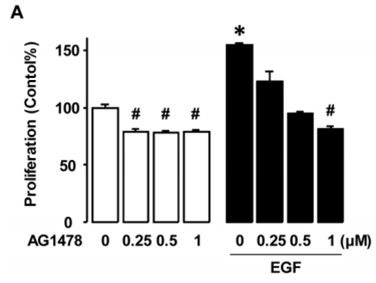
|
25258648 |

Les produits sont destinés à la recherche uniquement. Ne pas utiliser chez l'homme. Nous ne vendons pas aux patients.
©Copyright 2013 Selleck Chemicals. Tous droits réservés.