
pour la recherche uniquement
AMG-458 c-Met inhibiteur
Réf. CatalogueS2747
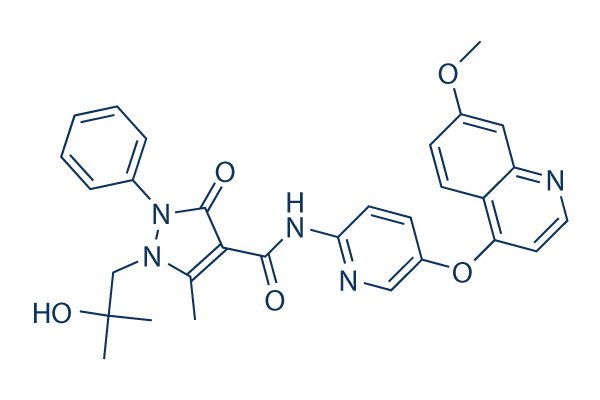
Structure chimique
Poids moléculaire: 539.58
Contrôle Qualité
| Cibles apparentées | EGFR VEGFR PDGFR FGFR Src MEK CSF-1R FLT3 HER2 c-Kit |
|---|---|
| Autre c-Met Inhibiteurs | Tepotinib Dihexa SGX-523 PHA-665752 Foretinib SU11274 BMS-777607 JNJ-38877605 Tivantinib PF-04217903 |
Informations chimiques, stockage et stabilité
| Poids moléculaire | 539.58 | Formule | C30H29N5O5 |
Stockage (À compter de la date de réception) | |
|---|---|---|---|---|---|
| N° CAS | 913376-83-7 | Télécharger le SDF | Stockage des solutions mères |
|
|
| Synonymes | N/A | Smiles | CC1=C(C(=O)N(N1CC(C)(C)O)C2=CC=CC=C2)C(=O)NC3=NC=C(C=C3)OC4=C5C=CC(=CC5=NC=C4)OC | ||
Solubilité
|
In vitro |
DMSO
: 26 mg/mL
(48.18 mM)
Water : Insoluble Ethanol : Insoluble |
Calculateur de molarité
|
In vivo |
|||||
Calculateur de formulation in vivo (Solution claire)
Étape 1 : Saisir les informations ci-dessous (Recommandé : Un animal supplémentaire pour tenir compte des pertes pendant lexpérience)
Étape 2 : Saisir la formulation in vivo (Ceci est seulement le calculateur, pas la formulation. Veuillez nous contacter dabord sil ny a pas de formulation in vivo dans la section Solubilité.)
Résultats du calcul :
Concentration de travail : mg/ml;
Méthode de préparation du liquide maître DMSO : mg médicament prédissous dans μL DMSO ( Concentration du liquide maître mg/mL, Veuillez nous contacter dabord si la concentration dépasse la solubilité du DMSO du lot de médicament. )
Méthode de préparation de la formulation in vivo : Prendre μL DMSO liquide maître, puis ajouterμL PEG300, mélanger et clarifier, puis ajouterμL Tween 80, mélanger et clarifier, puis ajouter μL ddH2O, mélanger et clarifier.
Méthode de préparation de la formulation in vivo : Prendre μL DMSO liquide maître, puis ajouter μL Huile de maïs, mélanger et clarifier.
Note : 1. Veuillez vous assurer que le liquide est clair avant dajouter le solvant suivant.
2. Assurez-vous dajouter le(s) solvant(s) dans lordre. Vous devez vous assurer que la solution obtenue, lors de lajout précédent, est une solution claire avant de procéder à lajout du solvant suivant. Des méthodes physiques telles que le vortex, les ultrasons ou le bain-marie chaud peuvent être utilisées pour faciliter la dissolution.
Mécanisme daction
| Caractéristiques |
Completely bioavailable across species and the intrinsic half-life is increased in higher mammals.
|
|---|---|
| Targets/IC50/Ki |
c-Met (H1094R)
0.5 nM(Ki)
c-Met (V1092I)
1.1 nM(Ki)
c-Met (Human)
1.2 nM(Ki)
c-Met (Mouse)
2.0 nM(Ki)
c-Met (D1228H)
2.2 nM(Ki)
c-Met (M1250T)
4.1 nM(Ki)
c-Met (Y1230H)
4.5 nM(Ki)
|
| In vitro |
AMG 458 inhibe également la phosphorylation de c-Met médiée par HGF dans les cellules PC3 et CT26 avec une IC50 de 60 et 120 nM. Il est observé que AMG 458 se lie de manière covalente aux protéines microsomales hépatiques de rats et d'humains en l'absence de NADPH. On pense que AMG 458 réagit avec les groupes thiol des protéines, produisant un conjugué thioéther de méthoxy quinoléine. Une étude récente montre que la phosphorylation constitutive de c-Met dans les cellules H441 est abrogée par AMG 458. La phosphorylation basale et induite par HGF de c-Met dans les cellules A549 est atténuée par AMG 458. La combinaison de la radiothérapie et du traitement par AMG 458 augmente synergiquement l'apoptose dans la lignée cellulaire H441 par réduction des niveaux de p-Akt et p-Erk, mais pas dans les cellules A549.
|
| In vivo |
AMG 458 est métaboliquement stable dans les microsomes hépatiques de souris, rats, chiens, singes et humains avec de faibles clairances intrinsèques (Clint: <5, 62, 8, 8, 18 (μL/min)/mg, respectivement). Administré par voie orale, AMG 458 atteint une biodisponibilité remarquablement élevée chez toutes les espèces testées. L'administration orale d'AMG 458 inhibe la phosphorylation de c-Met médiée par HGF avec une ED90 approximative de 30 mg/kg et une exposition plasmatique associée d'environ 15 μM à 6 heures. AMG 458 inhibe significativement la croissance tumorale dans les modèles de xénogreffe NIH3T3/TPR-Met et U-87 MG à 30 et 100 mg/kg q.d. et 30 mg/kg b.i.d. sans effet indésirable sur le poids corporel. Des concentrations élevées d'AMG 458 dans certains organes peuvent produire une toxicité via le stress oxydatif.
|
Références |
|
Support technique
Tel: +1-832-582-8158 Ext:3
Si vous avez dautres questions, veuillez laisser un message.

Les produits sont destinés à la recherche uniquement. Ne pas utiliser chez lhomme. Nous ne vendons pas aux patients.
©Copyright 2013 Selleck Chemicals. Tous droits réservés.