
pour la recherche uniquement
Copanlisib (BAY 80-6946) PI3K Inhibiteur
Réf. Catalogue: S2802
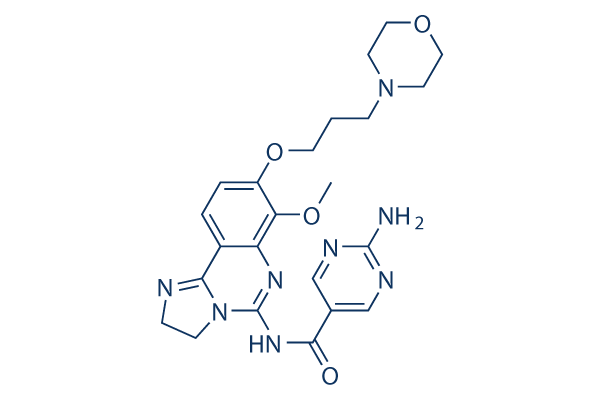
Structure chimique
Poids moléculaire: 480.52
Contrôle Qualité (Quality Control)
Produits souvent utilisés avec Copanlisib (BAY 80-6946)
| Cibles apparentées | Akt mTOR GSK-3 ATM/ATR DNA-PK AMPK PDPK1 PTEN PI4K PP2A |
|---|---|
| Autre PI3K Inhibiteurs | GDC-0077 (Inavolisib) SAR405 Quercetin (Sophoretin) LY294002 XL147 analogue Tersolisib (STX-478) Buparlisib (BKM120) 740 Y-P (PDGFR 740Y-P) GO-203 TFA Eganelisib (IPI-549) |
Culture cellulaire, traitement et concentration de travail
(Cell Culture, Treatment & Working Concentration)
| Lignées cellulaires | Type d'essai | Concentration | Temps d'incubation | Formulation | Description de l'activité | PMID |
|---|---|---|---|---|---|---|
| Huh7 | Growth inhibiton assay | 100 nM | Copanlisib dose-dependently inhibited cell growth in vitro. IC50=47.9 nM. | 30962952 | ||
| HepG2 | Growth inhibiton assay | 100 nM | Copanlisib dose-dependently inhibited cell growth in vitro. IC50=31.6 nM. | 30962952 | ||
| Hep3B | Growth inhibiton assay | IC50=72.4 nM | 30962952 | |||
| PLCPRF5 | Growth inhibiton assay | IC50=283 nM | 30962952 | |||
| Chang | Growth inhibiton assay | IC50=442 nM | 30962952 | |||
| JVM-3 | Function assay | 48 h | inhibits metabolic activity with an IC50 of 2 μM in the XTT assay | 25912635 | ||
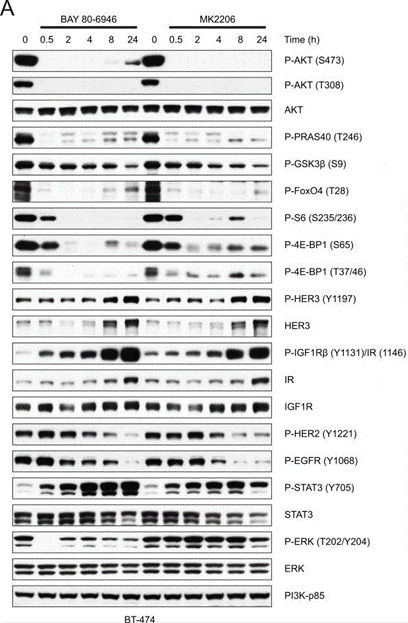
| BT-474 | Function assay | 50 nM | 0.5, 2, 4, 8, 24 h | rapidly inhibits the phosphorylation of AKT (S473, T308) as well as its direct substrates PRAS40 (T246) and GSK3β (S9), and inhibition was sustained for up to 24 hours | 24436048 | |
| SK-BR-3 | Function assay | 0, 1, 2, 4 h | downregulation of P-AKT | 24436048 | ||
| UACC-893 | Function assay | 0, 1, 2, 4 h | downregulation of P-AKT | 24436048 | ||
| HCC-1954 | Function assay | 0, 1, 2, 4 h | downregulation of P-AKT | 24436048 | ||
| MDA-MB-453 | Function assay | 0, 1, 2, 4 h | downregulation of P-AKT | 24436048 | ||
| MDA-MB-361 | Function assay | 0, 1, 2, 4 h | downregulation of P-AKT | 24436048 | ||
| BT-20 | Function assay | 0, 1, 2, 4 h | downregulation of P-AKT | 24436048 | ||
| MCF-7 | Function assay | 0, 1, 2, 4 h | downregulation of P-AKT | 24436048 | ||
| T-47D | Function assay | 0, 1, 2, 4 h | downregulation of P-AKT | 24436048 | ||
| HCC1806 | Function assay | 0, 1, 2, 4 h | downregulation of P-AKT | 24436048 | ||
| NCI-H292 | Function assay | 0, 1, 2, 4 h | downregulation of P-AKT | 24436048 | ||
| NCI-H1650 | Function assay | 0, 1, 2, 4 h | downregulation of P-AKT | 24436048 | ||
| CCRF-SB | Function assay | 0, 1, 2, 4 h | downregulation of P-AKT | 24436048 | ||
| U937 | Function assay | 0, 1, 2, 4 h | downregulation of P-AKT | 24436048 | ||
| SU-DHL-4 | Function assay | 0, 1, 2, 4 h | downregulation of P-AKT | 24436048 | ||
| SU-DHL-5 | Function assay | 0, 1, 2, 4 h | downregulation of P-AKT | 24436048 | ||
| HCT116 | Function assay | 0, 1, 2, 4 h | downregulation of P-AKT | 24436048 | ||
| A549 cells | Function assay | 0, 1, 2, 4 h | downregulation of P-AKT | 24436048 | ||
| SK-MEL-30 | Function assay | 0, 1, 2, 4 h | downregulation of P-AKT | 24436048 | ||
| SK-MEL-2 cells | Function assay | 0, 1, 2, 4 h | downregulation of P-AKT | 24436048 | ||
| NCI-H1703 | Function assay | 0, 1, 2, 4 h | downregulation of P-AKT | 24436048 | ||
| NCI-H661 | Function assay | 0, 1, 2, 4 h | downregulation of P-AKT | 24436048 | ||
| PC9 | Function assay | 0, 1, 2, 4 h | downregulation of P-AKT | 24436048 | ||
| TC32 | qHTS assay | qHTS of pediatric cancer cell lines to identify multiple opportunities for drug repurposing: Primary screen for TC32 cells | 29435139 | |||
| A673 | qHTS assay | qHTS of pediatric cancer cell lines to identify multiple opportunities for drug repurposing: Primary screen for A673 cells | 29435139 | |||
| Saos-2 | qHTS assay | qHTS of pediatric cancer cell lines to identify multiple opportunities for drug repurposing: Primary screen for Saos-2 cells | 29435139 | |||
| RD | qHTS assay | qHTS of pediatric cancer cell lines to identify multiple opportunities for drug repurposing: Primary screen for RD cells | 29435139 | |||
| MG 63 (6-TG R) | qHTS assay | qHTS of pediatric cancer cell lines to identify multiple opportunities for drug repurposing: Primary screen for MG 63 (6-TG R) cells | 29435139 | |||
| OHS-50 | qHTS assay | qHTS of pediatric cancer cell lines to identify multiple opportunities for drug repurposing: Primary screen for OHS-50 cells | 29435139 | |||
| LAN-5 | qHTS assay | qHTS of pediatric cancer cell lines to identify multiple opportunities for drug repurposing: Confirmatory screen for LAN-5 cells | 29435139 | |||
| NB-EBc1 | qHTS assay | qHTS of pediatric cancer cell lines to identify multiple opportunities for drug repurposing: Confirmatory screen for NB-EBc1 cells | 29435139 | |||
| SK-N-SH | qHTS assay | qHTS of pediatric cancer cell lines to identify multiple opportunities for drug repurposing: Confirmatory screen for SK-N-SH cells | 29435139 | |||
| Rh41 | qHTS assay | qHTS of pediatric cancer cell lines to identify multiple opportunities for drug repurposing: Primary screen for Rh41 cells | 29435139 | |||
| A673 | qHTS assay | qHTS of pediatric cancer cell lines to identify multiple opportunities for drug repurposing: Confirmatory screen for A673 cells) | 29435139 | |||
| BT-37 | qHTS assay | qHTS of pediatric cancer cell lines to identify multiple opportunities for drug repurposing: Confirmatory screen for BT-37 cells | 29435139 | |||
| MG 63 (6-TG R) | qHTS assay | qHTS of pediatric cancer cell lines to identify multiple opportunities for drug repurposing: Confirmatory screen for MG 63 (6-TG R) cells | 29435139 | |||
| Rh30 | qHTS assay | qHTS of pediatric cancer cell lines to identify multiple opportunities for drug repurposing: Confirmatory screen for Rh30 cells | 29435139 | |||
| OHS-50 | qHTS assay | qHTS of pediatric cancer cell lines to identify multiple opportunities for drug repurposing: Confirmatory screen for OHS-50 cells | 29435139 | |||
| SJ-GBM2 | qHTS assay | qHTS of pediatric cancer cell lines to identify multiple opportunities for drug repurposing: Primary screen for SJ-GBM2 cells | 29435139 | |||
| SK-N-MC | qHTS assay | qHTS of pediatric cancer cell lines to identify multiple opportunities for drug repurposing: Primary screen for SK-N-MC cells | 29435139 | |||
| NB-EBc1 | qHTS assay | qHTS of pediatric cancer cell lines to identify multiple opportunities for drug repurposing: Primary screen for NB-EBc1 cells | 29435139 | |||
| LAN-5 | qHTS assay | qHTS of pediatric cancer cell lines to identify multiple opportunities for drug repurposing: Primary screen for LAN-5 cells | 29435139 | |||
| Rh18 | qHTS assay | qHTS of pediatric cancer cell lines to identify multiple opportunities for drug repurposing: Primary screen for Rh18 cells | 29435139 | |||
| NB1643 | qHTS assay | qHTS of pediatric cancer cell lines to identify multiple opportunities for drug repurposing: Confirmatory screen for NB1643 cells | 29435139 | |||
| SK-N-MC | qHTS assay | qHTS of pediatric cancer cell lines to identify multiple opportunities for drug repurposing: Confirmatory screen for SK-N-MC cells | 29435139 | |||
| SJ-GBM2 | qHTS assay | qHTS of pediatric cancer cell lines to identify multiple opportunities for drug repurposing: Confirmatory screen for SJ-GBM2 cells | 29435139 | |||
| TC32 | qHTS assay | qHTS of pediatric cancer cell lines to identify multiple opportunities for drug repurposing: Confirmatory screen for TC32 cells | 29435139 | |||
| Rh18 | qHTS assay | qHTS of pediatric cancer cell lines to identify multiple opportunities for drug repurposing: Confirmatory screen for Rh18 cells | 29435139 | |||
| Saos-2 | qHTS assay | qHTS of pediatric cancer cell lines to identify multiple opportunities for drug repurposing: Confirmatory screen for Saos-2 cells | 29435139 | |||
| Cliquez pour voir plus de données expérimentales sur la lignée cellulaire | ||||||
Informations chimiques, stockage et stabilité (Chemical Information, Storage & Stability)
| Poids moléculaire | 480.52 | Formule | C23H28N8O4 |
Stockage (À compter de la date de réception) | |
|---|---|---|---|---|---|
| N° CAS | 1032568-63-0 | Télécharger le SDF | Stockage des solutions mères |
|
|
| Synonymes | BAY 80-6946 | Smiles | COC1=C(C=CC2=C3NCCN3C(=NC(=O)C4=CN=C(N=C4)N)N=C21)OCCCN5CCOCC5 | ||
Solubilité (Solubility)
|
In vitro |
5%TFA : 8 mg/mL
DMSO
: Insoluble
Water : Insoluble |
Calculateur de molarité
|
In vivo |
|||||
Calculateur de formulation in vivo (Solution claire)
Étape 1 : Saisir les informations ci-dessous (Recommandé : Un animal supplémentaire pour tenir compte des pertes pendant l'expérience)
Étape 2 : Saisir la formulation in vivo (Ceci est seulement le calculateur, pas la formulation. Veuillez nous contacter d'abord s'il n'y a pas de formulation in vivo dans la section Solubilité.)
Résultats du calcul :
Concentration de travail : mg/ml;
Méthode de préparation du liquide maître DMSO : mg médicament prédissous dans μL DMSO ( Concentration du liquide maître mg/mL, Veuillez nous contacter d'abord si la concentration dépasse la solubilité du DMSO du lot de médicament. )
Méthode de préparation de la formulation in vivo : Prendre μL DMSO liquide maître, puis ajouterμL PEG300, mélanger et clarifier, puis ajouterμL Tween 80, mélanger et clarifier, puis ajouter μL ddH2O, mélanger et clarifier.
Méthode de préparation de la formulation in vivo : Prendre μL DMSO liquide maître, puis ajouter μL Huile de maïs, mélanger et clarifier.
Note : 1. Veuillez vous assurer que le liquide est clair avant d'ajouter le solvant suivant.
2. Assurez-vous d'ajouter le(s) solvant(s) dans l'ordre. Vous devez vous assurer que la solution obtenue, lors de l'ajout précédent, est une solution claire avant de procéder à l'ajout du solvant suivant. Des méthodes physiques telles que le vortex, les ultrasons ou le bain-marie chaud peuvent être utilisées pour faciliter la dissolution.
Mécanisme d'action (Mechanism of Action)
| Targets/IC50/Ki |
PI3Kα
(Cell-free assay) 0.5 nM
PI3Kδ
(Cell-free assay) 0.7 nM
PI3Kβ
(Cell-free assay) 3.7 nM
PI3Kγ
(Cell-free assay) 6.4 nM
|
|---|---|
| In vitro |
In both KPL4 cells and LPA-stimulated PC3 cells, BAY 80-6946 reduces pAKT levels. In a subset of human cancer cell lines with PIK3CA mutations and/or overexpression of HER2, BAY 80-6946 shows antiproliferative activity and induces apoptosis. [1] The combination of HER2-targeted therapies and BAY 80-6946 inhibits growth more effectively than either therapy used alone, and can restore sensitivity to trastuzumab and lapatinib in cells. [2] |
| Essai kinase |
Essais de lipid kinase biochimiques
|
|
L'effet du BAY 80-6946 sur l'activité de PI3Kα, PI3Kβ et PI3Kγ est mesuré par l'inhibition de l'incorporation de 33P dans le phosphatidylinositol (PI) dans des plaques MaxiSorp® de 384 puits revêtues de 2 µg/puits de PI et de phosphatidylsérine (PS) (rapport molaire 1:1). Dans chaque essai d'isoforme de PI3K, 9 µL de tampon de réaction (50 mM MOPSO, pH 7,0, 100 mM NaCl, 4 mM MgCl2, 0,1 % BSA) contenant 7,5 ng de protéine p110α ou p110β tronquée N-terminale marquée His, ou 25 ng de protéine p110γ humaine purifiée, sont utilisés. La réaction est démarrée par l'ajout de 5 µL d'une solution d'ATP à 40 µM contenant 20 µCi/mL de [33P]-ATP. Après 2 heures d'incubation à température ambiante, la réaction est arrêtée par l'ajout de 5 µL d'une solution d'EDTA à 25 mM. Les plaques sont lavées et 25 µL de cocktail de scintillation Ultima Gold™ sont ensuite ajoutés. La radioactivité incorporée dans le substrat de PI immobilisé est déterminée avec un compteur à scintillation liquide BetaPlate.
|
|
| In vivo |
In rat KPL4 or HCT116 tumor xenograft model, BAY 80-6946 (6 mg/kg, i.v.) induces 100% complete tumor regression. In nude mice with Lu7860 erlotinib-resistant, patient-derived NSCLC and MAXF1398 patient-derived luminal breast tumor models, BAY 80-6946 (14 mg/kg, i.v.) also causes tumor growth inhibition. [1] |
Références |
|
Applications (Applications)
| Méthodes | Biomarqueurs | Images | PMID |
|---|---|---|---|
| Western blot | p-FoxO4(T28) / p-S6(S235/236) / p-4E-BP1(S65) / p-4E-BP1(T37/46) / p-HER3(Y1197) / HER3 / p-IGF1Rβ/ IGF1R / p-HER2 / p-EGFR / p-STAT3 / p-ERK p-AKT / AKT / p-PRAS40(T246) / p-GSK3β(S9) / cleaved caspase-3 / cleaved caspase-7 / PI3K-p85 |
|
24436048 |
| Growth inhibition assay | Cell viability |
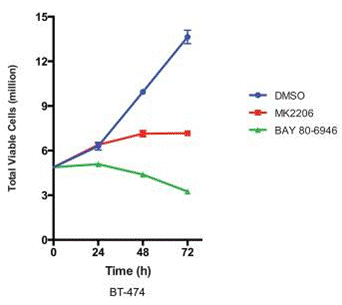
|
24436048 |
Informations sur l'essai clinique (Clinical Trial Information)
(données du https://clinicaltrials.gov, mis à jour le 2026-05-06)
| Numéro NCT | Recrutement | Conditions | Promoteur/Collaborateurs | Date de début | Phases |
|---|---|---|---|---|---|
| NCT03474744 | ACTIVE_NOT_RECRUITING | Marginal Zone Lymphoma |
Christian Buske |
2019-12-15 | PHASE2 |
| NCT03502733 | ACTIVE_NOT_RECRUITING | Lymphoma; Metastatic Malignant Solid Neoplasm; Recurrent Malignant Solid Neoplasm; Unresectable Malignant Solid Neoplasm |
National Cancer Institute (NCI) |
2018-08-14 | PHASE1 |
| NCT04939272 | ACTIVE_NOT_RECRUITING | Recurrent Mantle Cell Lymphoma; Refractory Mantle Cell Lymphoma |
City of Hope Medical Center |
2022-06-29 | PHASE1; PHASE2 |
| NCT04253262 | ACTIVE_NOT_RECRUITING | Metastatic Castration-resistant Prostate Cancer |
Brown University |
2020-04-03 | PHASE1; PHASE2 |
| NCT06218667 | WITHDRAWN | Prostate Cancer |
Memorial Sloan Kettering Cancer Center |
2024-01-11 | PHASE1; PHASE2 |
| NCT02465060 | ACTIVE_NOT_RECRUITING | Advanced Lymphoma; Advanced Malignant Solid Neoplasm; Bladder Carcinoma; Breast Carcinoma; Cervical Carcinoma; Colon Carcinoma; Colorectal Carcinoma; Endometrial Carcinoma; Esophageal Carcinoma; Exocrine Pancreas Carcinoma; Gastric Carcinoma; Glioma; Head and Neck Carcinoma; Hematopoietic and Lymphoid Cell Neoplasm; Kidney Carcinoma; Liver Carcinoma; Lung Carcinoma; Lymphoma; Malignant Uterine Corpus Neoplasm; Malignant Uterine Neoplasm; Melanoma; Multiple Myeloma; Ovarian Carcinoma; Prostate Carcinoma; Rectal Carcinoma; Recurrent Bladder Carcinoma; Recurrent Breast Carcinoma; Recurrent Cervical Carcinoma; Recurrent Colon Carcinoma; Recurrent Colorectal Carcinoma; Recurrent Esophageal Carcinoma; Recurrent Gastric Carcinoma; Recurrent Glioma; Recurrent Head and Neck Carcinoma; Recurrent Liver Carcinoma; Recurrent Lung Carcinoma; Recurrent Lymphoma; Recurrent Malignant Solid Neoplasm; Recurrent Malignant Uterine Corpus Neoplasm; Recurrent Melanoma; Recurrent Multiple Myeloma; Recurrent Ovarian Carcinoma; Recurrent Pancreatic Carcinoma; Recurrent Prostate Carcinoma; Recurrent Rectal Carcinoma; Recurrent Skin Carcinoma; Recurrent Thyroid Gland Carcinoma; Refractory Lymphoma; Refractory Malignant Solid Neoplasm; Refractory Multiple Myeloma; Skin Carcinoma; Thyroid Gland Carcinoma |
National Cancer Institute (NCI) |
2015-08-17 | PHASE2 |

Les produits sont destinés à la recherche uniquement. Ne pas utiliser chez l'homme. Nous ne vendons pas aux patients.
©Copyright 2013 Selleck Chemicals. Tous droits réservés.